Feeds:
Posts
Comments

Posts Tagged ‘dubai’

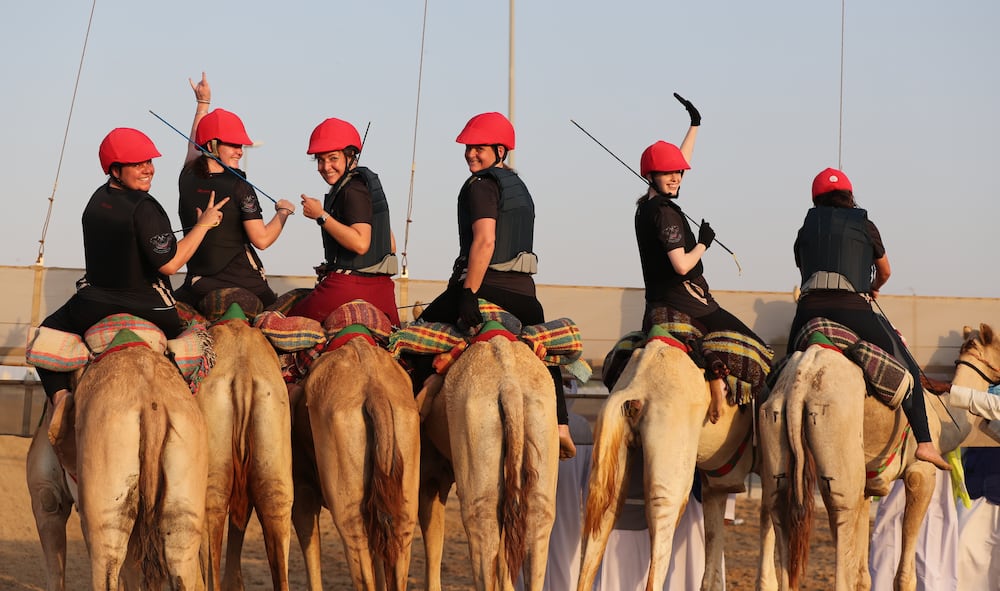
Photo: EPA/Ali Haider via the National News.
Female camel-racing event in Dubai, October 2021. Of the eight women who took part, seven were trained at the Arabian Desert Camel Riding Centre, the first in the region dedicated to teaching women to race camels.

For some reason, I’ve been hearing about camels a lot lately. Not just how long they can travel without refueling but how nutritious their milk is, how lovely their hair. Today we learn about racing camels.

Stacey Vanek Smith reports at PRI’s (Public Radio International’s)The World, “It was a scorching hot day at the Al Marmoom Camel Racing Track located just outside of Dubai in the United Arab Emirates. …

“On a typical morning, [the] arenas are packed with hundreds of enthusiastic fans placing bets on the early-morning camel races (early morning because temperatures are often in the triple digits by 10 a.m.). …

“Camel racing is an ancient sport — its roots stretch back to at least the 7th century on the Arabian Peninsula. But the races at Al Marmoom are a modernized version. Instead of riders, small robots sit atop the camels’ humps and control them with reins. The robots are controlled remotely by men who speed alongside the racetrack in cars, directing their camels. But the people gathered on this hot afternoon had come for something different but also far more traditional: The season’s first women’s race. 

“Though the crowd was undoubtedly smaller than the hundreds who regularly show up for the men’s races, the women’s team — a part of the Arabian Desert Camel Riding Center — has started to get real traction in the last few years. News outlets covered the race, and Jeep sponsored the event, along with a handful of local businesses, including Camelait, a company that sells camel milk.

” ‘It’s high in calcium,’ the emcee informed the crowd. …

“Meanwhile, the four women riders led their camels to the racetrack. One of the racers, 31-year-old Linda Krockenberger, is the reason behind the rise of women’s racing — she founded the women’s camel racing team. 

“Krockenberger came to Dubai in 2015 to work in the hospitality industry. She had raced horses back in Germany and decided to try her hand at camel riding. She was instantly hooked and was determined to learn how to race camels. The only problem was she couldn’t find anyone to train her. For years, she was told the sport was not for women. …

“But Krockenberger kept trying until she found a willing trainer, Obaid Al Falasi, a highly respected community member.  As soon as she felt comfortable with her skills, Krockenberger and Al Falasi decided to open a school. …

“Before she knew it, local and tourist women were flocking to her for lessons. Krockenberger emphasized the support she has gotten from the camel-riding community. … Still, Krockenberger added, there have been many skeptics.

“ ‘Critics sometimes say, “Oh, do we really need a German to teach us an Arabic tradition?” Of course, these comments do get to me because I don’t want to impose myself on the culture,’ she said. ‘But I try to calm these thoughts by saying, “Well if you’re such a great teacher, there’s nothing that stops you from teaching as well.” ‘

“Krockenberger’s riding school emphasizes the Bedouin camel riding tradition. The racers ride barefoot and don’t use saddles, just Bedouin blankets. 

‘Barefoot, it’s more freeing,’ racer Rawan Salah explained. ‘You feel everything. You can feel the belly of the camel. You can feel if they’re nervous. Everything.’

“ ‘The Bedouin didn’t have shoes, so we don’t have shoes,’ racer Yanna Schmiel added. …

“While the racers led their camels to the start line, a group of spectators got into their nearby cars and drove up beside the camel track where the riders mounted their camels. Spectators may watch the races from their vehicles or stand at the finish line.

“The women perched just behind the hump on their single-humped Dromedary camels, sitting on blankets. They clung to the camels with their legs, wearing riding helmets and team jerseys.

“Salah said that she feels that all-women racing is a special experience. ‘It feels empowering,’ she said.”

More at PRI’s The World, here.

Some additional fun: “Camels and Riders will be disqualified for the following reasons:

  1. “Belts used to strap rider to camel.
  2. “Electric shockers found mounted to the camel or used in whips, overusage of the whip.
  3. “External influence of camel owner on camel during race beyond vocal cheering on.
  4. “Interference with gear of competitor camels and riders
  5. “Riding gear that has not been tested and approved prior to the race.”

Read Full Post »

There’s something about elegant hotel atriums that carries one back to times gone by. Their ideal temperature must be horrendous to maintain, but they do give a traveler a feeling of being special.

Our family’s all-time favorite atrium was in a Sheraton Hotel in notably unspecial Cheektowaga, New York. The rooms gave onto a warm, landscaped pool area where ducklings and bunnies were added at Easter. Maintaining the trees so that they stayed the right size for the space was challenging, I imagine.

Anthony Paletta at Bloomberg CityLab has more about that.

“If you’re craning your neck as severely when you step inside a building as you did outside it, you might be in an atrium hotel, an intensely American structure for sleep, conferences, cocktails, and much more. These are facilities built around a massive central chamber stretching a dozen or several dozen stories into the sky; at the lobby level, you’ll find bars, restaurants, gardens, live birds, and maybe even a boat or two.

“We don’t build them much anymore, but Americans invented, perfected and exported this unique building style to the world (where it continues to prosper). Birthed in brash excess, atrium hotels were first seen as too gaudy by the modernist architectural establishment and as too profligate by penny-pinching chain hoteliers. To varying observers, they suggest everything from Disney to dystopia. But in their heyday, these buildings promised — and delivered — a spectacle like no other. 

“Real estate developer Trammell Crow, the man with the most Dallas-sounding name you’ve ever heard, provided early inspiration for the form with his Dallas Trade Mart atrium, built in 1958. But it was Atlanta architect-developer John Portman, his occasional partner, who adapted and built the form into a colossus. Portman’s Hyatt Recency Atlanta opened in 1967, and was an immediate sensation. Atriums became a signature of the Hyatt Regency brand, and Portman went on to work for a variety of other chains, including Marriott and Westin.

“Portman wasn’t taking half measures with his hotels. Consider their majestic heights: his first, the Hyatt Regency Atlanta: 22 stories; Marriott Marquis in New York City: 37 stories; Marriott Marquis Atlanta: 50 stories. Only Dubai’s Burj Al Arab, which opened in 1999, eventually topped Portman’s tallest atrium.  …

“The atrium is an ancient architectural feature. It’s fairly rare in skyscrapers, however, as it inevitably involves a waste of leasable space. There are a few direct hospitality antecedents: The Brown Palace Hotel in Denver, built in 1892, boasts a seven-story atrium topped with stained glass, and the West Baden Springs Hotel in French Lick, Indiana, which opened in 1902, features a 200-foot diameter atrium.

“Portman’s first atrium wasn’t in a hotel at all, but in the now-demolished Antoine Graves public housing tower in Atlanta, built in 1965. The idea was simple, says Mickey Steinberg, a structural engineer on many of Portman’s early projects. The architect was just trying to provide some sociable space and ventilation to tenants. (The building was not air conditioned.)

‘If I had a hole down the center of the building,’ Steinberg recalls Portman saying, ‘people could come out and talk to each other and I might be able to get some air through the building.’

“That notion recurred to Portman two years later for the Hyatt Regency. ‘It wasn’t any grand philosophy about a style of architecture,’ Steinberg says. ‘He was designing for people to want to be there.’

“He was also designing for people who might not have wanted to be in Atlanta, whose central business district was in decline. Steinberg recalled Portman’s intention: ‘I’m going to create a space for them to want to be in, because downtown Atlanta doesn’t have it anymore.’ …

“The atrium concept didn’t initially enthrall the moneymen, Steinberg says. …

“[But] a then-unknown savior turned up in the form of Don Pritzker, whose nascent Hyatt chain then had only three locations. That bet paid off once the Hyatt Regency Atlanta opened: Visits to the hotel in the first four months of operation exceeded their expectation of the first five years. Guests lined up just to go up and down in the glass elevators. …

“Sheer space was a vast lure, opening up the typical dark double-loaded urban hotel corridor, Steinberg says. ‘It was different than having a little bitty lobby where you enter and then you take an elevator to where you’re shelved.’ …

“As new construction, you are now likelier to see atrium hotels in the Middle East or Asia. Still, the company that pioneered the form remains enthusiastic about its virtues. ‘This concept changed the idea of what a hotel experience could be by converting lobbies from transactional spaces that guests passed through on their way to check in or check out,’ Sarah Klymson, vice-president of product and brand development at Hyatt, wrote in a statement. ‘The architectural form of atrium hotels acts as a stage that can evolve.’ “

More at CityLab, here.

Read Full Post »

Vote

I went to vote before work. I’d heard on the radio it would be a low turnout because it was a primary and on a Thursday, which is unusual. But one hotly contested election brought out the troops.

As I left the polls, I was thinking how some folks complain their vote won’t matter or nothing will change. But I think voting is important even if it isn’t perfect.

At this very moment, people around the world are literally dying for the right to vote. And if they do get the franchise, they line up for hours time and time again even if they know it’s not perfect — too many candidates, fraud attempts, threats of violence, the wrong person winning.

A few years ago I was reading stats about Dubai, just a list of facts like population, natural resources, weather, religion. I came to the column “franchise,” and it said “none.”

None? I never really thought about it although I knew the country was a monarchy.

Franchise: none. Wow.

Read Full Post »