Feeds:
Posts
Comments

Posts Tagged ‘Easter Island’

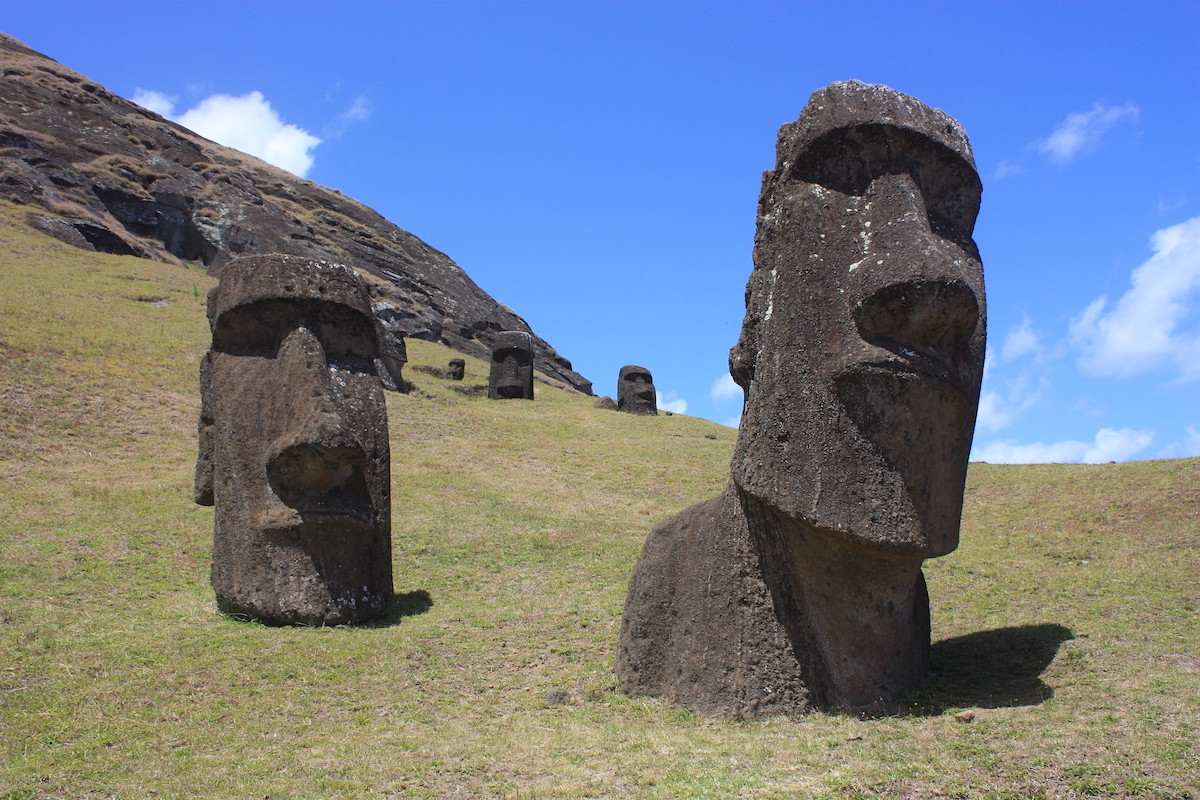
Photo: Arian Zwegers/Flickr.
The monumental statues of Easter Island. 

Imagine all the work that has gone into figuring out how dead civilizations died! Even now it often feels like guesswork. But I like how new research provides new details on how people lived.

Consider this report at YaleEnvironment360.

“A new study casts doubt on the narrative often told about Easter Island, of an ancient society that plundered its forests to the point of collapse. Researchers have found fresh evidence for another [story] that the islanders learned to live within the bounds set by nature.

“When Europeans first arrived to the remote South Pacific island in 1722, they found hundreds of massive statues, evidence of considerable manpower, but only around 3,000 people, too few to easily explain the monuments. Historians inferred that the Polynesians who settled Easter Island must have seen their population grow to a large and unsustainable level, at which point they destroyed their forests, exhausted their soils, and hunted seabirds to oblivion before seeing their own numbers collapse.

“But in recent years a competing narrative has taken hold. It posits that the population never exploded, but that instead a small number of people learned to sustain themselves on the arid and relatively barren island. Researchers found evidence for this view in the remains of ‘rock gardens,’ where islanders grew sweet potatoes, their staple crop.

“To protect crops from sea winds and supply minerals to the soil, islanders grew potatoes among densely packed rocks. It has been difficult to determine, however, how much of the island was composed of rock gardens, which would indicate how many people farming sustained. Prior research found that rock gardens potentially covered more than 12 percent of Easter Island, which, scientists estimate, could have supported as many as 25,000 people.

“For the new study, researchers aimed to improve on previous inventories of rock gardens by studying gardens on the ground and then training artificial intelligence to identify them in satellite imagery. To better distinguish between rock gardens and rocky outcroppings, they also gathered satellite data on the levels of moisture and nitrogen in the soil, markers of cultivation.

“With this additional data, researchers determined that rock gardens covered less that 0.5 percent of the island. Accounting for other potential sources of food, such as fish, bananas, taro, and sugar cane, they estimated that Easter Island would have supported around 3,000 people, the number first recorded by Europeans. The findings were published in Science Advances.

“ ‘The population could never have been as big as some of the previous estimates,’ said lead author Dylan Davis, a postdoctoral researcher at Columbia University. ‘The lesson is the opposite of the collapse theory. People were able to be very resilient in the face of limited resources by modifying the environment in a way that helped.’

“History will show that the islanders did ultimately face collapse, but after Europeans arrived.” Europeans, alas, brought disease and slavery. No wonder the population died out!

More at YaleEnvironment360, here.

Read Full Post »

Photo: Alamy
Binghamton University researchers have found that Easter Island’s moai statues were built close to sources of fresh water. A new study adds weight to the idea that communities competed through monument building, not violence.

There’s always something new that research can reveal, even in parts of the world that seem to have been endlessly studied.

Consider this report on the Easter Island statues by Nicola Davis at the Guardian. “The huge stone figures of Easter Island have beguiled explorers, researchers and the wider world for centuries, but now experts say they have cracked one of the biggest mysteries: why the statues are where they are.

“Researchers say they have analysed the locations of the megalithic platforms, or ahu, on which many of the statues known as moai sit, as well as scrutinising sites of the island’s resources, and have discovered the structures are typically found close to sources of fresh water. …

“ ‘What is important about it is that it demonstrates the statue locations themselves are not a weird ritual place – [the ahu and moai] represent ritual in a sense of there is symbolic meaning to them, but they are integrated into the lives of the community,’ said Prof Carl Lipo from Binghamton University in New York, who was co-author of the research. …

“It is thought the monuments represent ancestors and were linked to ritual activity, forming a focal point for communities, but the reason for their locations was previously a mystery. … The team focused on the east of the island, where various resources have been well mapped …

“After finding no link to the proximity of rock used for tools or for the monuments, they looked at whether the ahu were found near other important resources: gardens spread with stones in which crops like sweet potatoes were grown, sites linked to fishing, and sources of fresh water. The island has no permanent streams, and there is little evidence that residents relied on the island’s lakes.

“However, fresh water passes through the ground into aquifers, seeping into caves as well as emerging around the coast. … The results of the new research, published in the journal Plos One, reveal proximity to freshwater sites is the best explanation for the ahu locations – and explains why they crop up inland as well as on the coast.

“ ‘The exceptions to the rule about being at the coast where water comes out actually are met by the fact there is also water there – it is found through cave locations,’ said Lipo, adding historic wells were found to explain some ahu locations apparently without fresh water. …

“He says the study also adds weight to the idea that communities competed and interacted through monument building, in contrast to the idea that islanders engaged in lethal violence over scarce natural resources – something Lipo says there is little evidence for. …

“And community and cooperation, stresses Lipo, were crucial in construction of the monuments. ‘Anything that brings you together is going to make you stronger and allow you to survive,’ he said. ‘I think that is the secret to Easter Island.’ ”

More at the Guardian, here.

Photo: Joe Carter/British Ministry of Defence
A moai stone statue at the Hanga Roa quarry, Easter Island.

Read Full Post »