Feeds:
Posts
Comments

Posts Tagged ‘Eastern Europe’

Photo: Mindaugas Kulbis/AP.
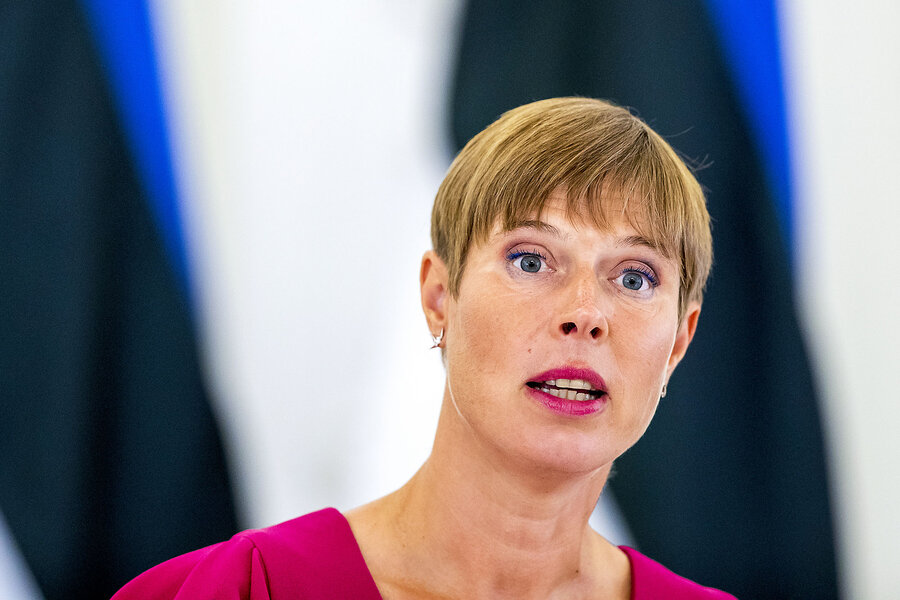
Estonian President Kersti Kaljulaid speaks during a news conference in Lithuania, Aug. 14, 2020.

Americans these days do not have much trust in government. It’s unfortunate because government does many good things. But a suspicious attitude has gained hold over the American mindset in the last few years. That’s why I look with envy at an Eastern European country that’s working really well because of a high level of trust — plus the efficient use of technology.

Lenora Chu explains at the Christian Science Monitor.

“Getting married is now one appointment easier in Estonia. The world’s most digitally integrated country launched the sacred union into the e-governance stratosphere last year – where it joined nearly every other government service you can imagine.

“Estonian citizens were already able to file taxes online, vote online, and access digital prescriptions. All of this digital activity hinges upon the Estonian smart identification system – which allows for state-recognized digital signatures – and a public trust in digital governance that’s been hard to replicate in other countries.

“ ‘I actually own my data – I can always track when someone looks at my data,’ says Kristiina Veerde-Toompalu. ‘I trust [my government].’ …

“Ms. Veerde-Toompalu got married in July, and applying online for the certificate saved her and her fiancé a special trip to her hometown’s city registrar. ‘We don’t have to go somewhere and announce our intention to get married,’ she says. …

“To deploy digital services successfully requires Estonians to trust the act of offering up to the cloud everything from birthdate and birthplace to tax information, salary, and medical diagnoses. That public trust took decades to cultivate, and ultimately relies on Estonia’s tight and transparent system of regulation.

“ ‘Paper files are not safer, because you cannot tell who looked at an analog file,’ says Kersti Kaljulaid, who served as president of Estonia from 2016 to 2021. ‘Estonian e-governance is a tightly regulated environment. … The data belongs to citizens, and you have control over who looks at your data, and you can ask them why they did. This is a luxury compared to an analog world, and I believe this is why we have this in-built trust.’

“It takes decades to build up the kind of comfort Estonia has with digitization, says Linnar Viik, a leading Estonian information technology scientist and government adviser since 1995.

‘Trust in digital channels didn’t happen overnight. It was kind of word of mouth and private and personal experience.’ …

“Trust also had to flow from leadership to the tech industry, and it did. ‘That is another layer of trust, whether you as a leader trust the experts on something you don’t understand. The politicians started to listen to the technology people and gave them space,’ says Mr. Viik.

“One such example: In 2000, Mr. Viik was allowed to convert Cabinet meetings from paper-based – at the time, they required knee-high stacks of printouts – to completely digital after one conversation with the prime minister.

“ ‘He asked, “Do we have any other examples around the world of paperless government?” ‘ recounts Mr. Viik. ‘I said, “No.” He said, “Cool, OK, do we have money for that?” ‘

“The Cabinet budget had $85,000 left for printing in that fiscal year, and Mr. Viik spent it on hardware, software, and training for Cabinet ministers and staff. What resulted was the paperless e-Cabinet: a fully wired room that drew global media attention. …

“Now Estonians not only vote and pay taxes online, but also buy property, register cars, sign job and rental contracts, and apply for unemployment benefits digitally. Nearly every service linked with a government office can be done digitally. And for many services,  citizens need not even apply, as certain entitlements are automated. That includes parental allowances and child support. Digitization also extends to health care, with every provider required to submit patient information to a centralized digital health authority. …

“ ‘The connotations [around trust] are different in different countries,’ says Mr. Viik. … ‘Other European Union governments – particularly Germany, which has a long history with government surveillance – want to mitigate all risk before digitizing. In Estonia, we would rather say, “Let’s start doing things,” and only then we can find out what are the problems we need to mitigate,’ he says.

“The paradox is that people already offer up enormous amounts of personal data to Google, Facebook, and other companies that are not only foreign but also governed independently, Mr. Viik says. ‘The institution you can control and govern is your own government – but you don’t trust? Why you don’t trust your government who is under your control?’ “

More at the Monitor, here. No firewall.
Read Full Post »

Photo: George Chernilevsky
A basket of wild mushrooms in Ukraine. Hunting mushrooms is a popular activity in Eastern Europe. And it’s good for the environment.

Danger, wild mushrooms! That’s what I was taught and that’s what I taught my kids and grandkids. But it’s only because the only way I know if mushrooms are edible is if they are in a supermarket bin. In places like Eastern Europe, however, identification skills are learned young.

A story from UN Environment explains why using forest products like mushrooms is important both for subsistence living and environmentally sound forest management. (Boy, how I wish I’d known all this about Bulgaria when I was in sixth grade and had to write a fancy report: there was no information anywhere.)

“Wild mushroom picking in Eastern Europe is more than a tradition. It is a social event. Every year, in late summer and early fall, thousands of people roam the woods for the biggest, most perfect specimens. They take their children along to teach them which mushrooms are edible and which are poisonous, which are ripe and which should be left for another week or so, passing on generations-old teachings and care for the woods. In the evenings, families share their harvest around a plateful of tasty, butter-fried delicacies. Together, they celebrate their love for the forests, sharing the best spots they found and recalling the animals or birds they sighted along the way.

“Forests are among the most valuable treasures on earth: they supply energy from timber, help with water regulation, soil protection and biodiversity conservation. Yet in traditional forest management, trees are still primarily viewed as a source of wood. All other products derived from wooded lands — such as honey, mushrooms, lichens, berries, medicinal and aromatic plants, as well as any other products extracted from forests for human use — are considered of secondary importance.

“Non-timber forest resources, however, have far-reaching benefits for millions of households, both in terms of subsistence and income. These by-products go into food and everyday items like cosmetics or medicines. The protection of their environment is therefore a vital need.

“Bulgaria, whose forests cover more than a third of its land area, is one of Europe’s richest biodiversity hotspots. Brown bears, lynxes and wolves can be found in its woods, which also harbour hundreds of bird species as well as a great variety of tree types, including beeches, firs, spruces and oaks.

“The country has a long tradition of forest management practices. Large-scale monitoring programmes are in place, and local communities are known to keep a close eye on the natural environment. Together, these factors have allowed national authorities to make the most of their biodiversity.

“Over 90 per cent of the annual yields of wild and cultivated herbs are sold as raw material to Germany, Italy, France and the United States, making Bulgaria one of the world’s leading suppliers in this sector. By gaining expertise in the protection and sustainable use of non-wood forest products, they have become a model for other Balkan countries. …

“Around 80 per cent of the developing world’s population use these products for health and nutritional needs, notes Anela Stavrevska-Panajotova, Project Coordinator at the Connecting Natural Values and People Foundation. The practices and skills learned from Bulgarian experts are crucial to work on identifying non-wood forest products and pilot testing in [places that have not protected their resources].

“Educating local office managers and the business sector on the sustainable use of forest resources is a cost-effective solution to address climate change. Sustainable resource use helps to improve the state of forests and habitats and, by extension, ensure economic and food security for local communities.

“In addition, forests act as carbon sinks and can remove pollutants from the atmosphere, making them a highly versatile tool to fight air pollution and mitigate climate change. Every year, they absorb one third of the carbon dioxide released from burning fossil fuels worldwide.” More here.

By the way, an amazing book about subsistence living, Ramp Hollow, permanently changed everything I thought I knew about history. Recommended.

Read Full Post »

Some years before Suzanne launched Luna & Stella, her brother started his own entrepreneurial business, Optics for Hire. John’s work has entailed regular trips to Ukraine and Belarus to meet with optical engineers.

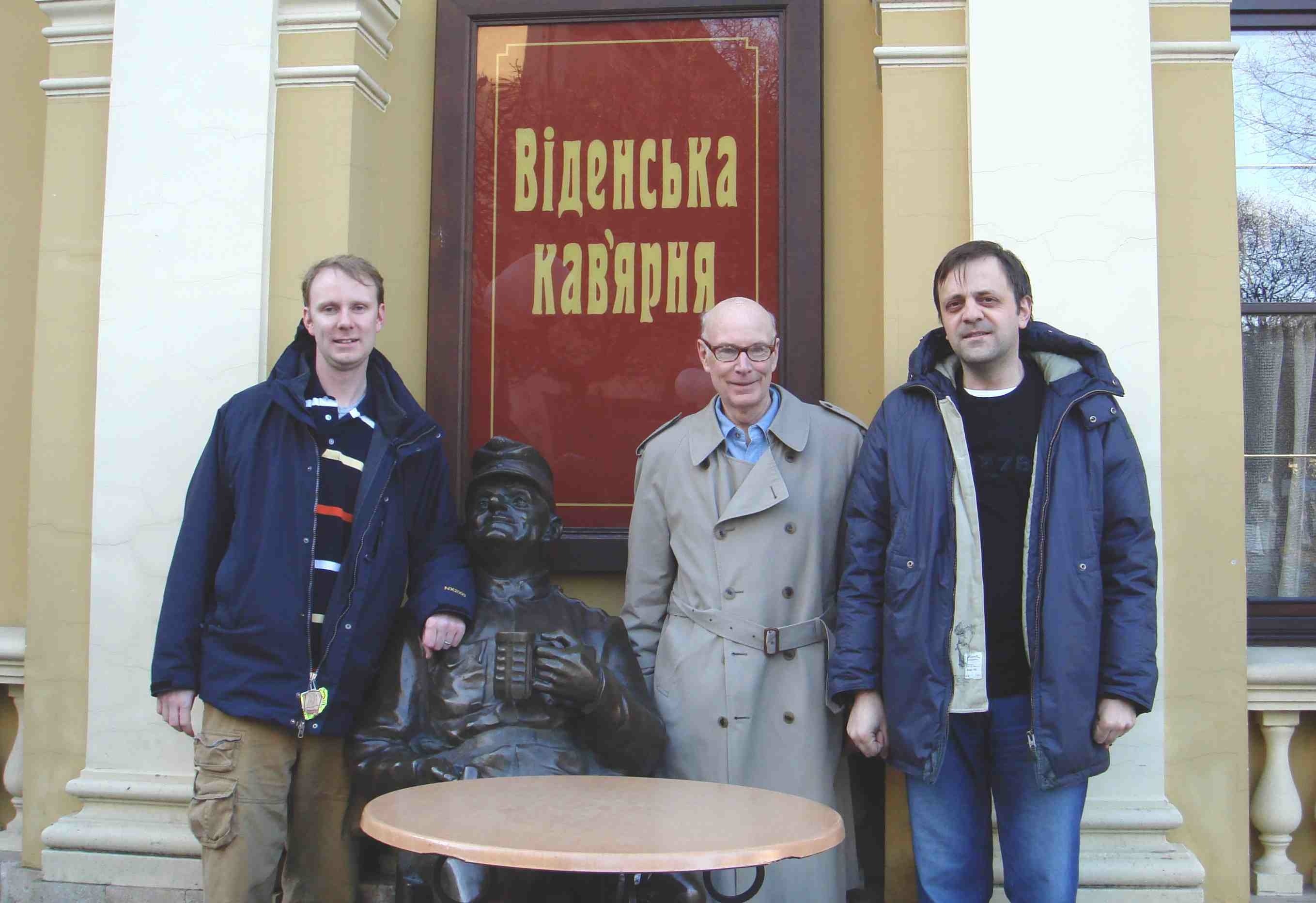
In 2008, his dad decided to join him on a trip to Lviv, Ukraine (called Lvov when it was part of Poland). Here they are.

John is on the left, then the Good Soldier Švejk (Schweick), then my husband, then a Ukrainian engineer.

Do you know the Good Soldier Švejk? He is a character in a Czech antiwar novel written after WW I. The book reemerged as the thing to read around the time of the Vietnam War. The Wikipedia write-up says in part:

“It explores both the pointlessness and futility of conflict in general and of military discipline, specifically Austrian military discipline, in particular. Many of its characters, especially the Czechs, are participating in a conflict they do not understand on behalf of a country to which they have no loyalty.

“The character of Josef Švejk is a development of this theme. Through possibly feigned idiocy or incompetence he repeatedly manages to frustrate military authority and expose its stupidity in a form of passive resistance: the reader is left unclear, however, as to whether Švejk is genuinely incompetent, or acting quite deliberately with dumb insolence.”

I was delighted to see that Švejk is still appreciated in Lviv.

Meanwhile, whenever John goes to Lviv, I always ask him to hunt down the lost masterpiece of the Jewish writer Bruno Schulz, best known for The Street of Crocodiles. He is said to have given his greatest work to a Catholic friend for safekeeping just before being shot in the street by a Nazi officer. I have read a good bit about him, including the biography Regions of the Great Heresy, and I am really worried about the missing work, The Messiah. He was an amazing writer.

 This write-up on the Internet generally coincides with what I have read about Bruno Schulz, except for the emphasis on his Polishness. Nations fight over his legacy because that part of the world has shifted so often. Israel also thinks he is theirs and about 15 years ago undercover agents upset Ukraine mightily by absconding with a mural Schulz had painted and taking it to a museum in Israel. The web write-up also mentions the great Israeli writer David Grossman’s novel about Schulz,  See Under: LOVE, a difficult read.

Read Full Post »