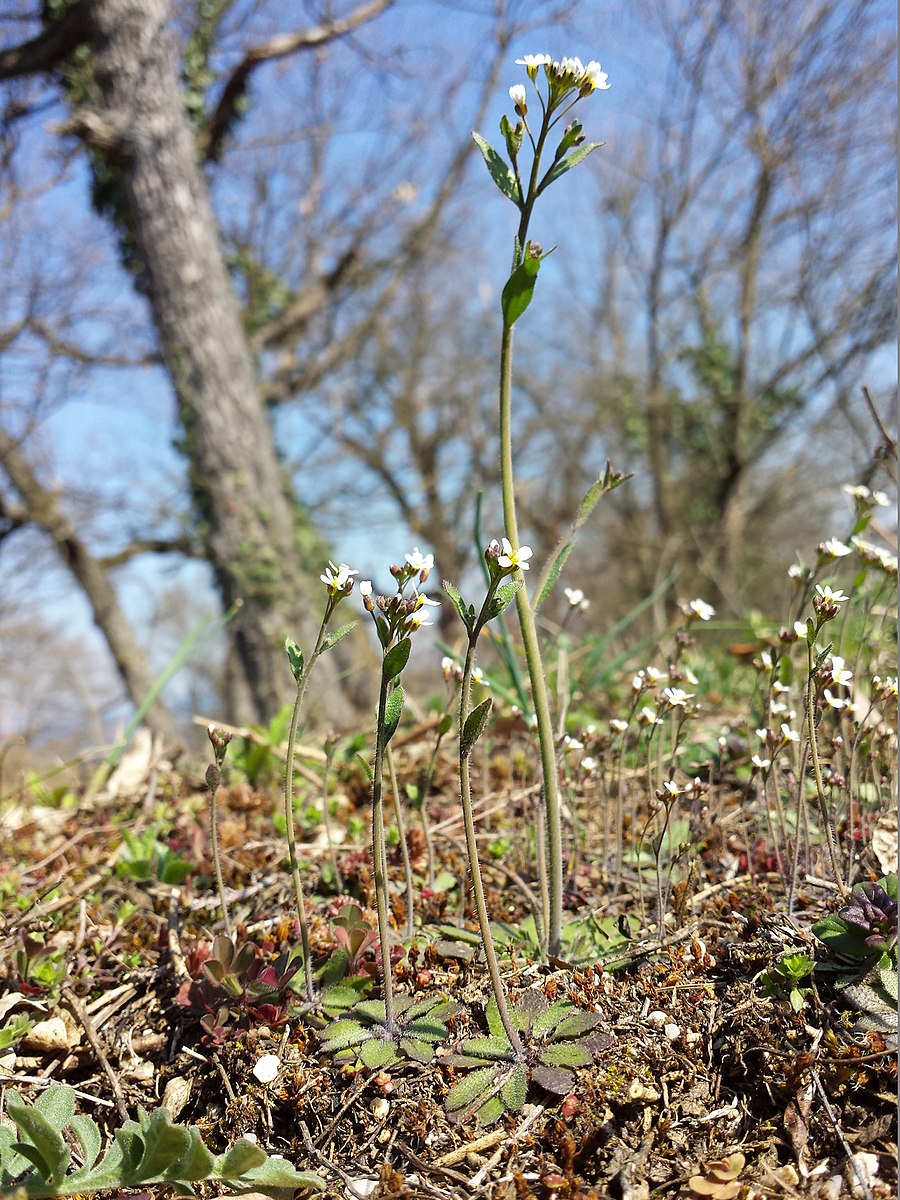
Photo: Stefan Lefnaer via Wikimedia.
In the video below, an Arabidopsis plant warns of danger from a hungry caterpillar.
I think we are lucky to be learning so much about the natural world these days. I didn’t study much science in school, but who wouldn’t love scientific research that reveals such wonders as plants’ communications systems.
Kasha Patel at the Washington Post writes that some plants actually warn their brethren when it’s necessary to increase defenses.
“Trees on our Earth can communicate and warn each other of danger,” she says, “and a new study explains how.
“Injured plants emit certain chemical compounds, which can infiltrate a healthy plant’s inner tissues and activate defenses from within its cells, the new research found. …
“For the first time, researchers have been able to ‘visualize plant-to-plant communication,’ said Masatsugu Toyota, senior author of the study, which was [published] in Nature Communications. ‘We can probably hijack this system to inform the entire plant to activate different stress responses against a future threat or environmental threats, such as drought.’
“The idea of ‘talking’ trees started to take root in the 1980s. Two ecologists placed hundreds of caterpillars and webworms on the branches of willow and alder trees to observe how the trees would respond. They found the attacked trees began producing chemicals that made their leaves unappetizing and indigestible to deter insects. …
The scientists discovered healthy trees of the same species, located 30 or 40 meters away and with no root connections to the damaged trees, also put up the same chemical defenses to prepare against an insect invasion.
“Another pair of scientists around that time found similar results when studying damaged sugar maple and poplar trees. …The trees sent chemical signals to one another through the air, known today as plant eavesdropping. Over the past four decades, scientists have observed this cell-to-cell communication in more than 30 plant species, including lima bean, tobacco, tomato, sage brush and flowering plants in the mustard family.
“But no one knew which compounds were important and how they were being sensed — until now. …
“Plants obviously don’t have ears and eyes, but past research shows they communicate with their surroundings by emitting chemicals known as volatile organic compounds, which we can smell. … Plants can produce an array of these compounds for different purposes. Some are used to attract pollinators or as defense against predators.
“However, one class of these compounds are emitted when a plant is injured: green leafy volatiles. These are emitted by, as the name suggests, pretty much every green plant with leaves, and are produced when a plant experiences physical damage. An example of this compound is the smell released from fresh-cut grass.
“In the new study, Toyota and his colleagues manually crushed leaves and placed caterpillars on Arabidopsis mustard or tomato plants to trigger the emission of various green leafy volatiles. Then, they spread individual fumes to healthy plants to see if the plants would react.
“To track the healthy plants’ responses, the team genetically modified the plants so calcium ions would fluoresce when activated inside individual cells. Calcium signaling is important for cellular functions in most living organisms on Earth, including humans. … Depending on the plant, it can trigger messages to close its leaves or digest an insect.
“After testing many green leafy volatiles, the team found only two seemed to increase calcium ions inside cells. Additionally, they found calcium signaling first increased in guard cells forming the plant’s leaf pores, or stomata — an important finding, because it shows the compounds are absorbed into the plant’s inner tissues. …
“The calcium signaling, Toyota said, is like a switch to turn on the defense responses from the plant. … For example, Toyota said the plant may start producing certain proteins to inhibit insects from munching on them, giving the insects diarrhea. …
“With this new understanding, researchers say plants could be immunized against threats and stressors before they even happen — the equivalent of giving a plant a vaccine. For instance, exposing healthy plants to insect-ridden plants or the associated green leafy volatiles could boost their genetic defenses, so farmers use less pesticides, Kessler said. The revelation could also help make plants more resilient during a drought, signaling the plants to retain more water.”
More at the Post, here.

 Suzanne's Mom's Blog