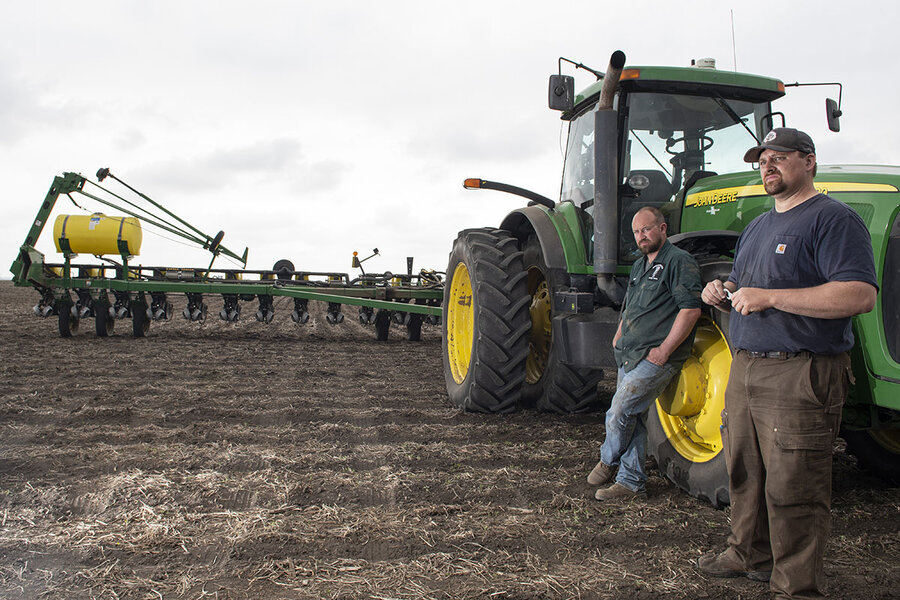
Farmers who aren’t climate-action types may nevertheless be proponents of profitable wind energy. In Knox County, Illinois, the farmers above were glad to get a contract with Orion Energy for a 300-megawatt wind farm that is bringing in extra money for them and tax revenues for the county
One precept that my reading of fiction keeps hammering home to me is that people are complicated. A character doesn’t have to be one of the good guys to do something good or one of the bad guys to do something bad. Similarly, in real life, you don’t have to be on one side of a political divide to find value in something the opposing side values.
This article from the Christian Science Monitor provides an example.
Stephanie Hanes writes at the Christian Science Monitor, “For five generations, Andrew Bowman’s family has worked the land in Oneida, population 700-ish – a flat and fertile swath of Illinois his father always said was good for growing crops and kids. Today, he farms soybeans and corn, as well as specialty popcorn, which he sells under the label Pilot Knob Comforts. Mr. Bowman hopes to have a new resource to harvest soon, as well: wind.
“This past year, Mr. Bowman took a lead representing local landowners in negotiating with Orion Renewable Energy Group, one of the many companies installing wind farms across Illinois, to build a new 100-turbine project in his part of Knox County. Clean energy would not only help keep the local school open and support the fire department and library, he says, but would also offer a new income stream to farmers who agree to lease some of their land for the project – some $30 million over 25 years, according to the proposal. …
“For Mr. Bowman, embracing wind power is part of stewarding the land for the next generation – and one of many steps he and his brother-in-law, Matt Hulsizer, have taken to ensure resiliency on their 1,800 acres. They are acutely focused on soil health, low tillage, and reducing fuel consumption; they have tried organic practices and are investigating cover crops to retain nutrients and prevent erosion.
“But none of this is because they are trying to fight climate change.
“They care deeply about the environment, they say; after all, they live and work in it. But they cringe at the cries for climate action, and they bristle when city people suggest their outdoor, low-consumption life is problematic. … If human-made climate change is happening, they say – something they find dubious – they doubt there’s much anyone can do to stop it.
“For them, tending soil and harvesting wind for clean energy – two initiatives climate scholars say are crucial for reducing carbon emissions – is simply about taking the best steps economically
“And that, scholars point out, is a tremendous shift.
“For years, the dominant narrative of climate action was one of trade-offs and costs – that saving the world as we know it meant taking hard steps to reduce carbon emissions, and likely sacrificing jobs and lifestyle in the process. …
“[But] economic shifts, whether around clean energy or electric vehicles, regenerative agriculture or green construction, may be starting to defuse much of the debate over climate change.
“Instead, climate action has merged with economic progress – particularly when it comes to clean energy. And although climate activists say this awakening won’t by itself put the nation on track to meet the Paris Agreement goal of net-zero carbon emissions by 2050, some suggest it is making that path less arduous, while creating new opportunities and connections for those across the ideological spectrum.
“ ‘There’s an argument that’s been around for a long time, that somehow the economy and the environment are at odds and we can’t do two things at once,’ says Bob Keefe, executive director of E2, an organization of business groups focused on environmental action.
‘What we’re seeing today is that there’s never been more clarity about the economic costs of climate change, or the economic potential of climate action.’
“The narrative of “climate versus jobs,” though, is an enduring one. For decades, environmental protection has been presented in terms of extra costs such as regulations on businesses, requirements for companies, and restrictions on activities. While this wasn’t always divisive – the Clean Air Act of 1970 and the establishment of the Environmental Protection Agency were both highly bipartisan measures, for instance – it has increasingly become a dividing line. …
“Where the left has seen necessary checks on industry for the preservation of the natural world, and the potential for a clean environment to lead to new economic prosperity, the right has seen challenges to businesses, job losses, and economic hardship. Both sides have studies that support their views. Climate action has followed a similar pattern. …
“ ‘We’ve seen that constant conversation about jobs versus climate action,’ says Catrina Rorke, vice president of policy for the Climate Leadership Council, a centrist bipartisan group that promotes policies to price carbon. ‘We think it’s woefully incorrect. We think aggressive climate action can actually unlock a lot of economic activity.’
“In large part, says Stephen Cohen, former director of Columbia University’s Earth Institute, this is because a climate action economy is simply a modern economy – one that is moving away from a stagnating World War II-era industrial approach and into a newly automated, technologically innovative, and cleaner system. …
“ ‘It’s 100 years later and it’s time to modernize,’ he says. … ‘Most of the farsighted businesspeople – they know all of this. It’s how they think about the world.’
“This isn’t just about fossil fuels versus clean energy, he and others say. From the auto industry’s shift to electric vehicles, with all of the connected grid and battery production, to the construction industry’s work retrofitting old buildings, to wind and solar energy jobs, the impact of climate-connected development is broad. It is also spurring a new wave of innovation and entrepreneurship, scholars say.
“None of this means the end to the underlying political tension surrounding climate action. … Nor does this new economy benefit everyone. In any industrial shift, Dr. Cohen points out, some skills and jobs become obsolete. And when it comes to a climate-connected economy, those hardships are concentrated in particular communities, such as in West Virginia and Wyoming, that were built around fossil fuel extraction. In other words, it’s easy to focus on the story of a coal town dying because of a shift in the energy sector. The hardship is concentrated. It’s harder to tell a story when the benefits are diffuse, and everywhere.
“ ‘The losers are more specific and more easily identified – the winners might not exist yet,’ says Wolfram Schlenker, a professor at Columbia University’s School of International and Public Affairs and the Earth Institute.
“Still, Americans increasingly see a price to pay if rising temperatures go unchecked. The number of Americans who believe global warming will harm people in the United States a great or moderate amount grew from 51% in 2014 to 61% last year, according to polling by the Yale Program on Climate Change Communication.
“Here in Illinois and elsewhere, most workers have jobs that aren’t directly focused on climate change. But ‘green’ growth, from the booming renewables market to energy-efficient construction projects, is everywhere. As a trip across the state shows, the positive economic story of industry that could be categorized as climate-related – even if those involved wouldn’t categorize it as such – is getting easier to observe.”
More at the Monitor, here, where among other topics you can learn about the battle between a fungi protein and chicken nuggets.

 Suzanne's Mom's Blog