
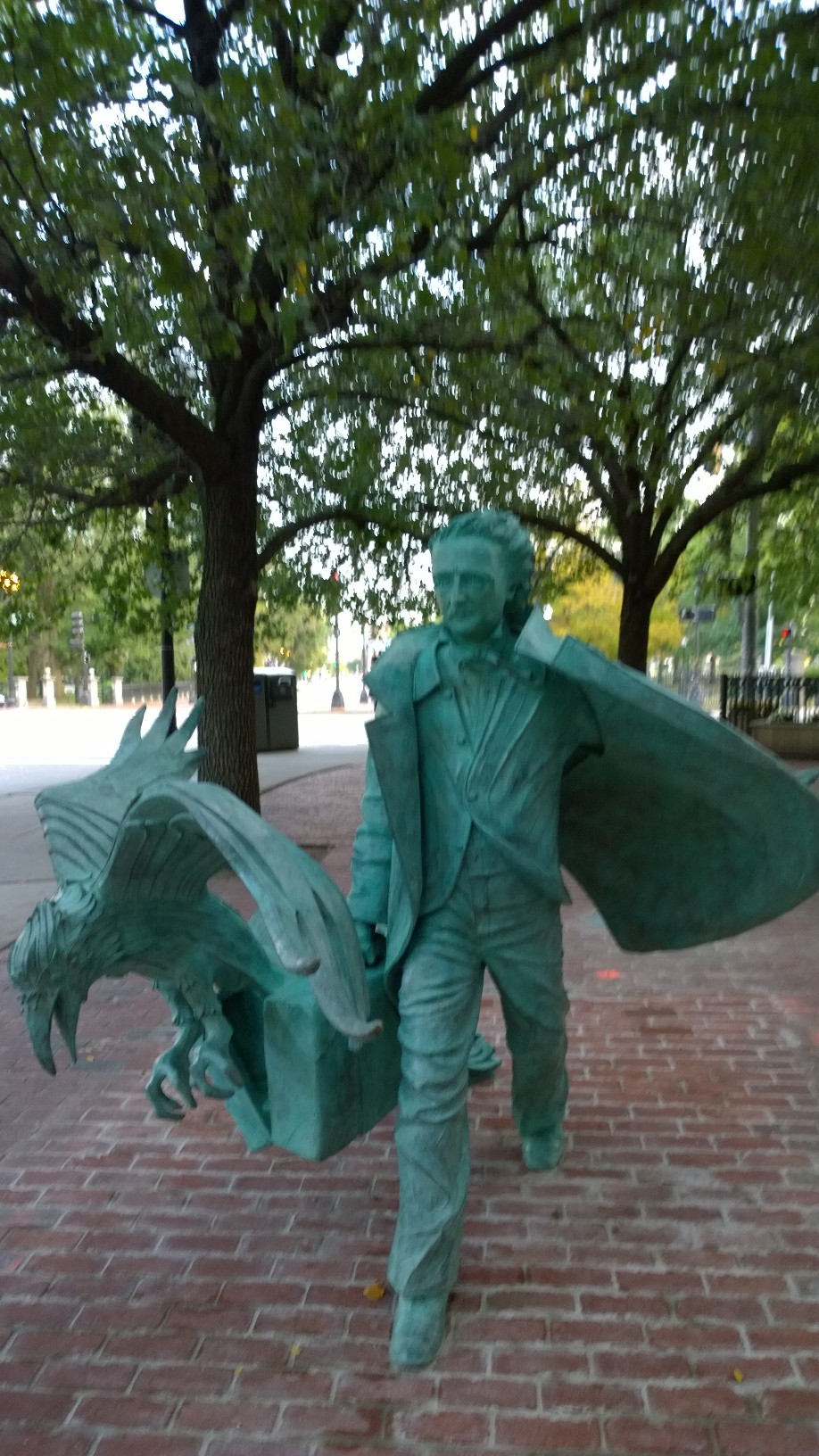
Photo: Steve Annear.
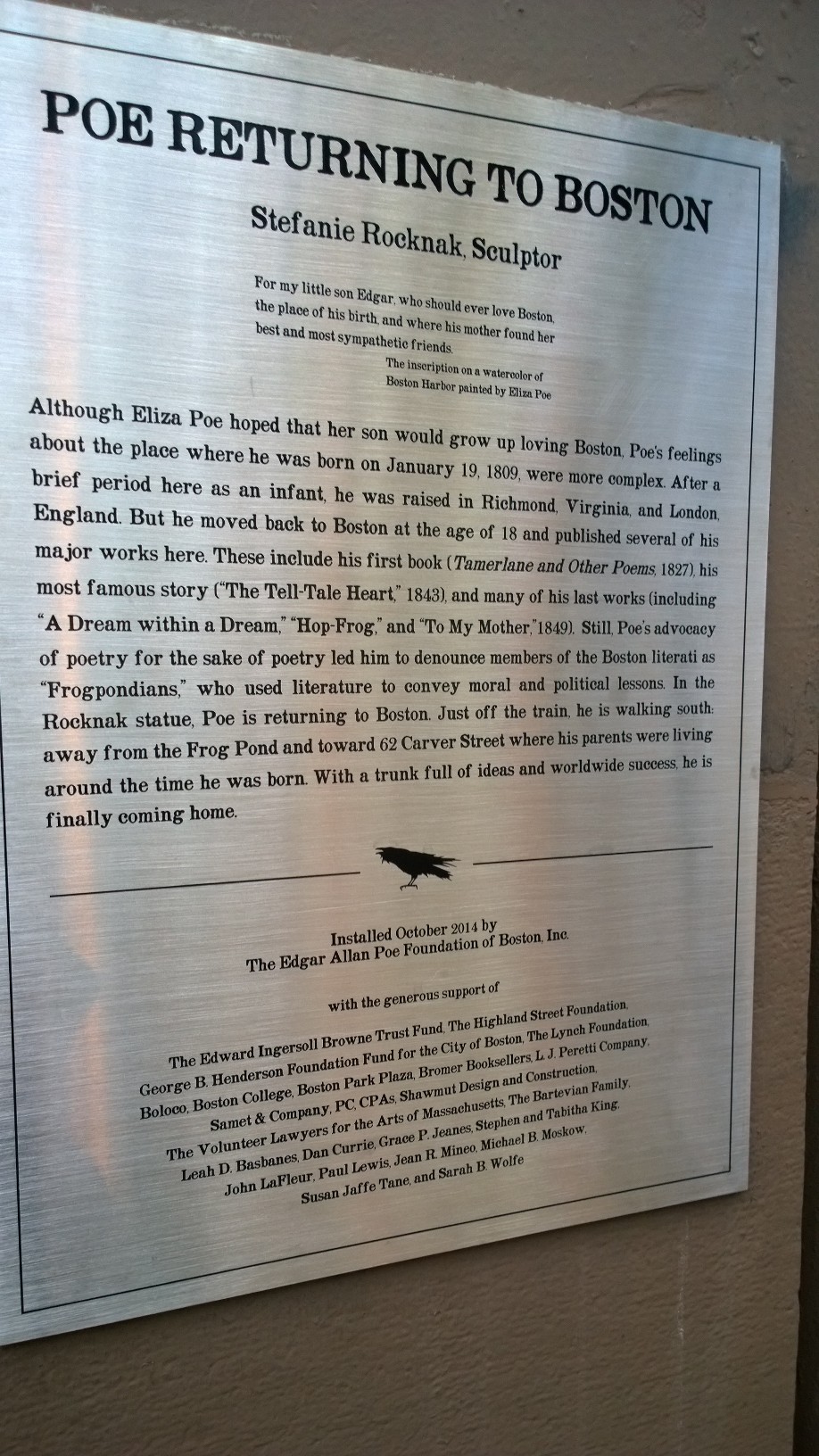
In October 2014, the Edgar Allan Poe Foundation of Boston officially unveiled the long-awaited statue of a literary phenomenon known for his dark personality and craft. Note the raven.
Why do generations of fiction readers love the creepy stories of Edgar Allan Poe? I for one, was so infatuated with “The Cask of Amontillado” as a teen that I wrote a theatrical adaptation and talked my high school into letting me cast a couple students to perform it for Halloween.
It was not a success. One of the actors couldn’t remember lines and spent most of the show hiding under a chair.
But we probably didn’t kill anyone’s love for Poe.
Recently at the Washington Post, Louis Bayard reviewed a new Richard Kopley biography of the horror-genre master. He compares the lack of control Poe seemed to have over his daily life with the utter mastery of the craft he essentially defined.
He writes in part, “A long and not always edifying tale of success and setback, temperance and bacchanals, playing out across the Atlantic seaboard and end-stopped by a death no less tragic for being in the cards. It’s exhausting stuff, and the only reason to strap ourselves in once more is the chance to see a genius being born.
“A good thing it happened, too, because if anybody desperately needed to be a genius, it was Poe. Born to indigent actors and orphaned at 2 years old, he was brought into the home of John Allan, a proud Richmond merchant. From the start, Poe’s foster father called the arrangement ‘an experiment,’ which meant that young Edgar was never formally adopted and lived in plain view of Allan’s disapproval. By the time Poe had withdrawn from the University of Virginia and been court-martialed out of West Point, the experiment was over.
“Lacking any other option, he embarked on the then-novel career path of becoming a working writer. …
“To the first editor who would listen to him, Poe declared: ‘I am young — not yet twenty — am a poet — if deep worship of all beauty can make me one — and wish to be so in the more common meaning of the word. I would give the world to embody one half the ideas afloat in my imagination.’ Journal by journal, he managed to carve out a fugitive living as poet, critic and short-story writer. Along the way, he found the family he’d been looking for: a doting aunt and a young cousin, Virginia, whom, according to then-common practice, Poe married when she was 13. The marriage wasn’t immediately consummated, but they remained deeply devoted to each other until her death at the age of 24.
“By then, Poe had become a real, if controversial, figure in the literary hierarchy with tales of grotesquerie like ‘The Fall of the House of Usher,’ ‘William Wilson’ and ‘The Masque of the Red Death.’
“ ‘Poe follows in nobody’s track,’ one admirer wrote. ‘His imagination seems to have a domain of its own to revel in.’ From that ferment, ‘The Raven’ emerged like a hit tune, immediately entering the zeitgeist. …
“Yet his fortunes never materially improved. In the words of one editor, he was ‘unstable as water,’ a gambler and serial debtor and inveterate drunk who fell off every wagon and was fired from every job and antagonized as many people as he befriended. In the wake of his wife’s death, he embarked on a chain of doomed platonic alliances and finished his days violently delirious in a Baltimore medical college. So few mourners showed up at his funeral that the minister dispensed with a eulogy. …
“By adhering [strictly] to chronology, Kopley opens the door to discontinuities, awkward transitions and numbing repetition.
“To his credit, though, he’s a good sight fonder of his exasperating subject than [previous biographer] Silverman was, and he does a fine job of recasting Poe’s alcoholism not as a moral problem but a medical one — ‘a terror equal to some of the terrors in his fiction.’
“Kopley also benefits from the privately held letters of Flora Lapham Mack, stepdaughter to Poe’s closest friend, who proffers such startling visions as Poe kicking up his heels in a Richmond parlor: ‘He would come with a sort of running leap in to the parlor & landing on the toes of his right foot twirl rapidly around for a moment & then he would dance most gracefully & rhythmetically an intricate a[nd] Spanish fandango.’
“Where Kopley really excels is in connecting the life back to the work. I always knew, for instance, that ‘The Cask of Amontillado’ was a revenge fantasy against one of Poe’s literary rivals, but it had never occurred to me that ‘The Tell-Tale Heart’ was a revenge fantasy against John Allan. Nor did I grasp how heavily Poe’s dead brother and mother figure in Poe’s lone novel, The Narrative of Arthur Gordon Pym (a superb book that remains shockingly underread). …
“There’s no disputing Kopley’s central argument: ‘As out of control as Poe’s life could sometimes be, his literary work was utterly in control.’
“That may explain why, despite all evidence to the contrary, I find Poe’s example not cautionary but inspirational. Through all his binges and bankruptcies, through every setback and depressive spell, he kept making art because he knew that’s where the best of him lay.”
More at the Post, here.


 Suzanne's Mom's Blog