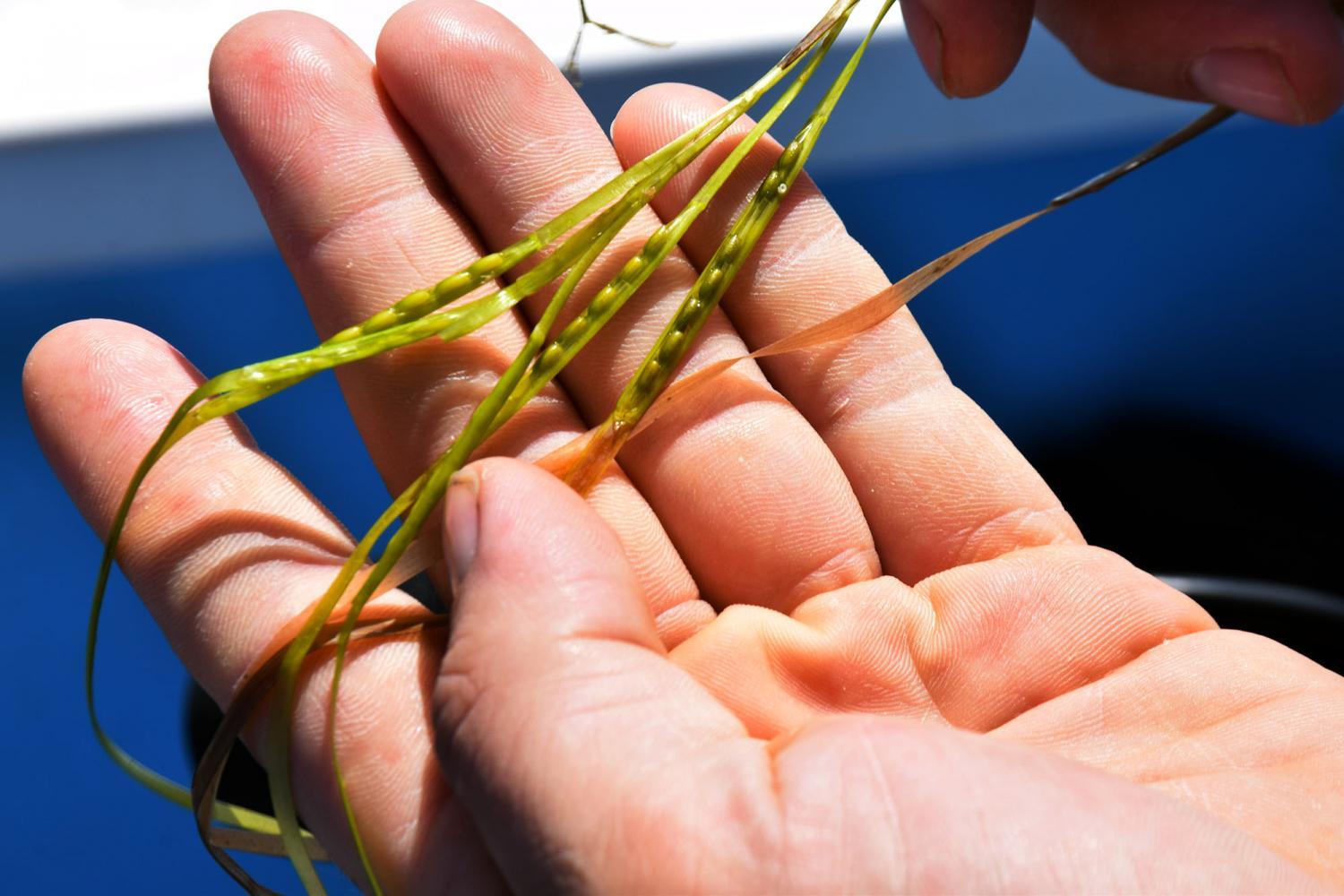
These eelgrass seeds are fresh from the sea. Mexico’s indigenous Comcáac people have managed to protect 96% of the precious eelgrass that grows in their region.
I have long known about beach grass and how it can hold the dunes and protect the land in a hurricane. I know about how easily the roots die if you walk on beach grass and why, when “Keep Off the Dunes” signs aren’t obeyed, houses wash away.
But I’m learning there’s another fragile grass that helps the environment. This one lives in the sea and captures carbon.
Sam Schramski has the story at Public Radio International’s the World.
“At a two-day festival on the coast of northern Mexico [last] month, scientists, chefs and local residents gathered to celebrate eelgrass — a unique type of seagrass that grows in the Gulf of California.
“Seagrass is on the decline in the world’s oceans, but the Indigenous Comcáac people who live in the region have managed to protect the eelgrass that grows in their waters.
” ‘From my parents, I learned about medicinal plants and the songs of plants, as well as about traditional foods,’ said Laura Molina, who is Comcáac.
“She remembers how her mom made tortillas out of flour ground from eelgrass seeds known as xnois in Comcáac language, a mix between wild rice and nori seaweed.
Seagrass is getting a lot of attention these days because of its capacity to store carbon, estimated to sequester up to half the so-called ‘blue carbon’ in the world’s oceans and coastal ecosystems — putting it on par with global forests.
“Ángel León, a Spanish chef and owner of Aponiente restaurant, has made it his personal mission to protect threatened seagrass beds off the Spanish coast. He’s interested not only in the plant’s environmental benefits but also its culinary potential in the kitchen as a nutrient-rich superfood. …
“Seagrass is down about 30% globally since the late 1800s. Through León’s restaurant and related nongovernmental organizations, he has heavily financed seagrass restoration projects.” More at the World, here. Listen to the audio version there.
Kendal Blust at Fronteras also wrote about the festival: “In the small Comcaac village of Punta Chueca, on the Sonoran coast of the Gulf of California, a group of women gathered around a white sheet piled high with dried zostera marina, or eelgrass.
“One woman sang an ancestral song dedicated to the plant, known as hataam, as others beat the dried eelgrass and rubbed it between their palms to remove its small, green seeds. Xnois, as the seeds are known in the Comcaac language, cmiique iitom, are an ancestral food.
“ ‘The Comcaac are the only people, the only Indigenous group, that consumes the seed,’ said Erika Barnett, a Punta Chueca resident who has been heavily involved in restoration efforts.
“Eelgrass seed has been a part of their culture for millennia, she said. Traditionally, the flour was used to make tortillas and a hot drink combined with honey and sea turtle oil. And because it’s quite filling, it used to be carried by Comcaac during sea journeys. …
“Barnett said her great-grandparents were probably the last members of her family to collect and eat the xnois seeds. Her father, now 76, last tasted it when he was just 7.
” ‘That’s was the last time he ate it,’ she said. ‘It’s very ancient, but it’s no longer eaten like it used to be, and most younger people have never tasted it. So this effort is really rescuing our culture.’ …
“Now, Barnett is part of a team working to bring the tradition back to their community — both because of the plant’s nutritional value and its ecological benefits. Eelgrass creates habitat for sea turtles and fish, protects the coastline and captures carbon.
“ ‘It’s important for us to revive these traditions so they can be passed on to future generations,’ she said. ‘But I think we need to show the community that it can be done, first. That it’s hard, but we can harvest the seeds.’
“So for weeks in April, a group of women and girls harvested eelgrass the way their ancestors would have. They waded into the sea to collect plants floating near the shore, then dried, thrashed and winnowed them. …
“ ‘One of the missions of Aponiente is to look to the sea with hunger,’ said Greg Martinez, a chef and biologist. … Martinez said the restaurant is committed to discovering the gastronomic potential in the ocean, both for our health and for the planet.
“And eelgrass has a lot of potential. For one thing, it captures and holds carbon below the water’s surface. Known as blue carbon, it can help mitigate climate change.
“ ‘But it doesn’t only sequester carbon,’ Martinez said. ‘It also protects coastlines. It serves as a habitat for thousands of different species that come to breed in their protection. It buffers waves so if you have a tsunami or another storm it protects the coastline in that way as well.’
“Despite the swath of ecosystem services seagrasses provide, however, seagrass beds currently are disappearing from the world’s oceans, he said. And that makes it especially important to protect the abundant meadows in the Canal del Infiernillo, a channel between the coast and the massive Tiburon Island that is entirely within Comcaac territory.”
More at Fronteras, here. Nice pictures. Both news sites are free of firewalls.


 Suzanne's Mom's Blog