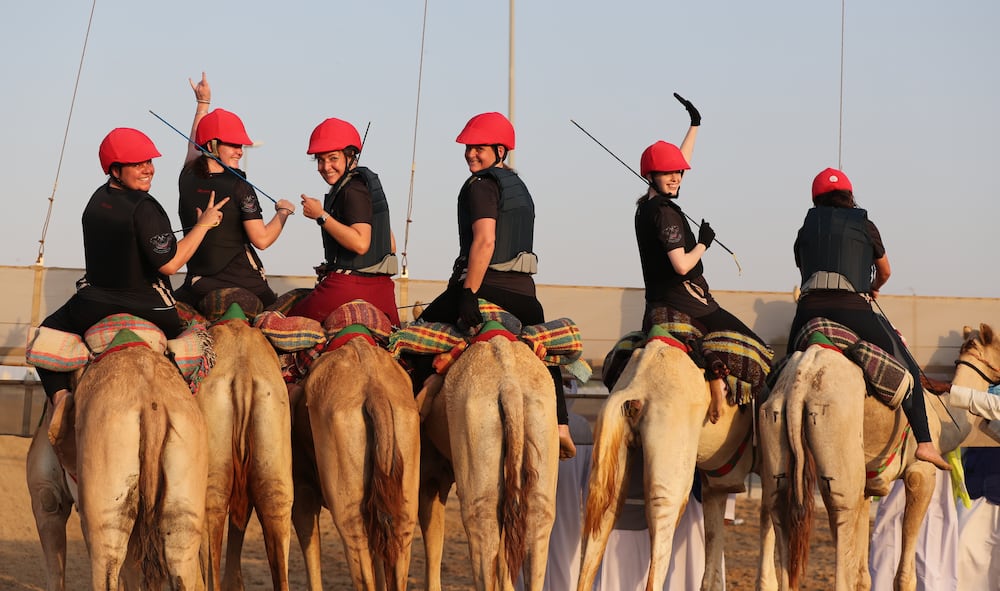
Photo: EPA/Ali Haider via the National News.
Female camel-racing event in Dubai, October 2021. Of the eight women who took part, seven were trained at the Arabian Desert Camel Riding Centre, the first in the region dedicated to teaching women to race camels.
For some reason, I’ve been hearing about camels a lot lately. Not just how long they can travel without refueling but how nutritious their milk is, how lovely their hair. Today we learn about racing camels.
Stacey Vanek Smith reports at PRI’s (Public Radio International’s)The World, “It was a scorching hot day at the Al Marmoom Camel Racing Track located just outside of Dubai in the United Arab Emirates. …
“On a typical morning, [the] arenas are packed with hundreds of enthusiastic fans placing bets on the early-morning camel races (early morning because temperatures are often in the triple digits by 10 a.m.). …
“Camel racing is an ancient sport — its roots stretch back to at least the 7th century on the Arabian Peninsula. But the races at Al Marmoom are a modernized version. Instead of riders, small robots sit atop the camels’ humps and control them with reins. The robots are controlled remotely by men who speed alongside the racetrack in cars, directing their camels. But the people gathered on this hot afternoon had come for something different but also far more traditional: The season’s first women’s race.
“Though the crowd was undoubtedly smaller than the hundreds who regularly show up for the men’s races, the women’s team — a part of the Arabian Desert Camel Riding Center — has started to get real traction in the last few years. News outlets covered the race, and Jeep sponsored the event, along with a handful of local businesses, including Camelait, a company that sells camel milk.
” ‘It’s high in calcium,’ the emcee informed the crowd. …
“Meanwhile, the four women riders led their camels to the racetrack. One of the racers, 31-year-old Linda Krockenberger, is the reason behind the rise of women’s racing — she founded the women’s camel racing team.
“Krockenberger came to Dubai in 2015 to work in the hospitality industry. She had raced horses back in Germany and decided to try her hand at camel riding. She was instantly hooked and was determined to learn how to race camels. The only problem was she couldn’t find anyone to train her. For years, she was told the sport was not for women. …
“But Krockenberger kept trying until she found a willing trainer, Obaid Al Falasi, a highly respected community member. As soon as she felt comfortable with her skills, Krockenberger and Al Falasi decided to open a school. …
“Before she knew it, local and tourist women were flocking to her for lessons. Krockenberger emphasized the support she has gotten from the camel-riding community. … Still, Krockenberger added, there have been many skeptics.
“ ‘Critics sometimes say, “Oh, do we really need a German to teach us an Arabic tradition?” Of course, these comments do get to me because I don’t want to impose myself on the culture,’ she said. ‘But I try to calm these thoughts by saying, “Well if you’re such a great teacher, there’s nothing that stops you from teaching as well.” ‘
“Krockenberger’s riding school emphasizes the Bedouin camel riding tradition. The racers ride barefoot and don’t use saddles, just Bedouin blankets.
‘Barefoot, it’s more freeing,’ racer Rawan Salah explained. ‘You feel everything. You can feel the belly of the camel. You can feel if they’re nervous. Everything.’
“ ‘The Bedouin didn’t have shoes, so we don’t have shoes,’ racer Yanna Schmiel added. …
“While the racers led their camels to the start line, a group of spectators got into their nearby cars and drove up beside the camel track where the riders mounted their camels. Spectators may watch the races from their vehicles or stand at the finish line.
“The women perched just behind the hump on their single-humped Dromedary camels, sitting on blankets. They clung to the camels with their legs, wearing riding helmets and team jerseys.
“Salah said that she feels that all-women racing is a special experience. ‘It feels empowering,’ she said.”
More at PRI’s The World, here.
Some additional fun: “Camels and Riders will be disqualified for the following reasons:
- “Belts used to strap rider to camel.
- “Electric shockers found mounted to the camel or used in whips, overusage of the whip.
- “External influence of camel owner on camel during race beyond vocal cheering on.
- “Interference with gear of competitor camels and riders
- “Riding gear that has not been tested and approved prior to the race.”

 Suzanne's Mom's Blog