Feeds:
Posts
Comments

Posts Tagged ‘eruption’

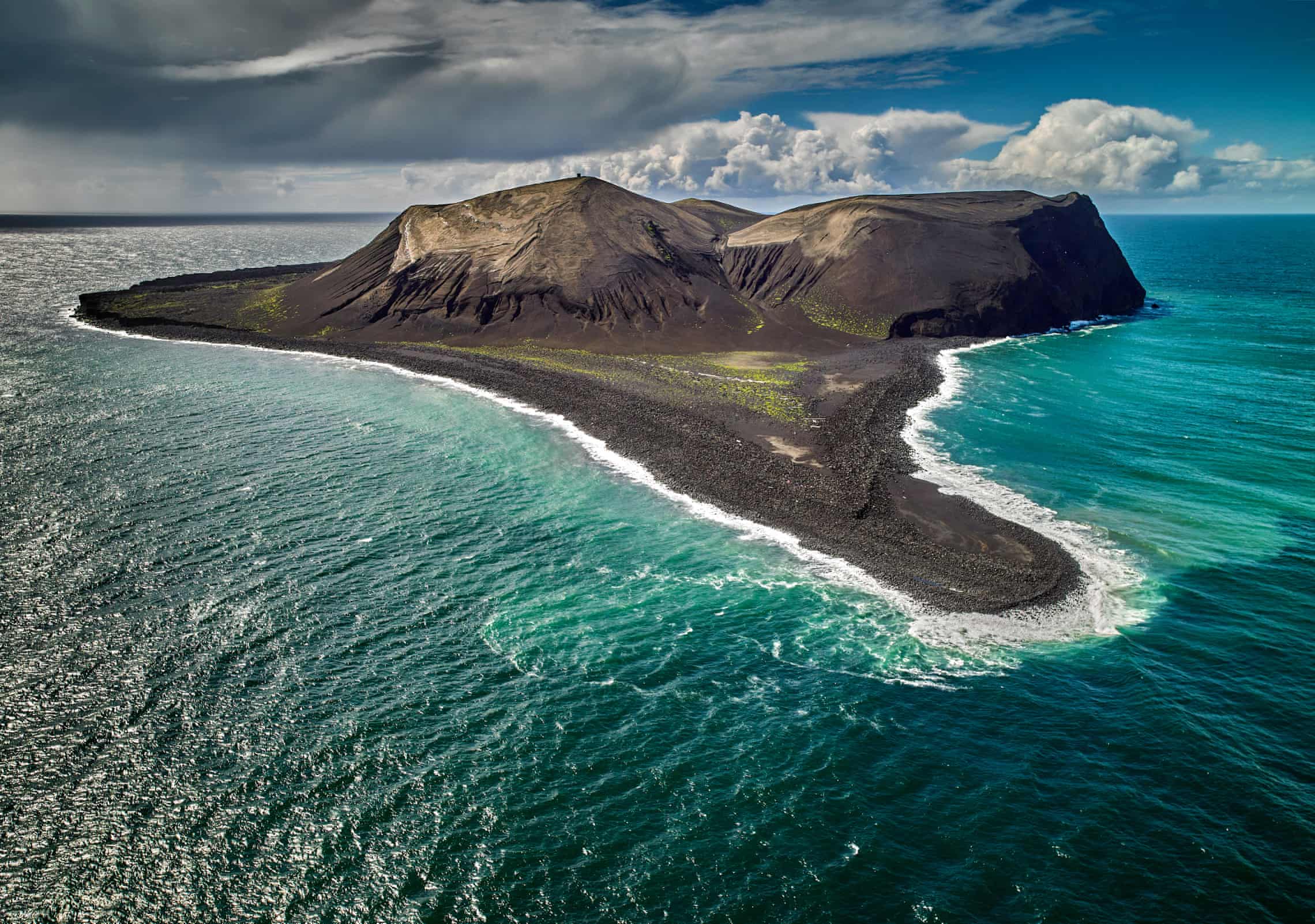
Photo: Arctic Images/Alamy.
Surtsey Island, off Iceland’s Vestmannaeyjar archipelago. It is rare for such longlasting islands to be created from eruptions – the last one was Anak Krakatau in 1927. 

How amazing to witness the birth of an island. People who live in Iceland have a better chance of that than most of us as Iceland is still bubbling with volcanic activity.

At the Guardian, Patrick Greenfield reports on what can be learned from an island that emerged in the 1960s. He starts with the fishermen who first noticed something unusual was going on.

“The crew of the Ísleifur II had just finished casting their nets off the coast of southern Iceland when they realized something was wrong. In the early morning gloom in November 1963, a dark mass filled the sky over the Atlantic Ocean. They rushed to the radio, thinking that another fishing vessel was burning at sea, but no boats in the area were in distress.

“Then, their trawler began to drift unexpectedly, unnerving the crew further. The cook scrambled to wake the captain, thinking they were being pulled into a whirlpool. Finally, through binoculars, they spotted columns of ash bursting from the water and realized … a volcano was erupting in the ocean below.

“By the time the sun had risen, dark ash filled the sky and a ridge was forming just below the surface of the water. By the next morning, it was 10 meters high [about 33 feet]. … An island was being born.

“Two months later, the rock was more than a kilometer long [0.6 mile]and 174 metres high [571 feet] at its peak. It was named Surtsey after the fire giant Surtr from Norse mythology. … It would be two years before it stopped erupting completely.

” ‘It is very rare to have an eruption where an island forms and is long lasting. It happens once every 3,000 to 5,000 years in this area,’ says Olga Kolbrún Vilmundardóttir, a geographer with the Natural Science Institute of Iceland. Those that do form are often quickly washed away by the ocean, she says.

“The emergence of Surtsey presented researchers with a precious scientific opportunity. They could observe how life colonizes and spreads on an island away from the human interference that has overtaken much of the Earth. …

If space is given, nature will always find ways to return, often faster and more creatively than we expect.

“The first scientists that stepped on Surtsey in 1964 could see that seeds and plant residues had been washed ashore. … Scientists had expected algae and mosses to be the first colonizers, building up a base of soil that would eventually support vascular plants. But that step was skipped completely. More plants were washed ashore in the following years, and some clung to the island’s bare volcanic rock. But after a decade, the changes seemed to stall.

“Pawel Wasowicz, director of botany at the Natural Science Institute, says: ‘People thought, what now? Around 10 species had colonized Surtsey at that point. The plant cover was really scarce. But then the birds arrived.’

“In the early 1980s, black-backed gulls started to nest on sections of the island, sheltering in one of the stormiest parts of the Atlantic Ocean. Their arrival kicked off an explosion of life. Guano carried seeds that quickly spread grasses along the island, fed in turn by the nutrients from the birds. For the first time, whole areas of bare rock became green.

“Wasowicz says … ‘Biologists thought that it was just plant species with fleshy fruits that could travel with birds. But the species on Surtsey do not have fleshy fruits. Almost all of the seeds on Surtsey were brought in the feces of the gulls.’

“One lesson from this living laboratory is that recovery after disturbance does not follow a single, predictable path, he says. Instead, it is shaped by multiple, sometimes surprising forces.

“Today, grey seals are the latest arrivals to drive changes in the island’s biodiversity. The volcanic rock has become a crucial ‘haul-out’ site where seals come ashore to rest and molt, as well as a breeding ground where they can raise their young safe from the orcas lurking nearby. …

“But the researchers warn that the colonization of Surtsey will one day go into reverse. The grey seal haul-out site is one of the areas slowly being eroded by the ocean. By the end of the century, scientists project that little will be left from that section of the island.

“Its biodiversity will probably peak, then fall over time … but the researchers say that lessons will remain.

“Surtsey demonstrates that, even in the harshest environments, resilience and renewal are possible, says Wasowicz. It offers hope and practical lessons for rehabilitating ecosystems damaged by war, pollution or exploitation. …

“Vilmundardóttir says: ‘I feel that Iceland is really contributing something important to humankind by preserving this area. On the mainland, the impact of humans is everywhere. When I am on Surtsey, I am really in nature. All you can hear are the birds.’ You see orcas along the coastline and the seals popping out and watching.’ “

More at the Guardian, here.
Read Full Post »

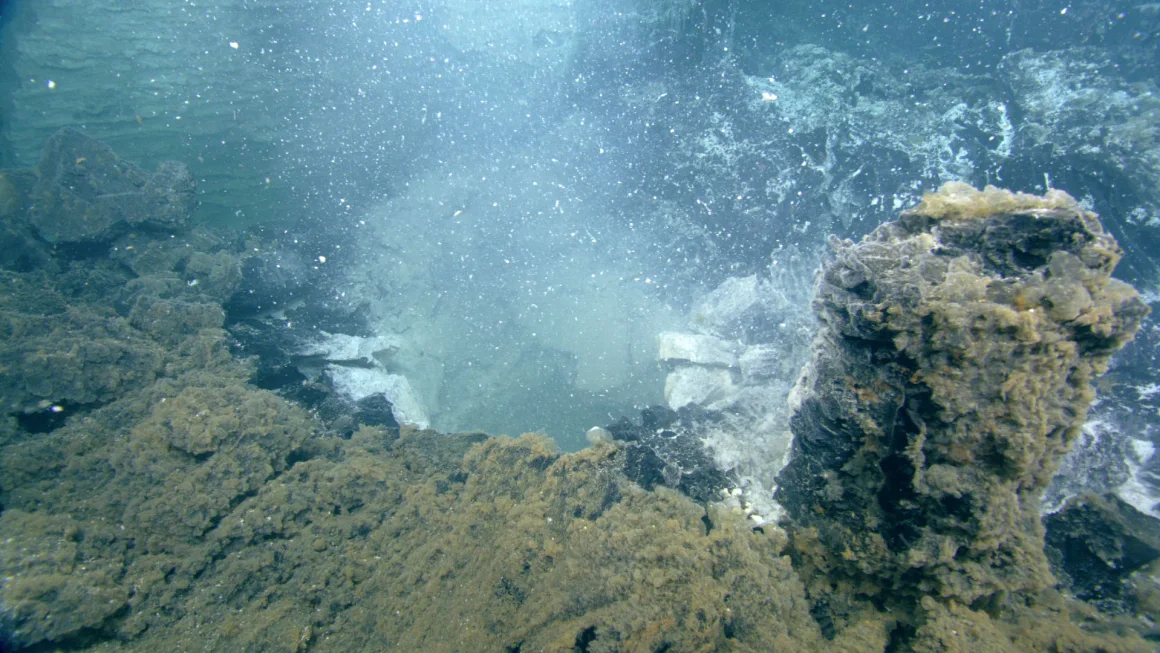
Photo: UW/NSF-OOI/CSSF-ROPOS via CNN Science.
White clouds of microbial waste billow from the seafloor — the result of a volcanic eruption. 

Rachel Carson thought it would be hard for humans to pollute the oceans because they were so vast. I guess she was wrong about that, but the oceans’ vastness does make them likely to remain a source of wonder and discovery — mysterious no matter how much we study them.

Today’s example of deep-sea wonder comes from the New York Times, where Maya Wei-Haas reports that scientists have witnessed a volcanic eruption that had never been experienced in person.

“Andrew Wozniak, a chemical oceanographer at the University of Delaware,” she writes, “struggled to process what his eyes were taking in. Dr. Wozniak was parked on the bottom of the Pacific Ocean beneath nearly 1.6 miles of water in Alvin, a research submersible. As far as he could see lay a mostly barren expanse of jet-black rock.

“Just a day before, at this same spot, a vibrant ecosystem had thrived in the sweltering waters of the Tica hydrothermal vent, about 1,300 miles west of Costa Rica. Creatures inhabited every inch of the rocky seafloor, writhing in a patchwork of life. The crimson tips of giant tube worms waggled in the current, tangling around clusters of mussels. Buglike crustaceans scuttled through the scene while ghostly white fish languidly prowled for their next kill.

“Now, only a single cluster of tube worms remained in the blackened terrain, all dead. A haze of particulates filled the water as glints of bright orange lava flickered among the rocks.

“ ‘My brain was trying to understand what was going on,’ Dr. Wozniak said. ‘Where did things go?’

“Eventually it clicked: He and the sub’s other passengers were witnessing the tail end of a submarine volcanic eruption that had entombed the flourishing ecosystem under fresh lava rock.

“This was the first time scientists had witnessed a clearly active eruption along the mid-ocean ridge, a volcanic mountain chain that stretches about 40,000 miles around the globe, like the seams of a baseball. The ridge marks the edges of tectonic plates as they pull apart, driving volcanic eruptions and creating fresh crust, or the layer of the Earth we live on, beneath the sea. About 80 percent of Earth’s volcanism happens on the seafloor, with the vast majority occurring along the mid-ocean ridge. …

“Observing such an event live offers a unique opportunity for scientists to study one of our planet’s most fundamental processes: the birth of new seafloor, and its dynamic effects on ocean chemistry, ecosystems, microbial life and more.

“ ‘Being there in real time is just this absolutely phenomenal gift — I’m really jealous,’ said Deborah Kelley, a marine geologist at the University of Washington who was not part of the research team.

“Dr. Wozniak and colleagues sailed on a ship, the R/V Atlantis, before setting out in the Alvin sub. Their original goal was to study carbon flowing from the Tica vent, funded by the National Science Foundation. Hydrothermal vents are like a planetary plumbing system, expelling seawater that’s heated as it seeps through the ocean floor. The process transports both heat and chemicals from Earth’s interior, helping regulate ocean chemistry and feeding a unique community of deep marine life.

“The dive on [on that May] Tuesday morning started like any other. Alyssa Wentzel, an undergraduate at the University of Delaware who joined Dr. Wozniak aboard Alvin, described the enchantment of sinking into the darkness of the ocean depths on the 70-minute journey to the seafloor. As the light vanished, bioluminescent jellies and tiny zooplankton drifted by.

“ ‘It was magical,’ she said. ‘It really takes your words away.’

“But as they approached the site, a darker magic set in as temperatures slowly ticked upward and particles filled the water. The usual dull gray-brown of the seafloor was capped by tendrils of inky rock that glimmered with an abundance of glass — the result of rapid quenching when lava hits chilly water.

“As particulates clouded the view from Alvin, Kaitlyn Beardshear of the Woods Hole Oceanographic Institution, the pilot in command of the day’s journey, slowed the sub, keeping close watch on the temperatures. As they ticked up, so too did concerns for safety of the submersible and the crew. Eventually, the pilot made the call to retreat. …

“The team learned after returning to the ship that sensitive microphones, called hydrophones, aboard the Atlantis had detected the volcanic eruption earlier in the day. It registered as a series of low frequency booms and campfire-like crackle.

“This was the third known eruption at the Tica vent since its discovery in the 1980s. Over the decades, Dan Fornari, a marine geologist at Woods Hole, and his colleagues have closely monitored the site, tracking changes in temperature, water chemistry and more. …

“In 1991, he and his colleagues had arrived at Tica within days of an eruption’s start. It might even have still been active, he said, but they saw no flashes of lava to confirm. This time, he said, there’s no doubt of what the Alvin crew saw. ‘This has been the closest that we ever come to witnessing the initiation of an eruption’ along the mid-ocean ridge, he said.

“The team is continuing to study the volcanic activity. Given safety concerns, they’re collecting data and taking photographs remotely from the Atlantis.

“The data will help researchers unravel the mysteries of deep-sea volcanism and the role it plays in marine ecosystems. ‘All of this has to do with understanding this holistic system that is Earth and ocean,’ Dr. Fornari said. ‘It’s so intertwined, and it’s both complex and beautiful.’ ”

More at the Times, here.

Read Full Post »