Feeds:
Posts
Comments

Posts Tagged ‘ethiopia’

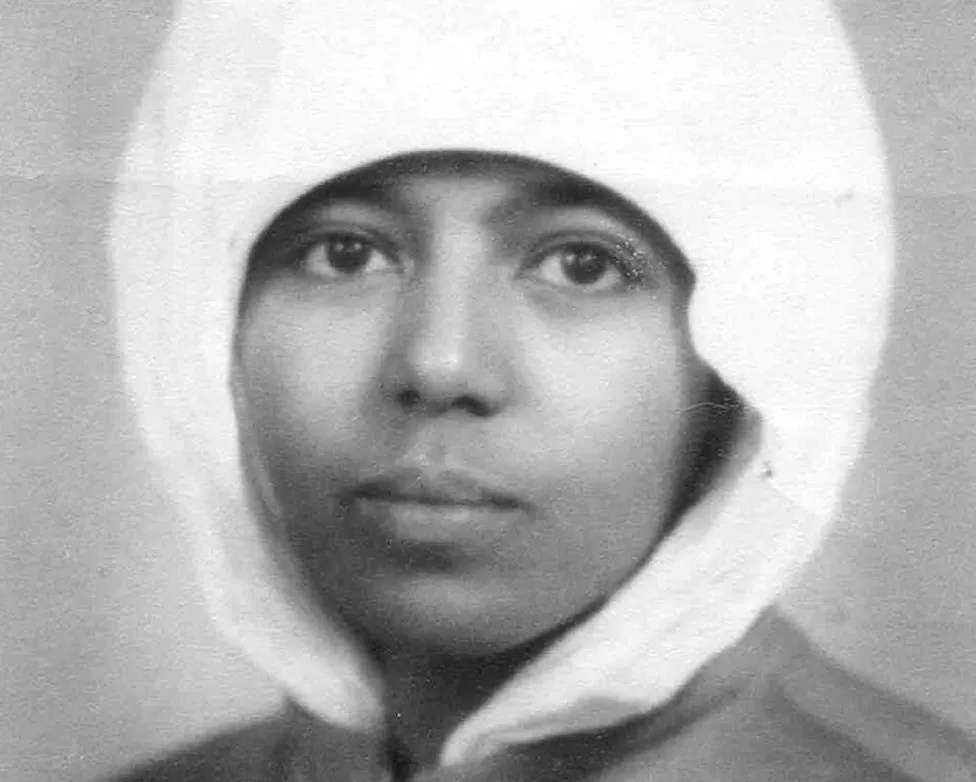
Photo: Buda Musique via the BBC.
Emahoy Tsegué-Maryam Guèbrou, the composer and piano-playing nun who died March 26 at age 99. The BBC reports she led an “extraordinary life, which included being a trailblazer for women’s equality and walking barefoot for a decade in the isolated mountains of northern Ethiopia.”

Here’s a woman who had a long and fruitful life, dying at 99 after making her mark as a nun, a musician, and a proponent of women’s equality. You may be surprised to learn of the advantages a girl could have back in the day if her family was connected to Ethiopian royalty.

Brian Murphy reports at the Washington Post, “Emahoy Tsegué-Maryam Guèbrou, a classically trained musician who once abandoned music for a hermit-like life as a nun in her native Ethiopia and later returned to the piano with a genre-defying blend of Western and Ethiopian influences, died March 26 at her convent in Jerusalem. She was 99. …

“The styles explored by Sister Guèbrou (the title Emahoy is equivalent to ‘Sister’ for a nun) were so singular in sound and structure that music scholars often puzzled over the main source of her inspiration — seamlessly mixing forms such as jazz, chamber music and rhythms from her homeland. …

“Her work was brought to a larger audience in recent years on the soundtrack for the Oscar-nominated documentary Time (2020) about a two-decade saga for an inmate and his family; and as music on the Netflix race-and-prejudice drama Passing (2021).

“Sister Guèbrou, meanwhile, spent long stretches in solitude inside the Ethiopian Monastery of Debre Genet, or Sanctuary of Paradise, in Jerusalem, where she lived since 1984 in a single room adorned with her artwork of icons and angels. …

“In her few specific comments on her musical influences, she expressed admiration for the European classical canon including Frédéric Chopin and Johann Strauss. Yet she stayed rooted in the five-note melodic runs common in Ethiopian music, while also exploring the flowing richness of Eastern Orthodox chants or the distinctly American sounds such as jazz or the old-timey snap of ragtime. …

” ‘Just within the first five or 10 seconds of the song, we have invocations of European modernism, of Ethiopian traditional music and of the links between Ethiopian Orthodoxy and a broader Judeo-Christian tradition,’ said Ilana Webster-Kogen, an ethnomusicologist at the University of London’s School of Oriental and African Studies.

“ ‘Getting all of that musical information within about five seconds of listening means that comparing her to anyone else wouldn’t make sense,’ she added.

“There was a decade, however, when Sister Guèbrou played nothing at all.

“She was a rising young talent as a teen, studying for two years under Polish violinist Alexander Kontorowicz in Cairo and then was offered a scholarship to London’s Royal Academy of Music. Sister Guèbrou never made clear what happened next. For some reason, she was blocked by Selassie’s government from traveling to London.

“She was devastated. For nearly two weeks, she refused to eat. She ended up in a hospital in Ethiopia’s capital, Addis Ababa. Her family feared she was near death. Weak and ailing, Sister Guèbrou said she slept for an entire day.

“ ‘When I wake up, I had a peaceful mind,’ she told the BBC in 2017. ‘I was changed. And I didn’t care for anything.’

“She left music behind. At 19, she joined the Gishen Mariam monastery in Ethiopia’s northern highlands. For the next decade, she barely left the monastery grounds, where she slept in a hut on a dried-mud bed. She noticed many of the nuns and monks were barefoot. She gave up shoes as well.

“She had already experienced huge swings in her life. She was raised in privilege in a family that had deep connections in the Ethiopian royal court, including her father’s work in diplomatic and liaison roles. She and her sister, Senedu, attended a Swiss boarding school and soaked in Western music and art.

“After Italian forces under Benito Mussolini invaded Ethiopia in 1935, Sister Guèbrou and her family were placed under house arrest and later sent to POW camps in Italy for two years. Three of her brothers were killed in the fighting. (She composed the 1963 piece, ‘The Ballad of the Spirit,’ in their memory.) …

“At nearly 30 years old, she decided to see how her fingers felt back on the piano keys. The music flowed. Now, however, it was more infused with the meditative sounds and chants from the monastery.

“ ‘I said to myself, “I have nothing. I have music,” ‘ she recalled. ‘I will try to do something with this music.’ …

“In 1974, a coup toppled Selassie and ended Ethiopia’s monarchy. Anyone favored by the ousted royal regime, including Sister Guèbrou and her family, was now under suspicion and closely monitored. When Sister Guèbrou’s mother died in 1984, she moved permanently to the monastery in Jerusalem, always seen in public in the flowing religious garb that covered her head. …

“ ‘We can’t always choose what life brings,’ she told the BBC. ‘But we can choose how to respond.’ ”

More at the Post, here.

Read Full Post »

Are you familiar with the journal Aeon? It’s a nonprofit website that has long, thoughtful articles from the world of ideas. Recently, I saw an article on a brilliant Ethiopian thinker — from the 17th century.

Dag Herbjørnsrud, founder of SGOKI (the Center for Global and Comparative History of Ideas) in Oslo, writes, “The ideals of the Enlightenment are the basis of our democracies and universities in the 21st century: belief in reason, science, skepticism, secularism, and equality. …

“As the story usually goes, the Enlightenment began with René Descartes’s Discourse on the Method (1637), continuing on through John Locke, Isaac Newton, David Hume, Voltaire and Kant for around one and a half centuries, and ending with the French Revolution of 1789, or perhaps with the Reign of Terror in 1793. By the time that Thomas Paine published The Age of Reason in 1794, that era had reached its twilight. Napoleon was on the rise.

“But what if this story is wrong? What if the Enlightenment can be found in places and thinkers that we often overlook? Such questions have haunted me since I stumbled upon the work of the 17th-century Ethiopian philosopher Zera Yacob (1599-1692), also spelled Zära Yaqob.

“Yacob was born on 28 August 1599 into a rather poor family on a farm outside Axum, the legendary former capital in northern Ethiopia. At school he impressed his teachers, and was sent to a new school to learn rhetoric (siwasiw in Geéz, the local language), poetry and critical thinking (qiné) for four years. Then he went to another school to study the Bible for 10 years, learning the teachings of the Catholics and the Copts, as well as the country’s mainstream Orthodox tradition. (Ethiopia has been Christian since the early 4th century, rivalling Armenia as the world’s oldest Christian nation.)

“In the 1620s, a Portuguese Jesuit convinced King Susenyos to convert to Catholicism, which soon became Ethiopia’s official religion. Persecution of free thinkers followed suit, intensifying from 1630. Yacob, who was teaching in the Axum region, had declared that no religion was more right than any other, and his enemies brought charges against him to the king.

“Yacob fled at night, taking with him only some gold and the Psalms of David. He headed south to the region of Shewa, where he came upon the Tekezé River. There he found an uninhabited area with a ‘beautiful cave’ at the foot of a valley. Yacob built a fence of stones, and lived in the wilderness to ‘front only the essential facts of life’, as Henry David Thoreau was to describe a similar solitary life a couple of centuries later in Walden (1854).

“For two years, until the death of the king in September 1632, Yacob remained in the cave as a hermit, visiting only the nearby market to get food. In the cave, he developed his new, rationalist philosophy. He believed in the supremacy of reason, and that all humans – male and female – are created equal. He argued against slavery, critiqued all established religions and doctrines, and combined these views with a personal belief in a theistic Creator, reasoning that the world’s order makes that the most rational option.

“In short: many of the highest ideals of the later European Enlightenment had been conceived and summarised by one man, working in an Ethiopian cave from 1630 to 1632.”

Read more about the remarkable 17th century Ethiopian at Aeon, here.


Read Full Post »

Photo: Addis Fortune
A passerby looks at what’s on sale at a sidewalk bookshop.

A love of reading appears to be growing in Ethiopia. According to Mahlet Workayehu at Addis Fortune and All Africa, “It is a common sight to have people carrying around books on the roads and selling them to people sitting in cars or people walking on the streets. …

” ‘Now people hanging out at bars and khat stores are buying books from us,’ says Addis, a book vendor.

“The cost of books in Addis, with the average price of a fiction novel book by a local author coming in around 80 Br [about $3.25], has increased in the past two years. …

“The people credited for expanding the readership of books in Addis are the mobile vendors. They walk around with books in their hands stacked all the way up to their neck, approaching any and everyone to buy a book of them. There are close to 1000 mobile vendors roaming the streets of Addis.

“Addis is a mobile vendor; he has been selling books for five years. Although he is not literate, Addis knows all the titles of the books he carries, whether it be in Amharic or English.” More here.

That bookseller’s lack of literacy really struck me. I work as a volunteer with adult refugees, some of whom never had any schooling and are eager to learn. Book vendor Addis is so near and yet so far from the joy of books.

(For fun, read Roger Duvoisin’s storybook Petunia, about the goose who thought she was wise because she carried around a book. I don’t accuse Ethiopian book vendors of being like Petunia, but I do wish someone could help them learn to read. Of all people, I imagine, they would most enjoy being literate.)

Read Full Post »