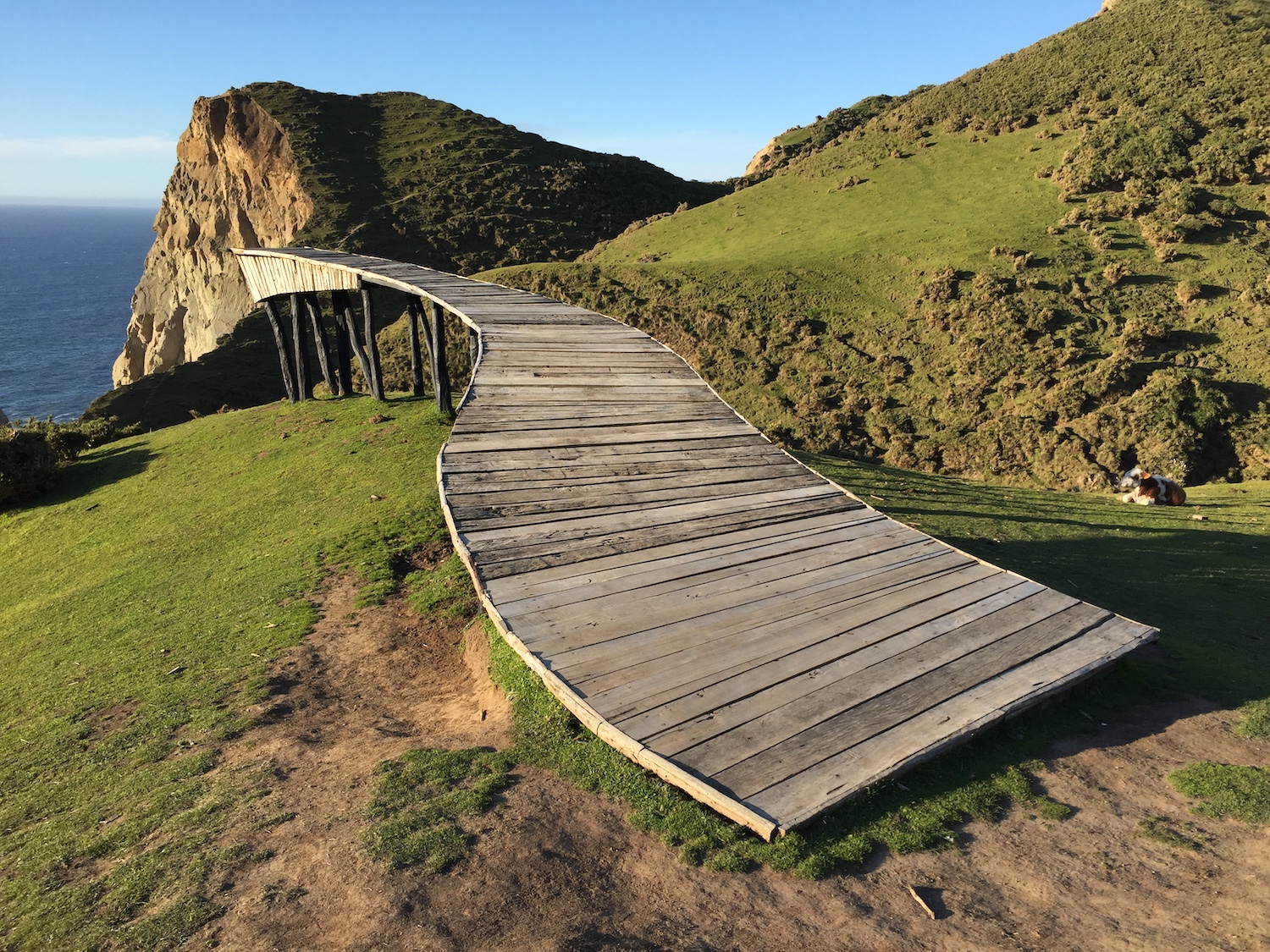
Chumono, Muelle de Alma (2005), site specific art installation near Cucao, Chiloé, Chile.
Today’s article is the first in a Hyperallergic series about a fellowship for curators that one recipient used for a project in Chile. Blogger Rebecca may know the part of Chile that curator Dan Cameron talks about.
He writes at Hyperallergic, “While preparing this project one day, I was perusing Chilean regional news outlets for details about the December 2021 fire that damaged or destroyed a number of houses in Castro, the capital of the Isla Grande de Chiloé, when I noticed that multiple sources referred to the island as a ‘tourist’ destination.
“Maybe it’s the just intellectual vanity that goes with being the sort of curator who leaves New York City to come to a remote corner of South America, but it felt weirdly like a slap in the face to see this little-known (outside of Chile) place that I’d been steadfastly exploring for a future curatorial project seemingly transformed by a single word into a locale that would be for, well, tourists. In my mind it didn’t matter that Chiloé’s famed palafito stilt houses and 17th- and 18th-century wooden churches attract visitors worldwide, or that the more secluded corners of Chiloé I’d scouted on previous trips had everything a moderately resourceful traveler would need for a splendid visit. …
“My flash of pique at reading Chiloé so described is curiously linked to my personal history with Chile, which I first visited exactly 30 years ago. … I’ve returned consistently to Chile over the years, precisely because I thought I wouldn’t otherwise get to know it. This was summarized by the word that the Santiago-based artist Eugenio Dittborn would employ five years later as his title for a survey exhibition I curated of his signature pinturas aeropostales (airmail paintings) at the New Museum: Remota.
In 1992 I hardly knew anybody who possessed firsthand information about Chile, and that made it irresistible.
“During our initial meeting at his studio in Santiago, I shared with Dittborn my very ambitious itinerary, which included Santiago, Valparaiso, Easter Island, and the northern cities of Iquique and Antofagasta. … Dittborn responded that in the future, I should visit the southernmost art museum in the world, in Castro [in Chiloé], and perhaps consider organizing an exhibition there. …
“I finally made it to Chiloé in 2015 with the artist Gianfranco Foschino. … It helped that Gianfranco was personally enthusiastic about organizing a contemporary art exhibition in Chiloé, but what became less clear once we’d made our initial reconnaissance of the island was whether or not MAM Chiloé was the ideal venue for a project that would function largely as a platform for local artists. After spending time with and talking to various artists living on the island, it seemed that, for most, the museum functioned as a venue for artists based in Santiago. If I wanted to see where local artists showed, I’d need to dig a little deeper into the patchwork of regional museums, municipal libraries, gallery-cafés, and community centers, which tended to be scattered all over Chiloé, and on the nearby islands of Quinchao and Lemuy.
“My last time in Chiloé, in November 2019 … I started envisioning Alrededores more as a long-term curatorial endeavor, where instead of artworks appearing for one season and vanishing, some might require years even to come to fruition. That would place the project closer in spirit to the niche that the Chilote artist Chumono opened up with his site-specific Muelle del Alma (‘Pier of the Soul’), which since its 2005 construction has become emblematic of art and nature co-existing on mutually beneficial terms. Thousands of visitors each year park their cars near the village of Cucao and hike nearly three miles through verdant hills and pastures to the westernmost edge of the island.
“There, according to Chiloé folklore, the boatman Tempilcahue will someday ferry them to the afterlife; fittingly, Chumono’s wooden ramp visually beckons visitors up into the sky and out over the Pacific Ocean. …
“The most exciting part of my plan was the possibility that Chiloé’s artists might end up with an international context for their work, without rupturing the sociocultural framework of their lives.
“The art was already there — I had already been surprised by its depth, and it was simply a matter of introducing the world to it. Even if cultural tourism, broadly speaking, was on a temporary hiatus as new waves of COVID spread worldwide, other avenues could bring the public to the art of Guillermo Grez or Anelys Wolf, or to the sole-proprietor storefront Museum of the Accordion in Chonchi.
“The latter, a modest but beloved establishment, preserves an integral part of the musical legacy left through centuries of ships — on which the accordion was that rare instrument capable of surviving adverse conditions — rounding Tierra del Fuego to pass between the Atlantic and Pacific Oceans, which slowed to a crawl after the 1914 opening of the Panama Canal. Part of the original Alrededores concept had been to move the museum’s collection — acquired long ago from sailors who left their accordions for repair and never returned — temporarily to MAM Chiloé, while putting some TLC into the museum’s display and conservation in Chonchi, where exhibits are typically set out on folding tables with hand-written labels.
“This month I’m returning to Chiloé for the fifth time in eight years … in pursuit of something that compels me to return over and over again, and to continue dreaming of a truly marvelous future art exhibition.”
More at Hyperallergic, here, where you can click through the curator’s updates. No firewall, nice pictures.


 Suzanne's Mom's Blog