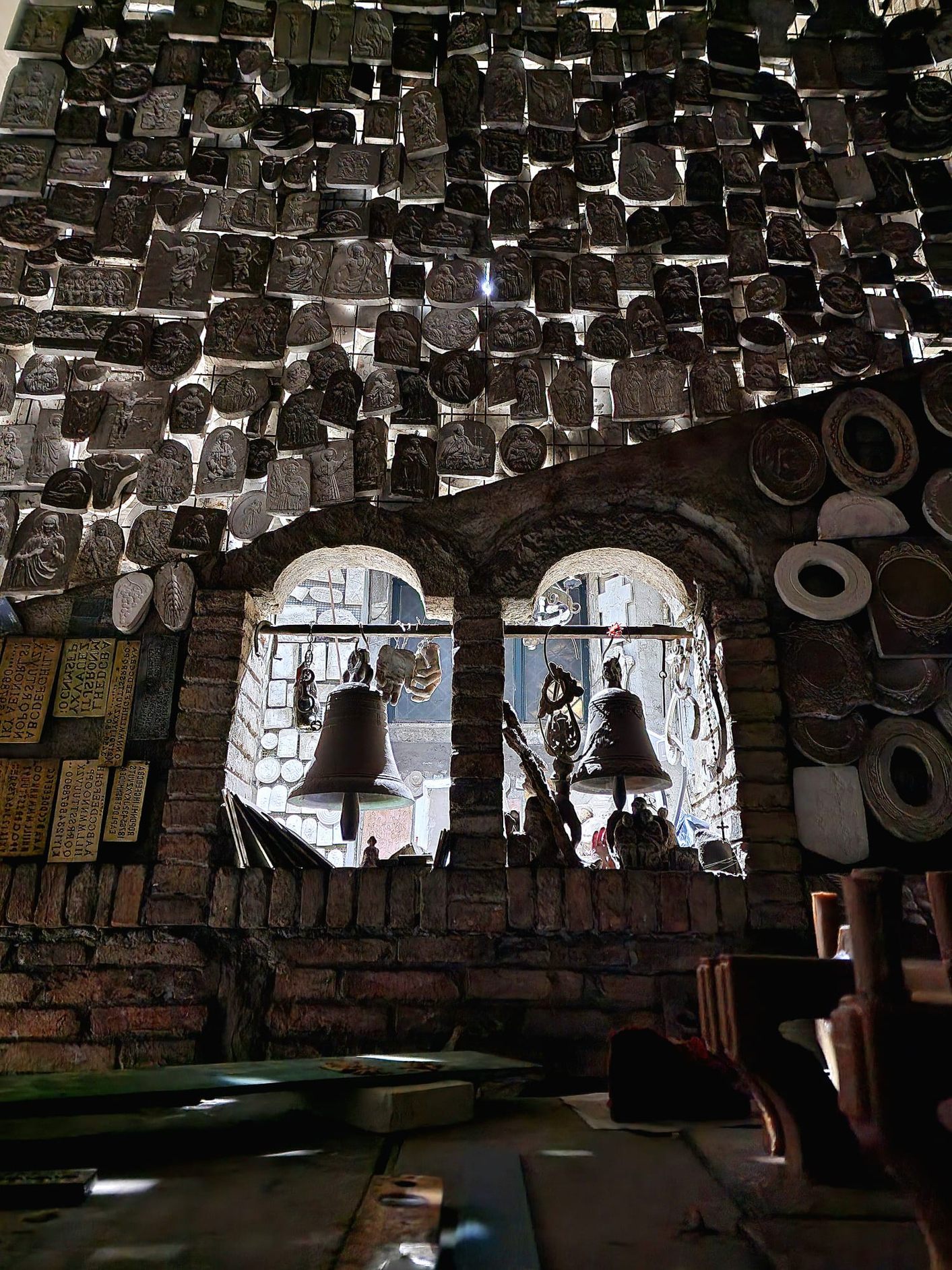
Photo: Pontifical Marinelli Bell Foundry.
One family has been making bronze bells for over 1,000 years in the Molise region of southern Italy. The bells can be seen in the Marinelli Bell Museum.
My brother the business writer has made a study of companies in America with impressive longevity. For example, the Hollingsworths of Hollingsworth Vose were granted a patent to manufacture paper from manila fibers in 1843, but my brother says they go back to the time of George III.
Be that as it may, the Italian family in today’s story has been in business even longer.
Asia London Palomba writes at Atlas Obscura that Pasquale Marinelli is “a bell artisan in Italy. Pasquale and his brother Armando are the 26th generation of a family who has been crafting handmade bells since the middle ages. Pouring scalding-hot liquid metal into carefully designed molds, the two sweat over glowing embers, working with 10 centuries worth of knowledge in order to spread a medieval chime around the world.
“Naturally, such historical work is done in an ancient town called Agnone. Located in Italy’s isolated and rugged southern region of Molise, the quiet stone village lies squarely in a mountainous valley, where green hills roll into each other like waves and hay barrels freckle the land like drops of gold. It’s here, teetering at the top of a rocky outcrop, where you’ll find the two brothers working in the Pontifical Marinelli Bell Foundry, which, appropriately, is the oldest family-run business in Italy and among the oldest in the world.
“The Marinellis have been handcrafting bronze bells since at least the 11th century, although archaeological findings at nearby Benedictine monasteries suggest the Marinellis’ craft could date as far back as the 9th century.
“ ‘The same techniques and models, everything from A to Z, have been the same for the last 1,000 years,’ notes Armando. ‘Deviating from these methods that have been passed down throughout the generations means shutting the door on 1,000 years of history.’ …
“Their ancestor Nicodemo Marinelli, for whom they have historical documents … is documented to have been crafting bells in an era when the sonorous instrument had a greater, even primary role in society. ‘Bells were the first mass media. They heralded the salient moments of the day: to call people to work, for lunch, to return home from work. They were a way of telling time, of warning people,’ notes Pasquale.
“For almost its entire history, the foundry and its artisans were mobile, moving around to forge bells wherever there was demand. ‘We were like nomads,’ explains Armando, ‘living away from home for months alongside the tratturi, which were like the highways of antiquity.’ …
During World War II, Nazi troops seized many of the family’s historic bells and melted them down to create cannonballs.
“The brothers’ grandfather managed to bury some of the business’ most important bells underground, which were eventually recovered after the war, although Armando suspects there still may be a handful forgotten beneath the town’s earth. …
“A Marinelli bell is made with three cups stacked within each other — think of them as Russian nesting dolls. The first cup, called the ‘soul,’ is the internal part of the bell and is created by laying brick fragments upon each other and wrapping them together with iron string. This is slathered in a thick layer of clay, then wax, and then even more clay to create the second cup, named the ‘false bell,’ which will eventually be destroyed to make way for the bronze product. Smoldering coals are poured inside these two structures to bake the clay and melt the wax from the inside out.
“Hand-drawn wax molds are then cast onto the exterior of the false bell. ‘This is a very important step, because once its realized in bronze, it’ll live on for centuries in a church or a community,’ explains Armando. While almost everyone in the family partakes in the decoration process, this work falls primarily on Ettore Marinelli, Armando’s 31-year-old son and part of the 27th generation of artisans. Also a talented bronze sculptor, he works mainly in the artist’s hall. … ‘I was practically born in the foundry. I was already molding clay at the age of three,’ says Ettore.
“The soul and decorated false bell are then covered in more clay to create the third and final cup, called the ‘mantle.’ Once dry, the mantle, with the wax designs embossed into it, is lifted and the false bell is destroyed by hand with a hammer. A bronze alloy, spiced with a smattering of tin, is heated to 1,200 degrees Celsius (roughly 2,192 Fahrenheit) and poured into the bell mold, now consisting only of the mantle and the soul, while a priest blesses the process with a sprinkling of holy water. When the alloy hardens, the mantle is broken apart with a hammer to release the bronze bell, which is then polished until it shines.”
More at Atlas Obscura, here. No paywall. Lovely photos.

 Suzanne's Mom's Blog