Feeds:
Posts
Comments

Posts Tagged ‘feet’

Above: In Chinese medicine, massaging different parts of the foot improves the health of body regions thought to correspond.

I’ve been interested in reflexology since 2007, when I ventured behind a Shanghai sandwich board that read “foot massage” and engaged with a young woman who spoke no English. It was a pretty aggressive massage, but I walked on air afterward.

Back in the States, I went to a place called Joyful Feet a couple times, and recently took a short class to learn about the philosophy. That class focused on hand massage, which was interesting but not the same.

Phil Daoust explored the topic of foot care, starting with pedicures, at the Guardian.

“I am in a south London nail bar,” he wrote, “reclining in a motorized armchair, mechanical fingers kneading my back while my feet soak in a little whirlpool bath. Someone has brought me coffee. …

“It has taken me 61 years to have my first-ever pedicure, and the moment I sat down all I could think was: ‘Why did it take me so long?’

“The next 40 minutes are bliss. … I leave Jolie Nails & Spa with a spring in my step, on feet that … well, no, you still wouldn’t call them beautiful – that will take several more sessions (and something to put a shine on my nails; I quite like the look of Boy de Chanel, probably in black) – but at least I’m no longer ashamed to show them to the world.

“This is not about getting beach-ready. … I have belatedly realised that if I want to make it to 100, I’ll have to take care of my feet. Unless I keep them strong, and flexible, and sensitive, more and more activities will slip out of reach. In the worst of all possible worlds, I will have a fall and end up in hospital. …

‘Our feet are literally the foundation for any movement we might make,’ the longevity guru Peter Attia reminds us in his book Outlive.

” ‘Whether we’re lifting something heavy, walking or running, climbing stairs, or standing waiting for a bus, we’re always channelling force through our feet.’

“They’re also crucial to balance. ‘They’re the feedback point for the brain to know where it is in its environment,’ says Asha Melanie, a York-based personal trainer with an interest in longevity. In their natural, unshod state, feet are our main point of contact with the earth. ‘There are hundreds of thousands of sensory receptors in each foot,’ Melanie says. ‘And then we put our clumpy shoes on and stop them from being able to feel anything.’

“More than that, I’d argue: we forget they should feel anything. We wrap them up and it’s out of sight, out of mind. … I’ve only really become aware of mine in the few months since I started yoga. There they were, naked, ugly and surprisingly unstable. Yoga teachers would tell me to spread my toes, or to ground ‘all four corners of my feet’ and I’d think ‘How?’ and ‘All four whats?‘ …

“This pedicure is my way of telling my feet: ‘I see you. I will do better by you.’ …

“Melanie says, now they’re fit for polite company, I must stop hiding them away. ‘Go barefoot as much as possible,’ she advises. … That doesn’t mean I should immediately chuck away my shoes, Melanie says, but I should try to transition towards something less chunky and cushioned, with plenty of room for the toes to spread and wriggle. ‘It has to be a gradual process, so that all your ligaments, tendons and joints can adapt.’

“But this is just the first step. Now I’ve freed my toes, I need to re-educate them, so I can spread them when I need a more stable base, or put my weight precisely where it’s needed. I could start by just splaying them out: simply standing or sitting in bare feet, then willing the toes to separate and spread a little. … I am embarrassed at how hard it is to isolate – or try to isolate – individual toes or groups of toes. … I struggle to move just the two biggies without taking everything with them. …

“How long will it take to make real progress, I ask Melanie. ‘How long is a piece of string?’ she says. ‘The more you put in, the more you’re going to get out of it. But doing a couple of minutes every day, you could see a difference in weeks.’

“I should also keep an eye on my big toes, where any weakness can lead to knee, hip and back pain. ‘It sounds ridiculous,’ Melanie admits, but when you’re walking this is where you push off, so problems here will affect the rest of your body. One way to build strength is to sit on a chair and lift your big toe as far as you can with your index and middle finger. Then, without moving any other muscles, press down with your toe while lifting with your fingers, so that nothing is moving yet both your toe and fingers are trying to. Hold for seven or eight seconds, relax and repeat four or five times.

“What else should be on my to-do list? Improving my ankle mobility, apparently. ‘Everyone should be doing ankle cars [controlled articular rotations],’ says Melanie. This is as simple as sitting down with one leg out in front of you, then keeping the leg immobile while slowly rotating the foot through its full range of motion, five times clockwise, then five times anti-clockwise, before repeating with the other leg.”

Much good advice on soles and arches, too, at the Guardian, here. No paywall.
Read Full Post »

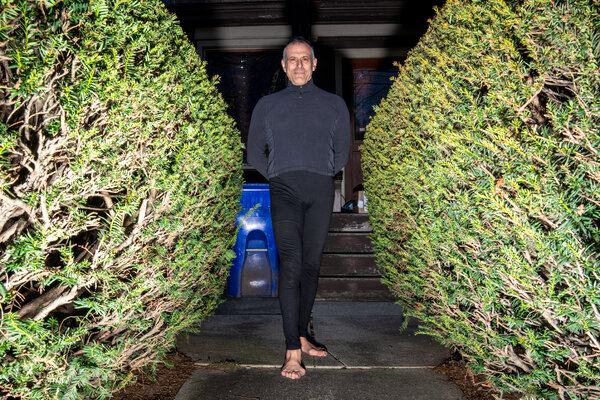
Photo: Joe Buglewicz for the New York Times via OddityCentral.
Joseph DeRuvo has gone barefoot for years. He says going barefoot means being mindful of how you move through the world. (And washing well at night!)

Here’s an unusual guy worth writing about. We can always learn something interesting from the outliers in our society. Let me know what you think. In my case, this guy makes me wince just thinking about all the stubbed toes I had as a barefoot child on Fire Island.

Katherine Rosman reports at the New York Times, “A few years back, Joseph DeRuvo Jr. made a quick stop at an upscale supermarket to buy eggs and was stopped in the dairy aisle by a store manager. ‘You’re not wearing shoes,’ he recalled the manager saying to him.

“He was right. Mr. DeRuvo wasn’t wearing shoes. He almost never does. The employee cited health codes; Mr. DeRuvo disputed that he was in violation. The employee made vague references to insurance policies; Mr. DeRuvo replied, ‘More people break their necks with high heels than they ever do going barefoot.’ …

“Mr. DeRuvo initially decided to forgo shoes because of agonizing bunions, but he has stayed barefoot for reasons that transcend physical comfort. …

“There are questions he is asked frequently that he is always happy to answer. How does he manage snow and ice? Doesn’t he get sharp objects stuck in his thick calluses? But that’s the simple stuff. ‘Navigating the terrain is easy,’ Mr. DeRuvo said. ‘Navigating people is tricky.’

“When asked to leave a shop or a restaurant, he normally does so without protest, said Mr. DeRuvo’s wife, Lini Ecker, a shoe-wearer who serves as a bridge between her husband and a world that generally asks for conformity. …

“For two decades, Mr. DeRuvo, 59, has lived an almost entirely barefooted life, one he has constructed, with Ms. Ecker’s help, to limit or avoid such confrontations. After years spent as a photographer and a photography teacher, he is still self-employed, now as a Pilates instructor, a particularly barefoot-friendly profession. And the couple stays close to home. When they go out, they gravitate toward mom-and-pop stores and restaurants where they can forge personal connections with owners and managers, and he can be seen as more than the guy with the feet.

“Still, said Ms. Ecker, 61, ‘we get thrown out of a lot of places.’ … Ms. Ecker, a preschool teacher, prepared lunch, lightly grilling bagels in a cast iron pan, slicing avocados, tossing a salad. Mr. DeRuvo grabbed a pair of chop sticks, his preferred cutlery. This is among his ‘quirks,’ as he calls them. He needs reggae music to play in the background at almost all times; the only numbers he can remember are of radio stations, which he uses for internet passwords.

“ ‘I clearly have one foot on the spectrum,’ he said earlier (though he clarified that he has never undergone an autism evaluation).

“Mr. DeRuvo’s lifestyle has given him reason to think a lot about bare feet, assessing their safety and hygiene and whether they threaten polite society. He can come up with no health risk. What germs can his feet carry that the bottom of someone’s shoes do not? …

“Mr. DeRuvo assumes all risk of stubbed toes, or worse. He has performed a number of jobs all in his bare feet and all safely. He is a tinkerer and a maker, including of his own Pilates equipment that he fabricates in the elaborate workshop he built out of the garage behind his house, sometimes wearing safety goggles but rarely shoes. (He will wear moccasins while welding.)

“In case he steps on something sharp, he carries a sunglasses case filled with tweezers to remove detritus, pulling his feet close to his face to spy metal splinters and shards of glass. He showers at night, scrubbing his feet clean before getting into bed with his wife.

“And he knows when to capitulate, he said, keeping a pair of loosefitting sandals in the car in case there is an event where others would be inconvenienced by him getting refused entry, like when they go to dinner with friends.

“But generally Mr. DeRuvo chooses the comfort of his feet over doing anything or going anywhere that forces him to force them into a pair of shoes.

“Bare feet outside of the beach, the yoga studio or the pedicure chair tend to attract attention. … ‘People have a thing about feet,’ Mr. DeRuvo conceded. ‘People get skeeved.’

“Mr. DeRuvo’s look like they would hurt inside a pair of shoes: His big toes, with a protruding large bump at their bases, jut aggressively toward the pinkie toes on a diagonal.

“The bumps are bunions. About 20 years ago, they had become painful — throbbing during long runs in tight sneakers and interfering with his life. Mr. DeRuvo saw a doctor who recommended surgery. As he awaited the scheduled procedure, he went without shoes because the pain was so intense. In the intervening days he learned that the screws that were to be implanted in his feet contained a metal he was allergic to. He also realized that he felt better since he quit shoes.

“It did not take long before he came to see that going barefoot was enriching his life in ways he did not anticipate. There were physical benefits in addition to the relief for the bunions: He found comfort from the ground beneath him. ‘The tactile feedback just kind of makes everything else going on feel a little bit smoother,’ he said.

“There are spiritual benefits too, said Mr. DeRuvo, a religious man. ‘God says to Moses, “Take off your sandals,” you know, “this ground is holy,” ‘ he said. ‘Well, I kind of like to take that as far as it can go.’ ”

More at the Times, here.

Read Full Post »