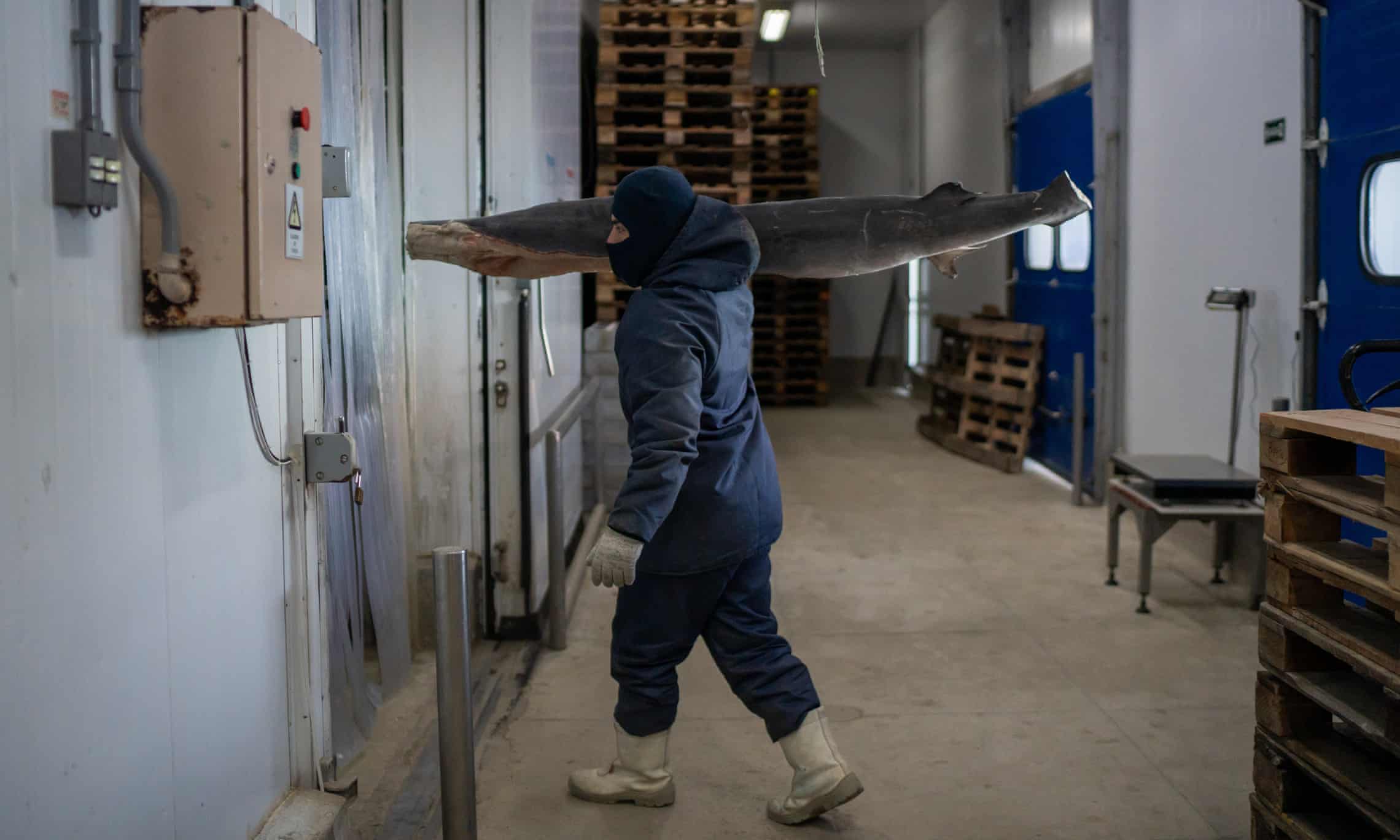
Photo: Avener Prado.
A trade that goes under the radar. Here, a blue shark is taken into cold storage in Cananéia, a fishing port in São Paulo state. Sharks reproduce slowly, but at least 80 million are killed annually.
This is a sorry tale. Even if you don’t like the idea of swimming with sharks or keeping them as pets, I know you will be concerned that we are decimating their numbers. Today’s story explains that sometimes we are eating sharks without realizing it.
Constance Malleret reports at the Guardian that “worried conservationists say most people do not realize they are eating shark.
“The bright blue skies and calm waters of the estuary belie rough conditions at sea, and there is no sign of activity among the colourful fishing boats moored around the harbor of Cananéia, a sleepy fishing town 160 miles south of São Paulo.
“On the wharf, however, a delivery of frozen fish from Uruguay has just arrived and a few men in white gumboots are busy unloading pallets of beheaded specimens labelled Galeorhinus galeus – school shark. These thin grey fish will be kept in a cold store on shelves already stacked ceiling-high with carcasses of blue sharks, all awaiting processing and distribution to cities inland.
“ ‘Why do we work with shark?’ says Helgo Muller, 53, the company manager. ‘Because people like it; it’s good and cheap protein. It doesn’t give you crazy profits, but it’s decent enough.’
“Shark is just a small fraction of the firm’s business but they process about 10 tons a month, he says, mostly blue shark imported from countries including Costa Rica, Uruguay, China and Spain.
“Communities up and down Brazil’s 4,600-mile coastline have always eaten sharks. ‘It is part of our tradition,’ says Lucas Gabriel Jesus Silva, a 27-year-old whose grandfather moved to the area in the 1960s to fish sharks for their fins.
“However, the widespread appetite for shark meat that Muller’s company helps feed is now troubling scientists and environmentalists, who worry about unsustainable pressure on various species. …
” ‘Sharks are very vulnerable to overexploitation as they don’t reproduce as often or with as many offspring as bony fishes do,’ explains Prof Aaron MacNeil, of Canada’s Dalhousie University.
“Research published in April found that 83% of the shark and ray species sold in Brazil were threatened, according to the International Union for the Conservation of Nature (IUCN) classification.
“For years, conservation efforts focused on the fin trade with Asia and the barbaric practice of ‘finning’ – removing a shark’s fins and returning the wounded and helpless animal, often still alive, to the sea. But research from earlier this year suggests restrictions on finning have not reduced shark mortality, with at least 80 million sharks still being killed annually.
“ ‘Meat was kind of left by the wayside,’ says MacNeil, who is researching the global shark meat trade. ‘It’s only now we’re realizing how big the trade is. Its value has certainly exceeded that of fins.’ The pressure on sharks for food has risen in parallel with a decline in catches of other fish, he says.
“Traditionally, Brazilians ate shark in moqueca, a seafood stew from the states of Bahia and Espírito Santo. And many of Cananéia’s residents recall how their older relatives would use shark’s head broth and cartilage as homemade remedies. But now, sold in fillets or steaks, shark has been absorbed into Brazilians’ diet as it is cheaper than other white fish, boneless and easy to cook. It now appears in school and hospital canteens.
“The fact that few Brazilians realize they are eating shark has probably helped make it ubiquitous. While coastal people with a shark-eating tradition recognize the subtle differences in texture and flavor between shark species, to most Brazilians it is just cação – a generic term under which both shark and ray meat are sold. …
“Campaigners say the generic labelling prevents informed decisions by consumers, and this could even affect their health due to high concentrations of dangerous pollutants in these top predators. ‘If they knew, they might not eat it,’ says Ana Barbosa Martins, a researcher at Dalhousie University. …
“ ‘Fishers don’t cast their nets to catch shark specifically, but sometimes a [protected] hammerhead comes up. What can you do?’ says Lucia Rissato, who runs a fish stall in Peruíbe. … ‘We have to sell it in secret, like drugs.’ “
I guess, for vegans, getting tricked into eating shark meat is not an issue.
More at the Guardian, here. No paywall.

 Suzanne's Mom's Blog