Feeds:
Posts
Comments

Posts Tagged ‘freezing’

Art: L.M.F. Doyère, “Mémoire sur les Tardigrades,” Annales des sciences naturelles: Zoologie et biologie animale, 1840.
Tardigrades are one of the life forms that survive under extreme conditions.

Science writer Alex Riley has hope for our planet, but his hope doesn’t necessarily include humans. Maybe if more of us appreciated and learned from science, he would feel differently.

At the Christian Science Monitor, Erin Douglass interviews Riley about the adaptive life forms he studied for his new book, Super Natural.

“In Super Natural,” she writes, “award-winning science writer Alex Riley casts his inquisitive, generous gaze upon … the far-deep, far-up, and far-flung life-forms that inhabit Earth’s less move-in-ready biomes. From snailfish and wood frogs to painted turtles and tardigrades, these remarkable creatures display a knack for thriving – or at least carrying on – in a niche of their own. …

Erin Douglass
“You describe finding solace in nature as a boy growing up in the 1990s. Do you have an early memory that stands out?”

Alex Riley
“I grew up in North Yorkshire, so northern England. It was very rural, very picturesque, but very lonely as well. You had to find your own interests. 

“We had this pond at the bottom of the garden, and frogspawn was there. It’s very mundane for grown-ups – a frog turns from a tadpole to a froglet to a frog – but for me to watch that was enthralling. Even today, that strikes me as something incredible: There are transformations going on around us, whether it’s caterpillars to moths or tadpoles into frogs. I think that metamorphosis was really crucial to my upbringing.”

Douglass
“You organize the book by conditions – heat, cold, depth, height, etc. Why did you choose this framework?

Alex Riley
“I didn’t want to make it too complex. I wanted a layperson to pick up this book, look at those chapters, and say, ‘OK, I understand these environmental stresses, and I want to learn more about them.’ 

“In the book’s sequence, I started with water – or lack of water – because water is so associated with life. That’s what NASA used to search for extraterrestrial life. Everything that we know in terms of life on Earth has involvement with water and requires it in their cells. We evolved from water. “

Douglass
“What’s behind the title?

Riley
“There’s a double meaning there. You Americans say ‘super’ for ‘very’ – so all of this stuff is very natural. But there’s also this supernatural element that’s sort of inexplicable. We can’t even comprehend how fungi survived in Chernobyl on the reactor that exploded, and actually used the radiation for their sustenance. We can’t imagine what it’s like to live in complete darkness and have no association with sunlight.” …

Douglass
“You call the tardigrade ‘the poster child of life’s resilience.’ What makes these tiny beings so amazing?”

Riley
“They’ve been studied since the 1770s, and we’re still trying to uncover how they are so tough. They’re adorable: Under a microscope, they look like little bears with a piglike snout, eight chubby legs. Even their movement is adorable. They don’t just swim or walk – they bumble through grains of sand and moss, and in the seabed. And yet, they’re almost indestructible.”

Douglass
“Which creature impressed you the most?”

Riley
“The microbes that live in the subsurface. There’s water down there, and there’s radiation from the rocks, and that radiation splits the water and it produces hydrogen. All these microbes need is that hydrogen and something to accept it; chemosynthesis is what they’re doing, but it’s very, very basic. We didn’t know that life could exist below the surface, below soil level. But these microbes have been found 5 kilometers down into the bedrock. 

“If we’re going to find extraterrestrial life, say on the moons of Saturn or the moons of Jupiter, these are worlds that are ice-covered, and they’re going to be dark. Hydrogen is the most common element in the universe. If there is going to be life elsewhere, then these little microbes in the subsurface seem to be a good example of what it could be like.”

Douglass
“You emphasize that endurance over the ages is only possible with ingenuity – and being different. Would you say more about that?”

Riley
“Life has to be different in order to survive, because to compete for resources, it pays to go against the grain.  If you’re a snailfish living 8,000 meters down in the Mariana Trench, you’ve got a pretty good life because you’ve pushed into this extreme that no other fish can get into. You have no predation, and you’ve got all the anthropods you can possibly eat. These oddities are actually a natural part of what life on Earth does. …

“For humans, our ingenuity was our intelligence, for all of its costs and all of its negatives. It will be ingenuity – in renewable energy sources and other forms of technology – that will enable us to live sustainably on this planet. …

“There’s this comfort that I get from thinking in deep time – not in political, five-year slots, but thinking beyond a human lifespan. What’s going to come next? Perhaps life will be more symbiotic because we have been so extractive. It’s a spectrum of hope that I have. I think we can, we have to, live more sustainably. But even if we don’t, life will adapt.”

More at the Monitor, here.
Read Full Post »

Photo: Reuters Marketplace/UK World Online Report.
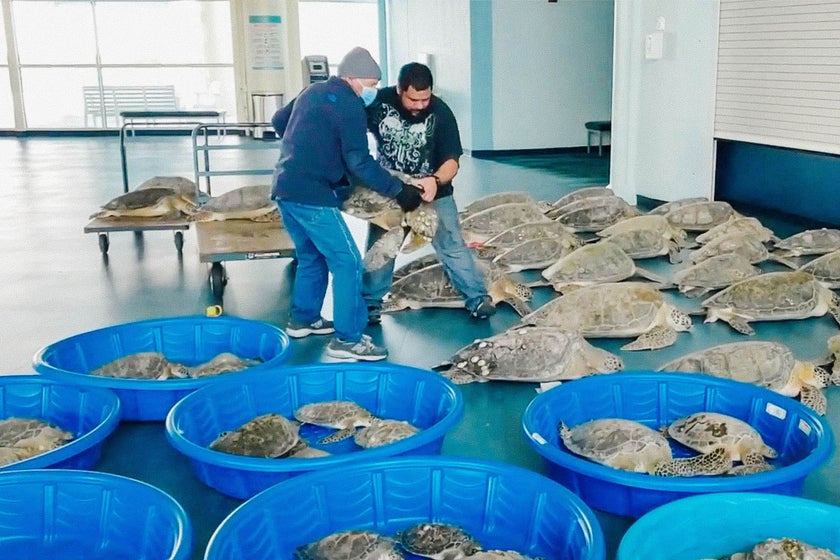
Endangered Green Sea Turtles are placed in bins and kiddie pools to help them warm up gradually.

Sometimes a crisis can bring out the best in human nature. Consider all the people making food for health-care workers in the pandemic or the volunteers manning pantries for 2020’s many unemployed.

This morning, as I was reading about the failure of the Texas electric grid, I learned that one supermarket, having suddenly lost power, couldn’t operate cash registers and let customers go home without paying.

Meanwhile, Texas nature lovers, despite hardships of their own, are rescuing sea turtles from the extreme cold. Many thanks to Hannah for pointing me to the story.

Raechel Allen reports at Slate, “An unprecedented winter storm provoked massive disruption in Texas this week: Millions lost power, hundreds were displaced from homes. [And] because of the temperature, thousands and thousands of sea turtles cannot move.

“An endangered species, these sea turtles usually live off the waters of South Padre Island, which is off the southern coast of Texas. Over the past week, they’ve been loaded into dinner cruise boats and minivans. The rescue center at the nonprofit Sea Turtle Inc. is used to rehabilitating injured sea turtles and responding to minor cold snaps but cannot hold all the turtles — so they’re also filling up a convention center. … Slate spoke to Wendy Knight, Sea Turtle Inc.’s executive director. Our conversation has been edited and condensed for clarity.

Rachael Allen: Can you walk me through what’s been going on this week with the turtles?
Wendy Knight: We are in the midst of the single largest cold-stun event in history. We have approximately 4,800 cold-stunned, federally protected, endangered sea turtles. … On Sunday things really started to hype up and we had local boat owners go out and find hundreds of floating sea turtles.

“What does it mean for a sea turtle to be cold-stunned?
“Sea turtles are cold-blooded so they need the temperature of water to regulate their own body temperature. … If the water gets below a certain temperature, the turtles are no longer able to sustain their own body temperature. Usually, they don’t think about all of their instincts — moving their flippers to swim, eating, diving to the bottom of the ocean, lifting their head up to draw breath. In a cold-stun event, they’re still aware they need to do those things, but because their body is frozen, or cold-stunned, it’s is not reacting to the instinct message. As a result they’re not able to swim, so the turtle floats to the top of the water and because their body is not responding by lifting their head to breathe, they drown in the ocean. I’m sure as we get farther away from the stun event, there will be perished turtles found, regardless of our best efforts.

“How did your team rescue thousands of turtles?
“This is a nesting beach where thousands and thousands of hatchlings are born each season, so everybody is keenly aware that we’re sharing space with sea turtles. We have almost 500 registered volunteers, plus all the city employees, who participate in training at the beginning of cold-stun season. That plan was executed here, just on a much bigger scale.

It’s important to remember that when all this was happening these hundreds of community members didn’t have power of their own. They hadn’t had electricity or running water in days. …

“They had their own personal tragedy happening. And despite that, they took time away to serve an animal that can’t serve itself.

“I can’t explain what it’s like to stand in a convention center that’s probably a football field and a half, and see 4,200 sea turtles laying tip to toe as far as the eye can see. And that’s not even all of them — that’s the overflow. … Nothing happens when they’re stunned — no bodily functions. It’s like a catatonic state. The best thing you can do is to let them rest. As things go along, they will start to wake up, but there are consequences that can come from cold stuns that require antibiotics and IV therapy, like pneumonia. We’ll watch them all closely, and as they recover and become more alert, we’ll start releasing them incrementally back into the Gulf of Mexico.”

I shouldn’t overlook the fact that there are people who volunteer year-round. Which is just to say that it doesn’t always take a crisis to bring out the best in human nature. More at Slate, here.

Read Full Post »

Photo: Terrence Antonio James/Chicago Tribune, via Associated Press
Candice Payne, “a regular person,” rented hotel rooms for more than 100 homeless people in Chicago — and strangers followed her lead — as temperatures headed way below freezing.

A Chicago real estate broker, a self-styled “little black girl from the South Side,” had a moment when she just couldn’t bear to see a particular bad thing happen.

The temperature in Chicago was about to go way below zero last week, and Candice Payne started thinking about the people in the city’s homeless camp. Here’s what can result when “a regular person” realizes that empathizing while doing nothing is not an option.

Sandra E. Garcia has the story at the New York Times.

“As temperatures plunged to life-threatening lows this week, more than 100 homeless people in Chicago unexpectedly found themselves with food, fresh clothes and a place to stay after a local real estate broker intervened.

“The broker, Candice Payne, 34, said it was a ‘spur-of-the-moment’ decision to help. ‘It was 50 below, and I knew they were going to be sleeping on ice and I had to do something,’ she said on Saturday.

“Ms. Payne contacted hotels and found 30 rooms available at the Amber Inn for Wednesday night at $70 per room. …

“After Ms. Payne paid for the rooms on a credit card, she asked on her Instagram account for anyone who could help transport the homeless people. Soon she had a caravan of cars, S.U.V.s and vans with volunteer drivers.

“ ‘We met at tent city, where all the homeless people set up tents and live on the side of the expressway,’ Ms. Payne said. … She asked as many people as she could to go with her to the Amber Inn as donations were pouring in to her Cash App account. …

“ ‘We had to accommodate everyone. It was really overwhelming,’ Ms. Payne said. ‘They were so appreciative. They couldn’t wait to get in a bath and lay in a bed.’

“Ms. Payne bought toiletries, food, prenatal vitamins, lotions, deodorants and snacks and made care packages to help make the people feel comfortable. Restaurants donated trays of food, and many people called the inn. …

“ ‘People from the community, they all piggyback off Candice,’ said Robyn Smith, the manager of the Amber Inn. ‘Other people started calling and anonymously paying for rooms,’ she added, and Ms. Smith lowered the price to accommodate more people. What started out as 30 rooms doubled to 60, Ms. Smith said. …

‘I am a regular person,’ Ms. Payne said. ‘It all sounded like a rich person did this, but I’m just a little black girl from the South Side. I thought it was unattainable, but after seeing this and seeing people from all around the world, that just tells me that it’s not that unattainable. We can all do this together. …

“ ‘This was a temporary fix, and it has inspired me to come up with more of a permanent solution.’ ”

Talk about the Power of One! Here’s hoping that the state’s wealthy governor, who called Payne to offer his praise, gets on board with a permanent solution.

More at the New York Times, here.

Read Full Post »