Feeds:
Posts
Comments

Posts Tagged ‘fresh produce’

Photo: Noah Stewart.
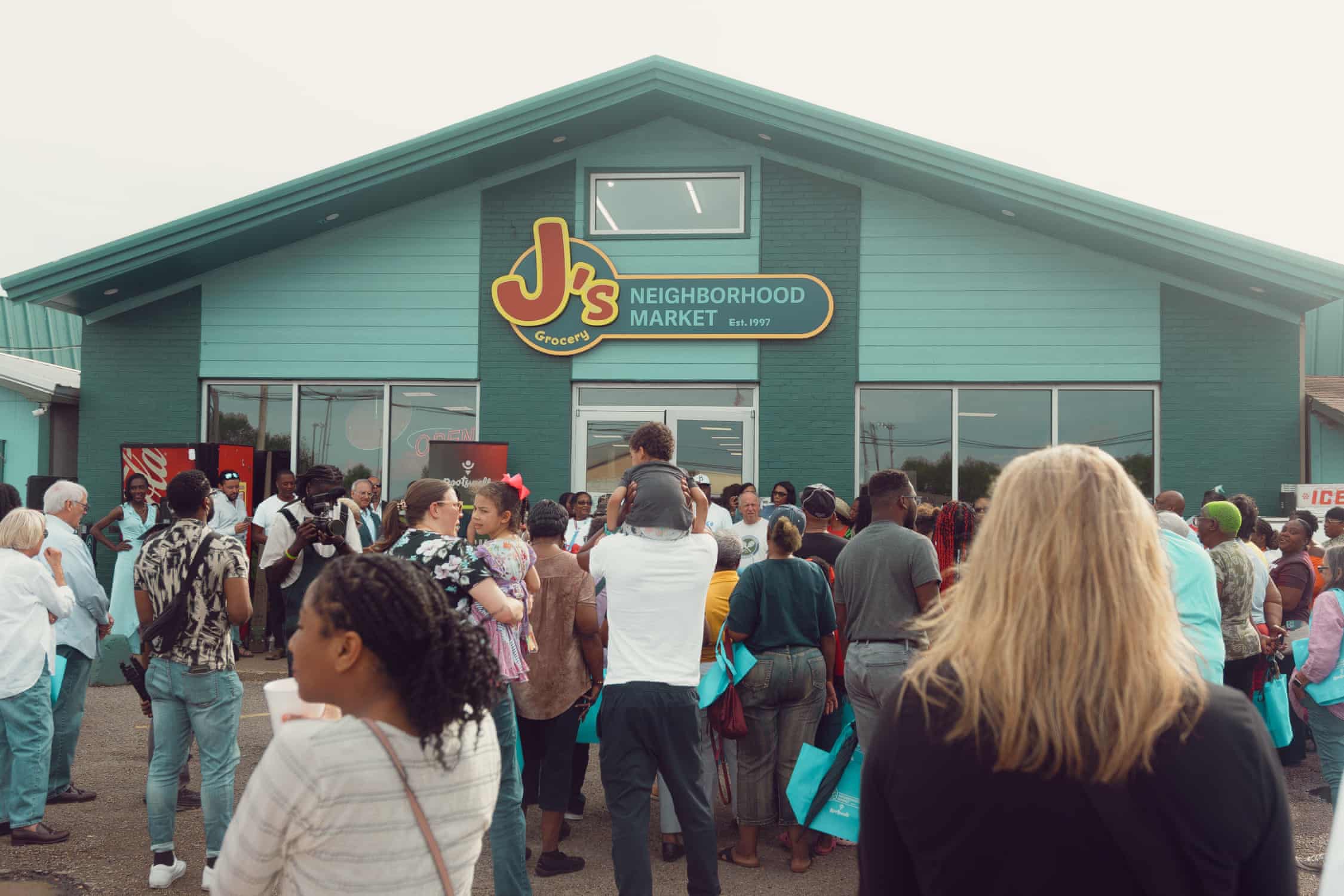
On 2 May, J’s Grocery in Clarksdale, Mississippi, reopened after a yearlong renovation. Through a new food-access initiative, J’s Grocery provides its mostly Black community with hard-to-come-by fresh produce.

The best medicine is often a healthful diet. But in many communities around the US, nourishing food is hard to access. That’s why a community in Mississippi is rejoicing about a newly renovated grocery store.

Adria R Walker writes at the Guardian about J’s Grocery revitalizing its majority-Black town with fresh produce.

“With the recent release of Ryan Coogler’s Sinners, Clarksdale, Mississippi, known as the home of the blues, has been thrust into the spotlight. But while the nation and world are captivated by a version of Clarksdale from more than 90 years ago, residents today are focused on the future.

“On 2 May, rain and warnings of thunderstorms were not enough to keep people in Clarksdale’s Brickyard neighborhood away from the reopening of J’s Grocery, a local staple since 1997 that had been under renovation for the last year.

“A collaboration between the store owner, Al Jones, and local farmers, J’s, the only Black-owned supermarket in the area, now carries fresh produce. …

“The new stock and collaboration was made possible by a deal among Jones; Partnership for a Healthier America (PHA), a nonprofit that works to provide access to nutritious food; Rootswell, a Mississippi Delta-based group that was formed to ‘shift the paradigm of food apartheid‘; Novo Nordisk, a pharmaceutical company; and other groups.

“ ‘At a time in our country when the federal government is just pulling money back everywhere, we invested in people and community,’ Noreen Springstead, PHA’s president and CEO said at the opening. …

“Jarvis Howard of Tunica, Mississippi, a visual artist who goes by DudeThatDraw, painted a mural, a smaller version of one he is installing at nearby George H Oliver elementary school. ‘Food is medicine,’ the mural reads over vibrantly colored vegetables. …

“Clarksdale, which today has a population of nearly 14,000 people, is primarily Black. The grocery store is in a walkable, mixed-income community, with an elementary school almost right across the street. A middle school, a Head Start center, a nursing home and senior citizen housing, low-income apartments and single-family homes are all in close proximity. In addition to the newly offered produce, the store also features a third space: a seated, shaded area surrounded by raised beds planted with herbs, where residents can gather and chat.

“The Mississippi Delta is abundant in fertile land and crops; agriculture is the state’s No 1 industry. Though some 30% of the state is farmland, most of that land is dedicated to cash crops, which are exported. In 2022, nearly 20% of Mississippians were food-insecure.

“Farms in the region ‘produce a lot of commodity crops, like corn, soybean, cotton. They don’t produce a lot of food that we eat,’ said Robbie Pollard, one of the farmers whose produce is now sold at J’s. ‘We’re trying to change the landscape to start producing more food in the Delta, like converting some of that land that’s used for row-crop production.’ …

“Pollard said that while the Mississippi Delta region is abundant in farmland, there’s a gap in what reaches the community. His initiative, Happy Foods Project, which is part of his farm, Start 2 Finish, is working to remedy that by collaborating with other farmers, and introducing youth to farming through farm visits and farm-to-school programs.

“J’s Grocery reopening will be a gamechanger for the neighborhood, he said. Some residents lack transportation to be able to get to big box stores that sell imported produce. Rural counties in the Mississippi Delta, like Coahoma county in which Clarksdale is the largest town, average one supermarket per 190.5 sq miles . …

“After Clarksdale lost its Kroger in 2017, residents initially pushed for another big box store to move in. But Tyler Yarbrough, the director of Mississippi Delta Programs for PHA, and others wanted the town to be able to return to its locally owned, locally operated roots. …

“Yarbrough said that stories from his grandmother and other older residents of shopping in the 1960s provided inspiration for what they might be able to bring back to the town. At the time, locals didn’t need to leave their communities to procure groceries. Instead, they went to the local grocery stores, which, like J’s, had a butcher who sold chicken, pork, freshly sliced bacon and produce.

“ ‘It is in our food-system history of having these neighborhood corner stores,’ he said, noting that the Brickyard and downtown Clarksdale once had 12 such shops. ‘This project is honoring that legacy and reminding us that we can own our food and the stores that we shop from.’ ”

More at the Guardian, here. No paywall, but donations keep this reliable news source alive. Help if you can.

Read Full Post »

Photo: SÜPRMARKT.
SÜPRMARKT is the reason a district in Los Angeles went from a food desert to a vegan oasis.

What a difference healthful eating can make! We all know someone who became healthier after changing diet. Unfortunately, communities that grocery chains have abandoned have almost no access to fresh fruits and vegetables or other healthful, nourishing food. In a “food desert,” people may live off fast food or whatever the local gas station or convenience store has on offer.

Nabou Ramu recently wrote at the Guardian about the difference that a vegan market made in what had been a Los Angeles food desert.

“The plate is her canvas,” writes Namu about a Los Angeles resident. “Imani Cohen never wants her dish to look too brown nor too starchy. She gravitates toward foods bright with luminous colors such as greens, purples and orange, during her weekly Saturday visits to the farmer’s market – a ritual she’s kept for herself and family as a way to be intentional [about food]. …

“Growing up in south central Los Angeles a lot of exotic vegetable ingredients Cohen’s mother loved to cook with were not always readily available in the neighborhood. …

“It’s why in 2020 her longtime homegirl, Olympia Auset, started a pop-up, SÜPRMARKT, in front of artist and educator Ben Caldwell’s storefront, KAOS in Los Angeles’ Leimert Park neighborhood to combat the existing food desert that dehydrates south central Angelenos. In July 2024, SÜPRMARKT upgraded into a brick and mortar oasis and became the first vegan grocery store in south central Los Angeles.

“Auset was disappointed that there were only three grocery stores within Crenshaw’s six-mile radius. She started SÜPRMARKT because she hated that residents had to travel miles into Manhattan beach, Marina Del Rey or Westchester to hunt for high value produce.

“ ‘It’s out of our way,’ said Auset, 33, who studied public relations and sociology at Howard University.

“Places such as Simply Wholesome, a Black-owned whole food store, has been a staple on Slauson Avenue and Overhill Drive but are more of an earth pharmacy and health restaurant. …

“SÜPRMARKT is accessibly located … inside a 1,908 sq ft free-standing home. Upon arrival, patrons are greeted by a patio with ample seating. Inside resembles ‘a cozy residential house.’ …

“The market offers a well-stocked selection of fresh, organic fruits and vegetables, including perfectly ripe mangoes, onions, yams, chard and dairy. Their open kitchen allows one to eat clean foods from their menu such as the signature ‘Everyday People’ salad, cornbread, cabbage and vegan gumbo. Customers are also able to purchase items using funds through government- and community-assistance programs.

“Gaining access to vegan processed foods for SÜPRMARKT was difficult for Auset, who said she faced racism and discrimination. One distributor laughed in Auset’s face questioning, ‘vegan ice cream on Slauson?’ Then denying her service citing the neighborhood ‘unsafe.’

“ ‘I have had people do a lot of really weird things when we were going through our permit process,’ Auset said.

“She wants to raise awareness of these problems to make access smoother for people who are attempting to make a healthier oasis in the communities needed most.

“Nearly one in five Angelenos – or roughly 2 million people – are food insecure … defined by the US Department of Agriculture (USDA) as a lack of access to enough food for an active, healthy life. …

“Residents in the four neighborhoods along the Crenshaw district – West Adams, Windsor Hills-View Park and Baldwin Hills – are more than likely to eat fast food and get food from liquor stores or [convenience stores] due to the lack of access to fresh ingredients in the area, according to a study done by students at the University of Southern California.

“ ‘I focus on food injustice and food access because I feel like it’s one thing that we have the ability to solve,’ said Auset.

“However, Cohen suggests that the locals’ inner priorities define what food they have to eat in their hood. As the ‘Hood Healer’ she pushes people in the neighborhood she grew up in to eat with the same self-love she does, and put their health first.

“Diets are ‘impacting our productivity,’ she said. ‘We are functioning under high stress. Let’s start working on changing our diets.’

“She points to the Crenshaw Farmers Market, operated by Food Access LA, that serves a large swath of south central Los Angeles. The market features regional farmers, food and artisan vendors who bring a diverse selection of local produce as well as sprouts, breads, nuts, baked goods and delicious prepared food. …

“The Baldwin Hills Crenshaw farmers market exists at the Crenshaw Mall bringing sustainable food systems that benefit low-to-moderate income residents of Los Angeles and supporting California’s small- and mid-sized farms and local small businesses, their website says.

“ ‘These markets are not well supported,’ said Cohen, who began a social media movement on Instagram ‘Farmers Market Saturday’ where she promotes and connects people to the farm-to-table experience and connect locals with Black farmers. …

“For Auset, quality food is about one thing – keeping people alive.

“ ‘Statistics are not just numbers, they’re actual people. I don’t want to go to my friend’s funeral when we’re 40,’ she said.”

More at the Guardian, here.

Read Full Post »

Photo: David L. Ryan/Globe Staff.
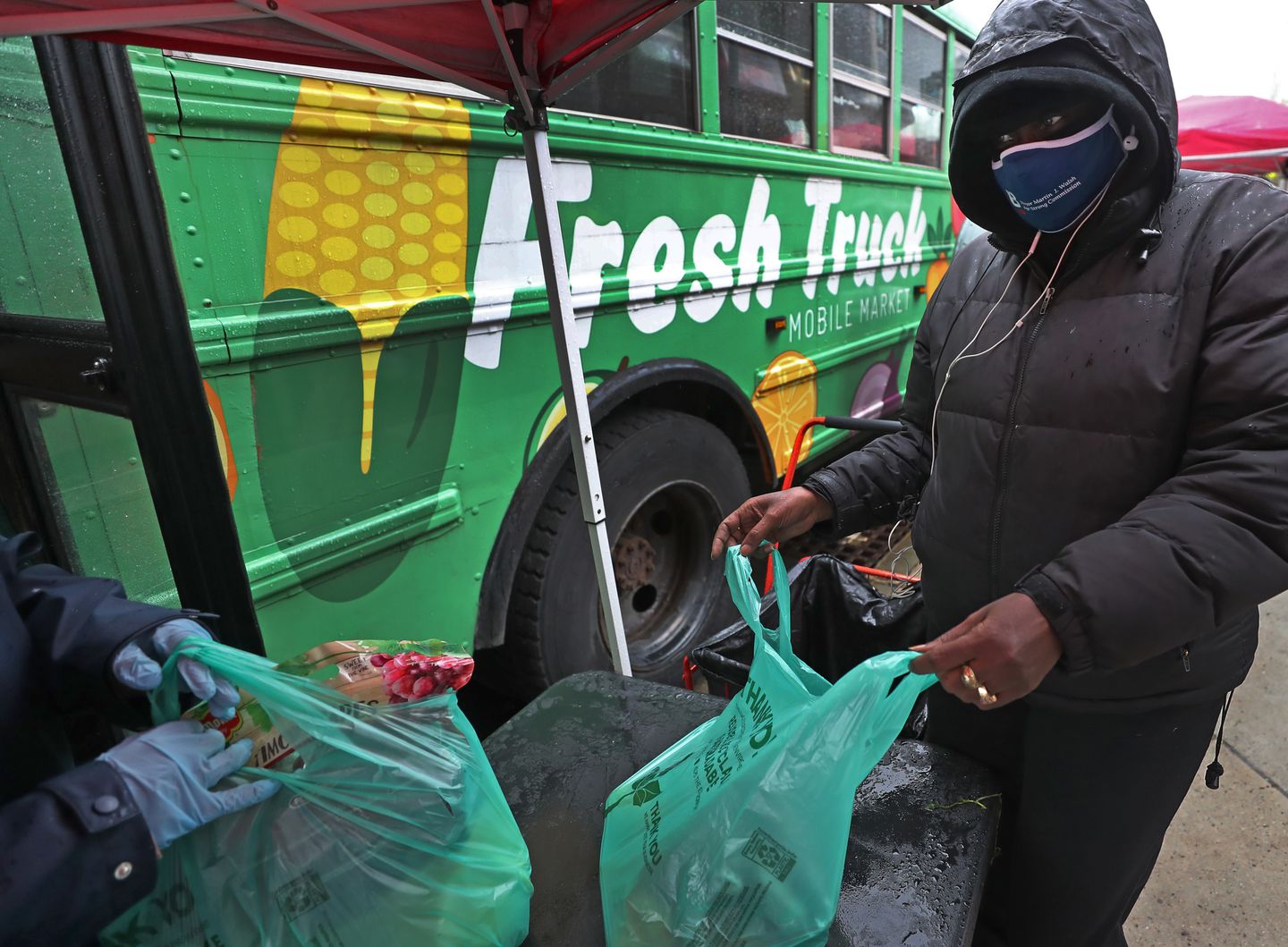
A customer got groceries at the Fresh Truck stop in the Mission Hill neighborhood of Boston.

When I was a kid, my mother sometimes bought vegetables from Mr. Mackey. Mr. Mackey was a “huckster” who came around in an old school bus, repainted blue and outfitted like a produce market. I think my mother patronized this project because it charmed her. Earle and Caroline’s mother, Grace, was more practical. She may have tested Mr. Mackey’s wares once or twice, but she objected that he was overpriced. As indeed he was.

But if nothing else, there’s something to be said for the memories generated by such “old tyme” services. My husband likes to talk about a knife grinder who frequented his childhood neighborhood. And ever since the pandemic inspired me to start getting milk delivered in glass bottles, I feel like I’m not only reducing plastic waste but preserving a happy tradition.

As to repurposed school buses carrying produce, Diana Bravo reports at the Boston Globe about a few that are now serving “food deserts” in the Boston area.

Fresh Truck “co-founder Josh Trautwein was working as a health educator at MGH Charlestown Healthcare Center,” she writes, “when he heard from local families that it was difficult to shop for healthy food because the only local grocery store was shut down for a yearlong renovation. That inspired Trautwein to start About Fresh, which operates a program called Fresh Truck to bring affordable, healthy food into Boston communities that need it most.

“The nonprofit purchases food wholesale, and during the growing season Fresh Truck buys from local growers and resells the food at around the same price to help families keep nutritious food on the table at affordable prices.

“The nonprofit operates three retrofitted school buses that have been converted to mobile grocery stores. The trucks accept a variety of payments. Beyond cash and credit, they also accept Electronic Benefit Transfer, Healthy Incentives Program, and Fresh Connect. … Before the COVID-19 pandemic struck, mobile markets would allow customers to board and shop on the three buses at 18 locations. But at the height of the pandemic, that was not possible. …

“After a brief shutdown, the program reopened with an open-air plan. Now, at most locations, customers order outside the bus while volunteers shop and package their orders.

“Customers order online in advance and pick up their produce at four locations. [Victoria Strickland, director of communications and partnerships for About Fresh,] says this has been beneficial to the nonprofit’s senior and disabled customers. As a result, Fresh Trucks hopes to continue and expand online ordering beyond the end of the pandemic.”

Sure beats food shopping for your family at “convenience” stores, where in addition to pretzels, Coke, and canned soup, a couple hard, bland apples are likely to be unconscionably marked up.

More at the Boston Globe, here. By the way, I have posted a lot of stories on how other people are addressing the challenge of food deserts. Just search on the phrase in the search box above if you’re interested.

Read Full Post »

103019-healthful-foods

Fresh produce in a market that is one of many in an affluent town. Many urban areas in America do not have easy access to such nutritious food.

In many parts of this great land of ours, people go hungry or subsist on junk food because that’s what’s available. I’ve written about food deserts before, and I continue to be interested in how activists and small businesses are addressing the problem.

Brittany Hutson reports at WEDT and National Public Radio (NPR), “On a cold, sunny day in early February, Raphael Wright and his business partner, Sonya Greene, check out a vacant building in Detroit’s Linwood neighborhood. Inside, wood panels are on the floor, and drywall is being placed over exposed brick. The only clue to the building’s past is a sign out front, with the words ‘Liquor, Beepers, and Check Cashing.’

“Located on the west side of Detroit, the Linwood neighborhood remains underdeveloped, with few retail businesses, countless empty lots and many vacant buildings. But Wright and Greene see potential here. It’s why they’ve chosen this neighborhood to open a bodega that sells healthy food. Like other neglected neighborhoods in urban areas, fresh fruits and vegetables aren’t a basic necessity here — they’re a luxury.

“Wright says it’s been that way since he was a kid.

” ‘I was raised in the ’90s, and I always say that we were junk food babies,’ he explains. … ‘Liquor stores, gas stations, and many times fast food restaurants were pretty much our go-to places to eat. … I’m a victim of food insecurity. … I was diagnosed with diabetes at 19, so before I was old enough to have a drink, I was diabetic.’

20190301_120903_rotated_custom-4084ece99773e7951a5621ef21e25cf293963742-s300-c85

Photo: Brittany Hutson/WDET
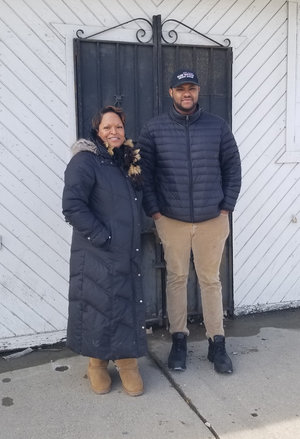
Sonya Greene and Raphael Wright are the folks behind a bodega offering fresh produce, prepared foods and staple items in an underdeveloped Detroit neighborhood.

“Wright wants the bodega, tentatively named the Glendale Mini Mart, to be a pilot for a full-range grocery store he hopes to open in the future. The bodega will offer fresh produce, prepared foods and staple items. He says he hopes it will be part of a larger mixed-use development that will include a barber shop, a beauty salon and housing. …

“Wright and Greene are not the first to recognize the importance of Detroit’s African American residents having access to fresh, reasonably priced food. That awareness began more than 50 years ago, following the rebellion that rocked the city. …

“The riots were the culmination of high levels of frustration, resentment and anger among African Americans due to unemployment, poverty, racial segregation, police brutality and lack of economic and education opportunities. However, there was something else not often discussed — food.

“According to Alex Hill, adjunct professor at Wayne State University in Detroit, there was a ‘fairly expansive hunger issue in the community’ around that time. Hill’s research on the ’67 Rebellion looks at food, power and race. In many ways, it’s the continuation of work that began when the non-profit group Focus: HOPE began studying conditions in Detroit’s black neighborhoods in the ’60s as a response to the riots.

“Focus: HOPE educated the clergy and the white Christian community on racism, poverty and other forms of injustice. In 1968, the organization released a Consumer Survey on Food and Drugs. …

“To get answers, nearly 400 suburban white women and inner-city black women were trained as undercover shoppers and sent to 300 grocery stores in the Detroit metro area. The main findings were that poor inner-city Detroiters were paying up to 20% more for lower-quality groceries. The survey also found that the quality of service, store condition, produce and meats in the city’s chain and independent stores were not of average quality compared to upper-income and suburban stores. …

” ‘In thinking about those disparities and access, those are still very much real. They may look different, but I’d say they’re very much the same from 1967.’ He says … Detroiters travel outside of the city on weekends to larger chain grocers to stock up and use their local grocer for smaller needs, such as eggs or milk, during the week. …

“Wright says the bodega is also about representation.

” ‘We’ve seen our grocery stores not be representative of our communities,’ he says. ‘So putting faces in the community that looked like us, that are from our neighborhoods and understand what we’re going through, it makes the education part easier.’ ”

More at NPR, here.

103019-veggies

Read Full Post »