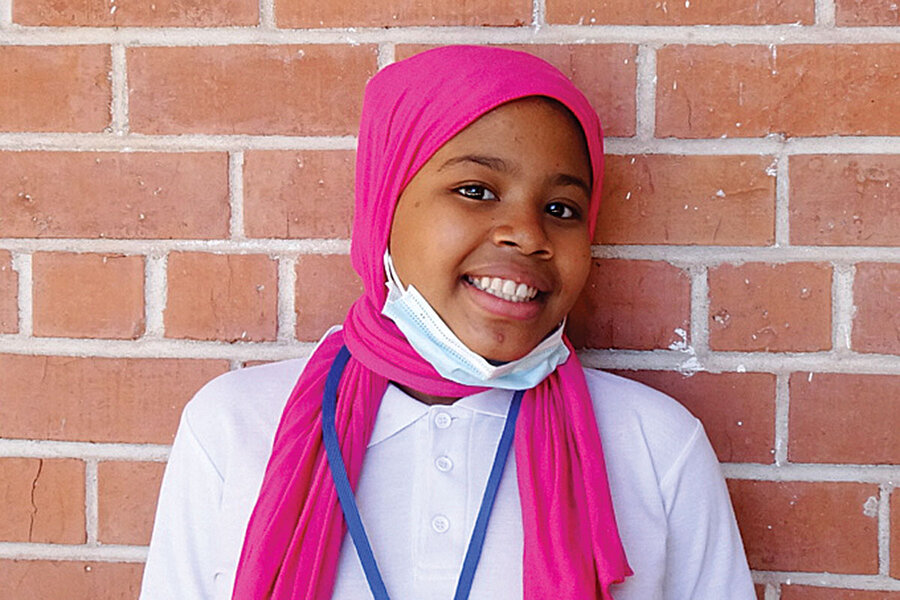
Fifth graders were asked to envision the future. “Everyone will have a new house to live in. It won’t matter how much money you have,” said Falhat Hassan, a student at John B. Wright Elementary School in Tucson, Arizona.
I loved working with fifth graders back when I was a teacher. They are funny, aware of the world, but not yet as rebellious as they are likely to be in a few years.
In a report at the Christian Science Monitor, fifth graders were asked to describe what they expected the world to be like in the future. If you ever get discouraged, hang out with some ten-year-olds.
“One student envisions a watch that tells you when you’re polluting – a sort of eco-nanny on your wrist. Another suggests that teachers might show up in classrooms, not in person, but as holograms. There’s talk of colonies on Mars, and people commuting in flying cars.
“These are among the ideas to emerge from the fertile imaginations of fifth graders across the country thinking about what the world will – or should – look like in 20 years. As the calendar flips to a new year, the Monitor, in collaboration with the Hechinger Report – a nonprofit education news site – had reporters sit down with students in four cities to give us their predictions of and aspirations for the future. …
“What we found is that they harbor plenty of concerns about tomorrow, sure, but they also exude an innate optimism, a sense of delight and possibility. Their visions represent a journey into cybersecurity and space travel, racism and robots.”
Contributor Lillian Mongeau, of the Hechinger Report, wrote about Hillsboro, Oregon. “One idea, for when we colonize Mars, is that all of humanity could spend a few years on the Red Planet to let Earth ‘rest.’
“ ‘And then when we come back, we’ll try better to not pollute as much,’ says Chandler Stark, a fifth grader at Paul L. Patterson Elementary School in Hillsboro, Oregon.
“Chandler estimates it will take two to five years for Earth to recover from what we’ve done to it, at which point we can all return. The idea was met with nods by three of Chandler’s classmates as they sat discussing the future. … Since Mars is not yet ready for human habitation, these kids agreed that cleaning up our current planet was a top concern.
“ ‘The time to fix it is now,’ says Caden Sorensen. ‘It’s not going to fix itself. And if we do end up colonizing Mars, don’t ruin Mars, too.’
“But while the technology necessary to move to Mars seems likely to be a net positive, these children aren’t interested in every new advancement.
“Technology ‘can bring really amazing good things, but those things could bring some other bad things,’ Caden says, noting that he would warn his future children about the downsides.
“Noelani Velasco Polley agrees. She hopes to one day own an iPhone 21, ‘with 21 cameras on it,’ but for now she’s OK not having a phone at all. …
“ ‘I’m really concerned that there’s going to be more electronics … that people can hack, so more identity theft,’ says Fatima Abdi, who prefers to be called Fati. She also worries about artificial intelligence. … Fati worries racism will get worse, and thinks steps should be taken, short of going to Mars, to save the environment. …
“Chandler hopes to one day compose music for TV shows and video games. Fati plans to be a business owner – she already has an Instagram shop where she sells jewelry. Caden is currently aiming to be a lawyer, but figures he’ll probably change his mind. And Noelani wants to be a scientist or an engineer.
“ ‘I think there won’t be that many jobs in fast-food places’ in the future, she says. ‘I think they’re going to be like, bigger jobs, and people are going to want to be in jobs where they can get more money, because in the future everything is going to be more expensive.’ …
“They say the power to create the future rests in human hands. ‘I think there can be more equality in the world if we just work hard for it,’ Fati says.”
Christina A. Samuels interviewed fifth graders in Woodbridge, Virginia, and saw some of the same concerns.
“In 25 years, schools could be multiple stories, connected by elevators and moving walkways. Scientists will have made greater strides in exploring the uncharted ocean depths and the edges of the galaxy. Humans may even have settlements on other planets. …
“Belmont’s math and science focus fosters the students’ interest in the environment, as does their location: Less than 2 miles away is Occoquan Bay National Wildlife Refuge, a habitat for migrating birds and butterflies. At Belmont, fourth and fifth graders get extra lessons in STEM subjects, such as robotics and hands-on science experiments.
“The coronavirus has affected the lives of these children since third grade – Prince William just returned to full-time, in-person learning this school year – but the fifth graders don’t like to imagine the pandemic in their future.
“ ‘Let’s hope the pandemic is over,’ says Jason Rivera. Other viruses may appear, ‘but maybe not very big.’
“Or maybe there will be more warning, Jashua [Alvarado] says. ‘Scientists would be able to tell if a pandemic is going to come to the world like two years before, or one year, or – I don’t know – months,’ she says. …
“The six students … take each question seriously and answer thoughtfully. That’s perhaps not surprising from a group of students who see themselves playing ambitious roles in building a new world in the future – as engineers, doctors, and scientists. …
“ ‘I’m kind of a science nerd and my mom tells me if I want to be a scientist, I have to be working hard for it,’ says Jashua.
“Yanet Hundessa and Anjelica [Jabbie] will be helping other people. ‘I really want to be a doctor because I want to help the elderly,’ Yanet says.
“ ‘I also wanted to be an engineer or a doctor because I love helping people, and I love building things,’ says Anjelica.
“They also plan to take on problems that grown-ups are now leaving behind. ‘Why don’t we focus on other people that live in different places?’ says Ethan [Ong]. ‘There’s people that are poor that don’t have lots of resources and that don’t have food.’ …
“ ‘People could donate to countries that have poor resources,’ says Sam Aphayvong. ‘If the people didn’t get the resources they need, they could become jealous and start wars.’ …
“ ‘I think people should be kind to each other,’ Yanet says. ‘No racism, and they should help out poor people and everybody will be equal.’ ”
More at the Monitor, here. No firewall.

 Suzanne's Mom's Blog