Feeds:
Posts
Comments

Posts Tagged ‘gangs’

Photo: Melanie Stetson Freeman/Christian Science Monitor staff.
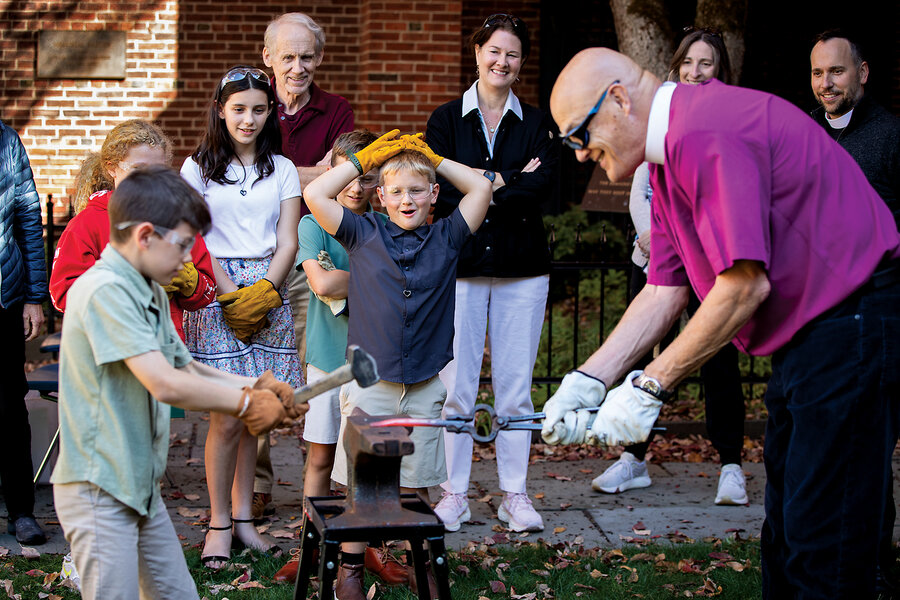
Retired Episcopal Suffragan Bishop Jim Curry, co-founder of the nonprofit Swords into Plowshares, gives a blacksmithing demonstration in Winchester, Mass. The nonprofit’s goal is to get guns off the streets and make young people enthusiastic about peaceful projects.

In a Providence park, there’s a sculpture made from illegal handguns. It’s kind of a depressing pillar to failure, unless you look at it as the removal of guns from circulation. It’s ambiguous, which I guess art is supposed to be.

Here’s a story about an effort to turn young people away from the gun culture of the streets.

Troy Aidan Sambajon writes at the Christian Science Monitor, “Retired Episcopal Suffragan Bishop Jim Curry ignites his propane forge in the courtyard of Parish of the Epiphany church. Slowly he heats the barrel of a dismantled rifle to 2,000 degrees Fahrenheit, and then starts hammering the red-hot metal on his anvil. In minutes, a piece of once-deadly weaponry transforms into a humble weeding tool. 

“Bishop Curry then invites onlookers to try their own hand at making garden tools from firearm parts, using the forge that he takes with him to various communities in the Northeast region. With each strike of the hammer, participants mold a hopeful vision of a future without gun violence.

“Before the demonstration, Bishop Curry gave a sermon explaining the mission of Swords to Plowshares (S2P) Northeast, a nonprofit that he co-founded a decade ago in New Haven, Connecticut. ‘At the forge, we hammer guns into gardening tools and art. We forge rings from shotgun barrels into hearts – symbolizing that the change we need begins in the transformation of our own hearts,’ he told parishioners.

“His work has inspired residents in Connecticut, New Hampshire, and Vermont to start their own independent S2P chapters, which host gun-surrender events in partnership with police departments. Law enforcement officials vet and dismantle the weapons, and then give the parts to the chapters for public blacksmithing demonstrations. Besides raising awareness about gun violence, the demonstrations help get young people interested in blacksmithing.

“Montrel Morrison, who runs a youth mentoring organization in Connecticut, calls S2P Northeast a ‘safe haven and beacon of hope.’ …

“Kam’eya Ingram, who spent the last two summers as a blacksmith with S2P Northeast, says that ‘when someone dies from gun violence, it’s like the world goes quiet.’ But for her, hammering on the anvil fills the silence with a resounding release of emotions. … ‘I feel like I’m bringing people peace – letting them know that one more gun is gone and that this [gun violence] might not happen to someone else.’

“Bishop Curry … studied religion at Amherst College. He graduated in 1970 and started his career working in public schools in Huntington, Massachusetts, as a middle and elementary schoolteacher for 10 years. Yet he longed to serve the spiritual needs of his community.

“That desire led him to the seminary in 1982, and, three years later, he was ordained as a deacon and priest in the Episcopal Diocese of Connecticut. He focused his ministry as a spiritual adviser, working in hospitals with families in Connecticut and addressing the devastating impacts of gun violence and suicide. By 2000, he was elected suffragan bishop of Connecticut. 

“His life ‘changed entirely,’ he says, in the wake of the December 2012 shooting at Sandy Hook Elementary School in Newtown, Connecticut. … Newtown was in his diocese. …

“In early 2013, he joined other Episcopal bishops in Washington, D.C., and helped found Bishops United Against Gun Violence. Through that group, he learned about the Guns to Gardens movement, a network of nonprofits that repurposes unwanted firearms into garden tools and artwork. …

“In 2014, he co-founded his chapter, S2P Northeast, with Pina Violano, a trauma nurse and nursing professor at Quinnipiac University. The group’s namesake peacebuilding mission comes from the Old Testament (Isaiah 2:4): ‘They shall beat their swords into plowshares, and their spears into pruning-hooks.’ …

“S2P Northeast has partnered with a Colorado organization called RAWtools on a nationwide gun-surrender program and, before the COVID-19 pandemic, taught blacksmithing skills to incarcerated people. …

“For Bishop Curry, ‘the real life of the forge’ has been to empower teens from New Haven through summer job opportunities. They are paid to transform guns through blacksmithing and help lead public demonstrations. …

“Jared Sanchez, age 18, takes pride in being a junior blacksmith instead of working a teenager’s typical mundane hustle. In a single day, he can make seven or eight garden tools out of shotgun barrels. He has also created a heart necklace for his younger sister and a cross to sit beside his grandfather’s urn. …

“After two summers serving as a blacksmith alongside Bishop Curry, Mr. Sanchez has come out of his shell and come into his own as a leader. Handling so many firearm parts has revealed to him the depth of the gun violence problem in his community and the work that must be done to combat it.”

More at the Monitor, here. No paywall. Nice pictures.

Read Full Post »

Photo: César Rodríguez.
The New York Times says, “Illegal deforestation for avocado crops points to a blood-soaked trade with the United States involving threats, abductions and killings.

Today’s story about Mexico’s environment-destroying avocado production and thoughtless US demand was concerning. If anyone knows where I can get sustainably grown avocados, please let me know.

Meanwhile, here is the New York Times story. The authors were Simon Romero and Emiliano Rodríguez Mega.

“First the trucks arrived, carrying armed men toward the mist-shrouded mountaintop. Then the flames appeared, sweeping across a forest of towering pines and oaks.

“After the fire laid waste to the forest last year, the trucks returned. This time, they carried the avocado plants taking root in the orchards scattered across the once tree-covered summit where townspeople used to forage for mushrooms.

“ ‘We never witnessed a blaze on this scale before,’ said Maricela Baca Yépez, 46, a municipal official and lifelong resident of Patuán, a town nestled in the volcanic plateaus where Mexico’s Purépecha people have lived for centuries.

“In western Mexico forests are being razed at a breakneck pace and while deforestation in places like the Amazon rainforest or Borneo is driven by cattle ranchinggold mining and palm oil farms, in this hot spot, it is fueled by the voracious appetite in the United States for avocados.

“A combination of interests, including criminal gangs, landowners, corrupt local officials and community leaders, are involved in clearing forests for avocado orchards, in some cases illegally seizing privately owned land. Virtually all the deforestation for avocados in the last two decades may have violated Mexican law, which prohibits ‘land-use change’ without government authorization.

“Since the United States started importing avocados from Mexico less than 40 years ago, consumption has skyrocketed, bolstered by marketing campaigns promoting the fruit as a heart-healthy food and year-round demand for dishes like avocado toast and California rolls. Americans eat three times as many avocados as they did two decades ago.

“South of the border, satisfying the demand has come at a high cost, human rights and environmental activists say: the loss of forests, the depletion of aquifers to provide water for thirsty avocado trees and a spike in violence fueled by criminal gangs muscling in on the profitable business.

“And while the United States and Mexico both signed a 2021 United Nations agreement to ‘halt and reverse’ deforestation by 2030, the $2.7 billion annual avocado trade between the two countries casts doubts over those climate pledges.

“Mexican environmental officials have called on the United States to stop avocados grown on deforested lands from entering the American market, yet U.S. officials have taken no action, according to documents obtained by Climate Rights International, a nonprofit focused on how human rights violations contribute to climate change.

“In a new report, the group identified dozens of examples of how orchards on deforested lands supply avocados to American food distributors, which in turn sell them to major American supermarket chains.

“Fresh Del Monte, one of the largest American avocado distributors, said the industry supported reforestation projects in Mexico. But, in a statement, the company also said that ‘Fresh Del Monte does not own farms in Mexico,’ and relied on ‘industry collaboration’ to ensure growers abided by local laws.

“In western Mexico, interviews by the Times with farmers, government officials and Indigenous leaders showed how local people fighting deforestation and water theft have become targets of intimidation, abductions and shootings.

“Like deforestation elsewhere, the leveling of Mexico’s pine-oak and oyamel fir forests reduces carbon storage and releases climate-warming gases. But clear-cutting for avocados, which require vast amounts of water, has ignited another crisis by draining aquifers that are a lifeline for many farmers.

“One mature avocado tree uses about as much water as 14 mature pine trees, said Jeff Miller, the author of a global history of the avocado.

“ ‘You’re putting in deciduous forests of a very water hungry tree and tearing out conifer forests of not so very water hungry trees,’ Mr. Miller said. ‘It’s just wrecking the environment.’

“In parts of Mexico already on edge over turf wars among drug cartels, forest loss is fueling new conflicts and raising concerns that Mexican authorities are largely allowing illegal timber harvesters and avocado growers to act with impunity.”

Bad as things are in Mexico, you know they would not be happening if there was no demand. That’s on us. Read more at the Times, here.

Because I still hope to have an avocado from time to time, I went looking for advice. The Eco Experts in the UK say, “Although avocados aren’t the worst food for the environment, growing them on a mass scale isn’t sustainable. This is because of the large amount of water they need to grow, and the fact that they can’t be grown locally in countries like the UK, where they are in high demand. The solution isn’t to cut avocados out of our diets altogether, but to reduce the amount that we consume.” More from the experts, here.

Read Full Post »

Photo: Victoria Onelien/Special to the Christian Science Monitor.
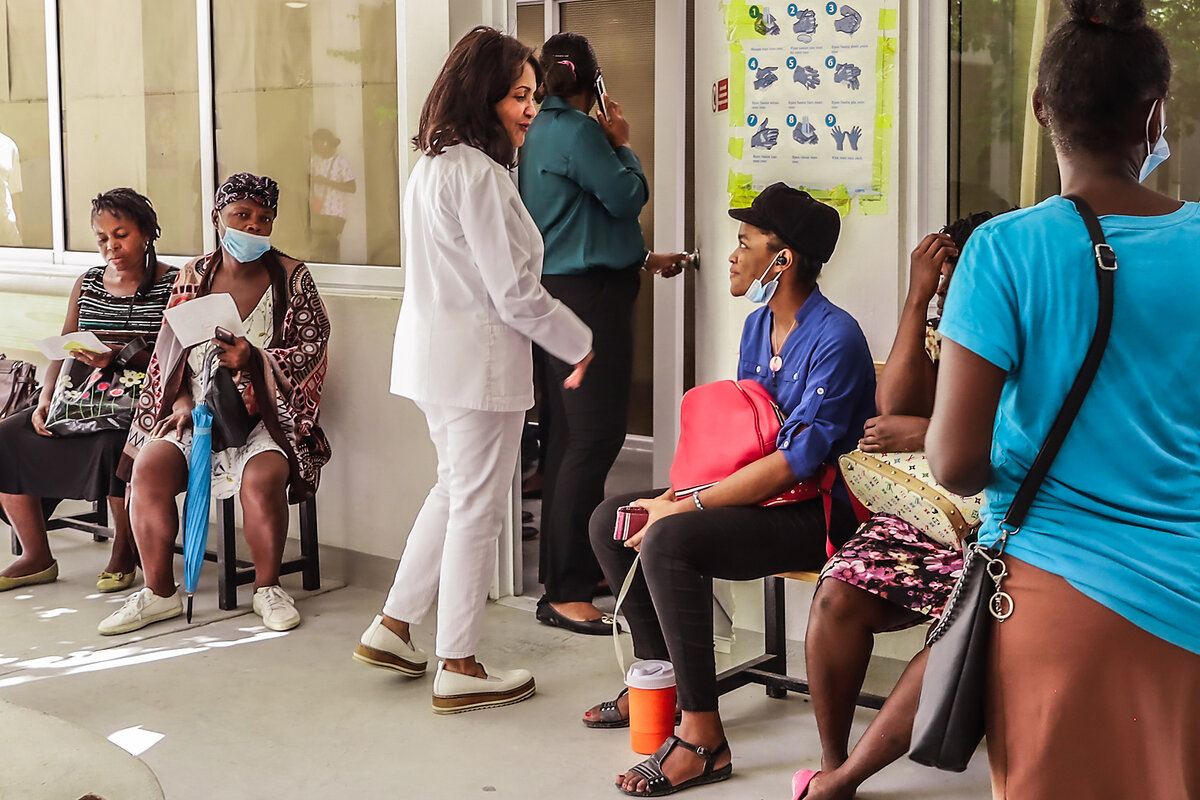
Dr. Marie-Marcelle Deschamps walks through the medical area of the Gheskio center, welcoming patients, in Port-au-Prince, Haiti, in July.

It’s hard to imagine that in a country ruled by armed gangs like Haiti, a doctor keeps doing her work “without fear.” Would we be without fear if our country were taken over by armed gangs?

Linnea Fehrm writes at the Christian Science Monitor, “Marie-Marcelle Deschamps was speaking at a conference in Washington last spring about her work running one of Haiti’s most innovative hospitals when the startling news started spilling in: Criminal gangs were releasing incarcerated people from a prison in Port-au-Prince, police stations and government buildings were under attack, and the international airport was shuttered. …

“ ‘Every day that I can’t go back is a catastrophe for me,’ she said with a sigh, speaking from her hotel room in Miami several weeks later, where she was anxiously awaiting the possibility of flying back to Haiti. ‘I can’t sleep at night. My staff are struggling, people are dying.’ …

“Dr. Deschamps is co-founder and deputy executive director of Gheskio, a hospital in Port-au-Prince known by its French acronym, where she has worked for the past 42 years. It’s not a typical clinic; it looks beyond physical health to tackle issues such as education, women’s leadership, job training, and community-building. …

“The doctor has guided the organization through earthquakes, epidemics, state coups, and political unrest. But when she finally returned to Port-au-Prince in April, she says she was faced with the most severe crisis she has ever seen. Hundreds of thousands of Haitians had fled their homes due to insecurity, many of whom began flooding her hospital in search of safety and treatment. Some people arrived close to starving, others with gunshot wounds, she says. …

“Gheskio is in downtown Port-au-Prince, adjacent to an enormous, gang-controlled area known as the City of God. The dusty access roads are teeming with heavily armed gangs, whose ranks have been reinforced by people who have escaped from prison. They regularly block the roads and kidnap people from passing cars. …

“Only a handful of hospitals have survived the past year’s violence in Port-au-Prince, according to Jean Bosco Hulute, head of UNICEF’s health program in Haiti. About a five-minute drive from Gheskio is the State University of Haiti Hospital, the largest health facility in the country. For more than four months this year, it was under gang control; doctors and patients were chased off the grounds and wards were looted of everything from medical supplies to ceiling fans. 

“Gheskio receives some funding and equipment from UNICEF, requiring Mr. Hulute to occasionally visit. These trips require ‘careful planning and authorization from the head office’ for safety purposes, he says.

“ ‘Dr. Deschamps, however,’ he says with a chuckle, ‘she just takes her car and drives there.’ 

“She holds weekly meetings with local community representatives, helping to earn respect for her organization’s work – even among gang leaders. When armed men on the street see her hospital ID, they let her pass, she says. …

“Today, the Gheskio grounds are like an oasis amid Haiti’s political and security-related chaos. Dr. Deschamps says she comes here to regain her strength, surrounded by green lawns, verdant gardens, and birds chirping from towering palm trees. …

“Shortly after founding Gheskio, Dr. Deschamps was selected by a group of Haitian and American doctors to study in the U.S. There, she trained under Dr. Anthony Fauci, who would later become a household name during the COVID-19 pandemic.

“ ‘He always had a positive attitude, so we were similar in that way. It has become a strategy in my life to team up with positive people.’ “

Just think of the comfort that her attitude must give to patients!

More at the Monitor, here. No paywall. Subscriptions are reasonable.

Read Full Post »

The Eastman School of Music in Rochester, New York, has an entrepreneurial competition they call the Eastman New Venture Challenge.

This is how it got started: “The Institute for Music Leadership (IML) received a major part of a $3.5 million grant to the University of Rochester from the Ewing Marion Kauffman Foundation to support entrepreneurship education. The IML’s focus in ‘entrepreneurship in music’ is helping students learn how to turn promising ideas into enterprises that create value.”

Award winners Marissa Balonon-Rosen and Lauren Petrilli came up with the Pianos for Peace Project.

According to the Eastman website, Pianos for Peace “follows the idea that by actively involving people in music, we can make for a more peaceful community. This summer, about 10 pianos (upright and baby grand) will be placed throughout the City of Rochester (mostly outdoors) for anyone to play. They will be placed in several different neighborhoods, including those that generally do not have much access to the arts or pianos.

“Youth, local artists, and community members will work together to paint the pianos peace themed. After a couple weeks, we will create a ‘Piano Park for Peace’ by placing the pianos outdoors at the Gandhi Institute for Nonviolence … . There will be several events to bring the community together through music and peace — free piano lessons, yoga, lectures about nonviolence, etc. The surviving pianos will then be donated to youth-focused and nonviolence-focused organizations.”

I once read about something similar in New York City, here. The British artist Luke “Jerram got the idea at his local coin-operated laundry, according to a website about the project. He saw the same people there every weekend, but none of them talked to each other. He thought a piano might help bring people together in places like that.”

The Pianos for Peace Project seems to be building on that idea. Read more about Marissa Balonon-Rosen and Lauren Petrilli, here.

Photo: Suzanne’s Mom
Until Eastman posts pictures of the Pianos for Peace, this one in a public space will have to do. Who can tell me where it is?

random-piano-for-anyone

Read Full Post »

I was hoping to see this documentary before writing about it, but can’t get it from Netflix.

Have you heard of The Interrupters? It’s about street workers in Chicago, former gang members, who try to stop violence by, if necessary, literally “interrupting” a fight. They are trying to atone to some extent for their own past and are working to keep other young people from making the same mistakes.

As Saul Austerlitz writes in the Boston Globe, one can “see the possibility of redemption, even in those seemingly beyond it, and to bear witness to the hesitant first steps taken by young men and women toward a better future. …

“If anything truly surprised [the filmmakers], it was how much they enjoyed making this film, somber subject matter to the contrary. ‘We got to hang out with people who are amazing, inspiring, funny, fun to be around,’ says James, ‘and who have made this incredible journey in their lives, and we got to bear witness to people beginning their own journey in that way.’

“Cajoling, hectoring, relentlessly interrogative, interrupters like Ameena are moral arbiters by virtue of their own experiences. ‘They have moral authority without moralizing,’ says James. Understanding their struggles to come to grips with their own pasts, we also understand their motivation.” Read more here.

Read Full Post »