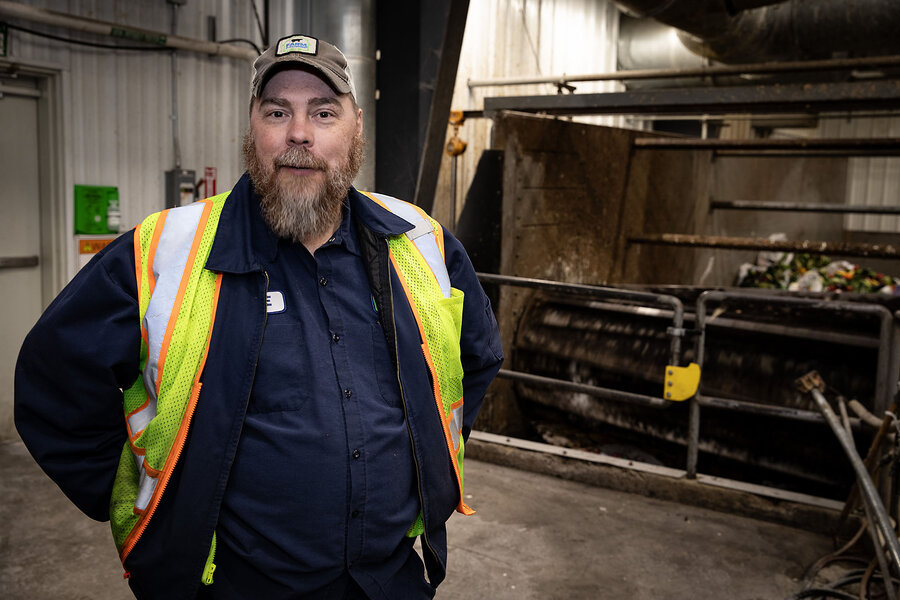
Photo: Melanie Stetson Freeman/CSM.
Abe Marciniec is the site manager of Vanguard Renewables, an organics recycling facility in Agawam, Massachusetts. It processes food waste from supermarkets, distribution centers, universities, and residential drop-offs, turning it to fuel.
Today’s story about Massachusetts being the only state to reduce food waste would seem to be a triumph, and in terms of intentions, it is. But I am ambivalent about the value of turning food waste into gas. Methane, after all, is one of the worst. See what you think.
Troy Aidan Sambajon reports at the Christian Science Monitor, “On a recent Thursday, Abe Marciniec unloads two dozen pallets of ice cream – enough to fill 31 refrigerators – into a machine that transforms it into fuel.
“Today’s flavor is room-temperature rocky road, but this facility handles all kinds of food waste from supermarkets, distribution centers, universities, and even residential drop-offs.
“ ‘We get everything you can find in Aisles 1 through 12,’ says Mr. Marciniec, site manager of the Agawam Organics Recycling Facility, owned and operated by Vanguard Renewables. Mr. Marciniec’s recycling facility is one of six in the commonwealth and only one of 25 nationwide.
“As the expired ice cream funnels into a turbo separator, Mr. Marciniec watches the machine strip food from its packaging. The organic waste is then trucked to a dairy farm, where it’s mixed with cow manure and processed into renewable natural gas.
“ ‘It’s really a great circle,’ says Mr. Marciniec. ‘Food starts at the farm, and our farms turn it back into energy. Farm to table, then back to farm.’ …
“Facilities like this one, which can process up to 250 tons of food waste daily, replace manual work typically done by hand or not done at all. That’s a crucial step in diverting waste away from landfills. Americans throw out about 40% of food annually – a waste of both money and natural resources. Reducing food waste can increase food security, promote resource and energy conservation, and address climate change.
“The Bay Sate has become a leader in reducing food waste. In fact, it’s the only state to significantly do so – to the tune of 13.2% – according to a 2024 study. Massachusetts was among the first five states to enact a food waste ban in 2014. (The others were California, Connecticut, Rhode Island, and Vermont.)
“ ‘The law has worked really well in Massachusetts,’ says Robert Sanders, an assistant professor of marketing and analytics at the University of California San Diego and co-author of the study. ‘That’s due to three things: affordability, simplicity, and enforcement.’
“[Food waste is] the largest category of waste – at 25% – sent to landfills in the United States. In 2019, 66 million tons of food waste came from retail, food service, and households. Around 60% of this waste was sent to landfills, according to the Environmental Protection Agency.
“Vanguard Renewables specializes in turning organic waste into renewable energy. The Massachusetts-based company partners with dairy farms to convert food scraps and manure into biogas through anaerobic digestion.
Microorganisms in cow manure digest organic matter, releasing biogas – a mix of methane and carbon dioxide.
“The gas is captured in large steel vats on the farm and refined into renewable natural gas, which can be used to heat homes and power buildings. … Since 2014, Vanguard has processed more than 887,000 tons of food waste in New England, producing enough natural gas to heat 20,000 homes for a year. By 2028, the company plans to have more than 50 systems across the country.
“In western Massachusetts, Amherst College has become a model for limiting food waste at the source. Last year, it was recognized as the winner in the zero waste category in the Campus Race to Zero Waste Case Study Competition.
“ ‘The goal has been to push us aggressively to make sure everything is compostable,’ says Weston Dripps, director of sustainability. To achieve that, the school has phased out single-use plastics, to-go boxes, and even canned water, replacing them with refill stations and compostable materials.
“In 2023, Amherst College generated 238 tons of food waste – roughly 4 to 5 tons per week. But instead of ending up in landfills, Vanguard collected 100% of that waste and processed it at its Agawam facility.
“That total includes both pre-consumer waste – such as kitchen scraps from food prep – and postconsumer waste, like leftovers scraped off plates in the dining hall and campus cafés. ‘To really have a clean waste stream, we have to focus on the front end,’ says Mr. Dripps.
“Amherst’s approach goes beyond composting. Each month, the school donates 2,000 to 3,000 pounds of frozen surplus food to the the Food Bank of Western Massachusetts, ensuring edible food reaches those in need.
“Commercial businesses, too, are finding ways to cut down on waste. Maura Duggan, founder and CEO of Fancypants Baking Co., knows firsthand how much food can go to waste in the food industry. Her company produces hundreds of thousands of cookies each week.
“At its Walpole facility, Fancypants has large totes from Vanguard, which collect burnt cookies, food scraps, and anything that can’t be donated or sold. Last year alone, Fancypants diverted about 22 tons of waste. …
“Back in Agawam, Mr. Marciniec passes by 275-gallon totes full of leafy vegetables. Every day, he faces the reality that Americans waste 92 billion pounds of food a year – enough to make 145 million meals.
“ ‘It really makes you think about the things we take for granted,’ he reflects.
“ ‘Millions of people are starving everywhere, and the amount of food waste in this country is substantial,’ says Mr. Marciniec. ‘I’m sure we can do a better job.’ ”
Although I hate to quibble with this effort to at least do something, I know that enforcement has not reached my residential facility yet. Moreover, I’m pretty sure what we really need is not to have so much waste in the first place. What do you think? Is this a good first step?
Note Earle’s comment on my earlier post about this process, here.
More at the Monitor, here.

 Suzanne's Mom's Blog