Photo: Brian Otieno/The Guardian.
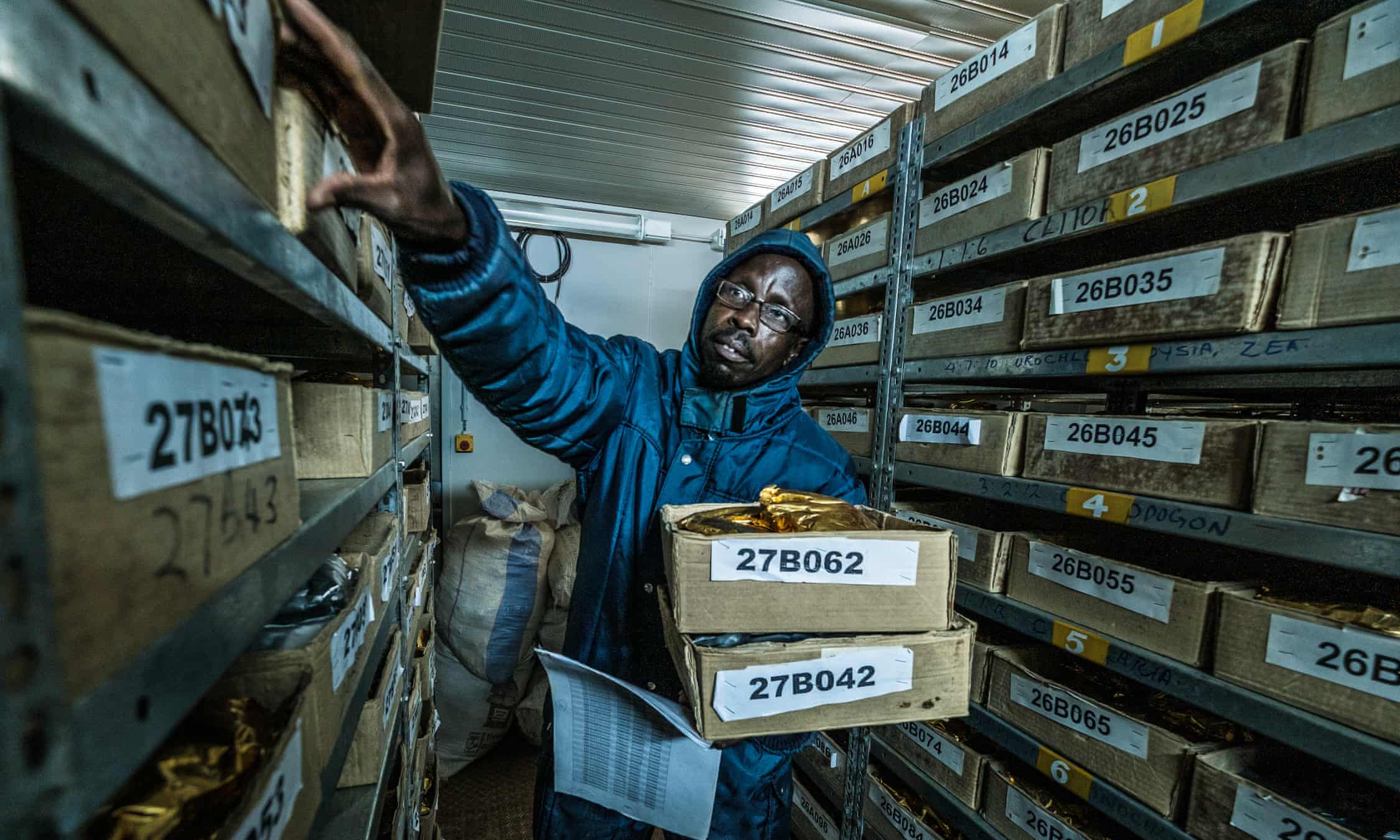
John Okemer, a seed technician, arranges some of the thousands of seeds stored inside Kenya’s gene bank.
As our wounded planet hurtles through space, what should we take with us to replicate the better things as needed? Noah took two of each animal, bird, fish. Some of our contemporaries are taking seeds.
Caroline Kimeu writes at the Guardian, “On a winding road in the densely forested Kikuyu highlands of south-central Kenya lies a nondescript government building: the Genetic Resources Research Institute. Opened in 1988, during the country’s ‘green revolution,’ this little-known national gene bank was set up to hold and conserve seeds from the traditional crops that were in danger of disappearing as farmers and agricultural industry moved to higher-yield varieties.
“For decades, it has collaborated with researchers studying crop genetics and others working to develop improved varieties. But as the climate crisis worsens food insecurity, the repository of about 50,000 seed and crop collections could become a lifeline for farmers.
“ ‘We were established as a conservation unit, but these are unusual times with climate change, so we’ve had to diversify our work to respond to needs,’ says Desterio Nyamongo, who runs the institute. ‘Given the erratic weather these days, smallholder farmers need a diverse mix of crops.’
“Through a project with the Crop Trust organization the gene bank is now playing a part in the comeback of indigenous crops that are resistant to drought and pests, but fell from favor and have been neglected for decades.
“It stores backups of its most unique seeds at the Svalbard global seed vault in Norway, where it has been sending collections since 2008. The international repository contains more than a million seed samples from around the world.
“Matthew Heaton, the project manager for Crop Trust’s Seeds for Resilience program, says: ‘National gene banks can be overshadowed by the larger international ones, but they are best positioned to quickly improve local resilience and nutrition because their collections are adapted to local needs and growing conditions.’
“The national gene bank is a small operation, with few staff and limited funding, and its cold rooms, which plant scientists say contain only a third of the country’s plant diversity, are almost full. The Seeds of Resilience project, launched in 2019, has supported national gene banks in Ethiopia, Ghana, Kenya, Nigeria and Zambia with financial and technical support to keep resilient, healthy and nutritious crop collections, and to increase their support for farmers. …
“Farmers from the village of Obucuun in rural Busia county, on the border of Kenya and Uganda, say that before sourcing new sorghum varieties from the gene bank, growing the cereal had become challenging. Attacks by flocks of weaver birds, which can ravage entire cereal fields, increased in frequency after the wild grasses preferred by the birds became more scarce as a result of the climate crisis.
“Ruth Akoropot, a 50-year-old farmer from the area, spends hours each day watching over her crops during peak hours of attack, after studying the birds’ behavior patterns for years.
“ ‘If you don’t do that, your crop will be wiped out,’ says Akoropot, who runs the women’s sorghum farmers association, which sells bales of the grain to Kenya’s national beer brewery. …
“Most of Busia’s population rely on farming for food and to make a living, but … a number remain vulnerable to food insecurity. Flooding in April and May [in 2024] swept away farmers’ seeds and yields, exacerbating poor agricultural productivity. Old improved crop varieties sourced from the gene bank, such as Kenya’s red-headed sorghum okoto, which farmers say is less prone to bird attacks, have become community favorites in Busia after decades of disuse. …
“Tobias Okando Recha, an impact researcher for the Seeds of Resilience program, says: ‘These are crops that farmers don’t need to pump a lot of fertilizer on. With just a little fertilizer, the yield is good and they are more [resilient] than hybrid varieties. …
“Plant scientists say that while the divide between farmers and seed conservationists is narrowing, more needs to be done. …
“ ‘The gene banks are not museums, but a resource for the future,’ says Heaton. ‘By linking them with farmers, we can swiftly build local resilience and food security.’ ”
More at the Guardian, here.

 Suzanne's Mom's Blog