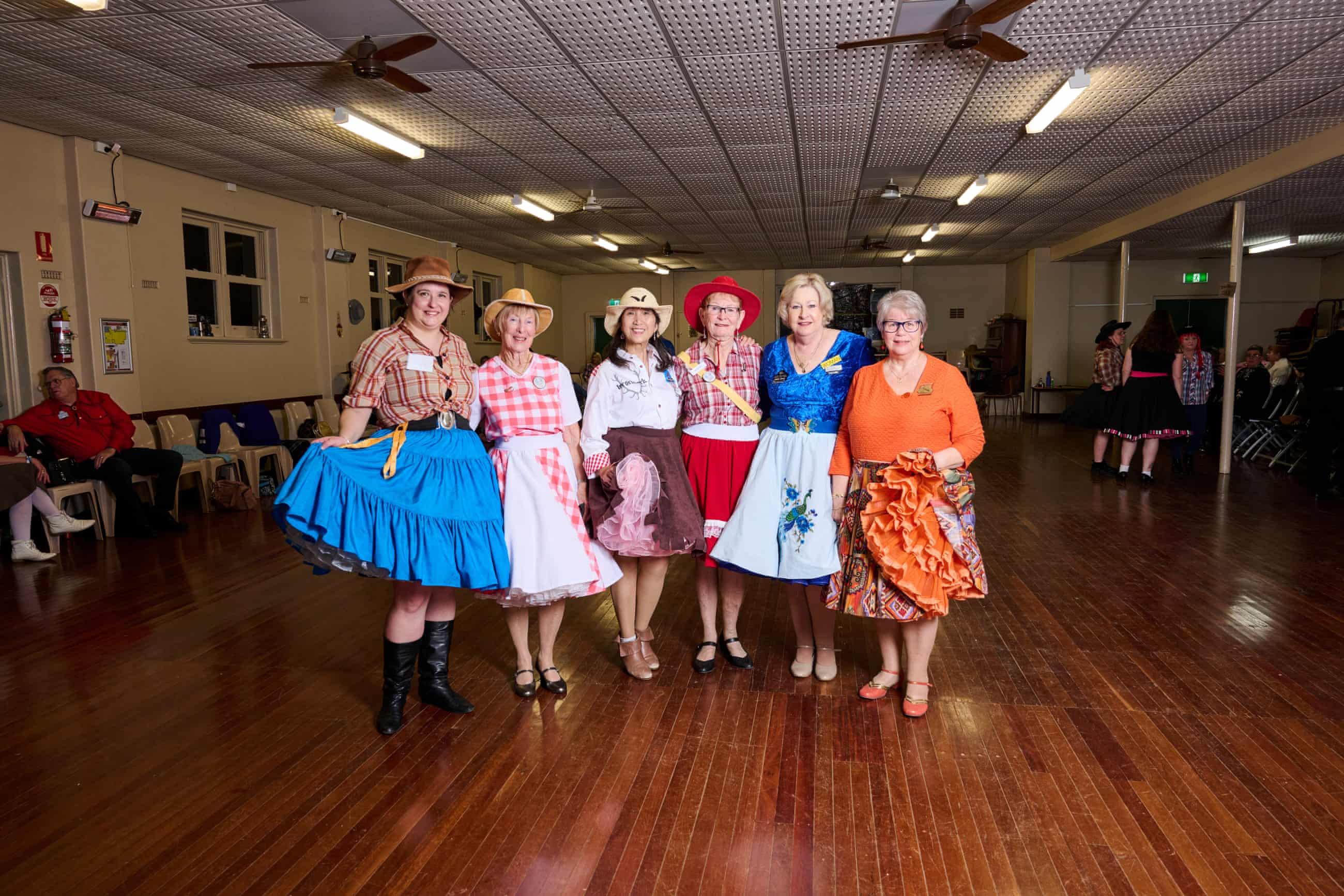
Members of the venerable Gidgegannup’s square dance club near Perth have begun teaching the moves to a new generation.
The topic of square dancing brings both happy memories and uncomfortable ones. The uncomfortable occasions were the result of my mother trying to manage my social life by pressing into service a philosophy professor whose many avocations included square-dance calling. That meant that I, an uncool teenager, had to invite kids I barely knew to an old-fashioned kind of party under her watchful eye.
But in and of themselves, square dances are loads of fun, and I usually got into it despite my reluctance. There’s one I remember as awkward that my little sister remembered as magical.
Today’s story is about square dancing in Australia and how the seniors who love the camaraderie and the exercise are trying to introduce the tradition to a new generation.
Emily Wind writes at the Guardian, “Less than an hour north east of Perth sits Gidgegannup, a small township known for its picturesque hiking trails and agricultural shows – plus a vibrant square dancing community that has endured through the decades.
“Despite the challenges of Covid-19 and declining membership, passionate members of the town’s square dancing club have kept the tradition well and truly alive.
“ ‘We like to see people having a go at square dancing,’ club caller Ken Pike says.
“ ‘It doesn’t matter what age, what race, color, creed or religion … you’re all the same once you’re on the square dance floor and we just want people to have fun.’
“Pike resurrected the Gidgegannup Square Dance Club in 1985 after it closed in the late 70s. He did so after members of the local Country Women’s Association branch showed a keen interest in learning. …
“A square dance involves four couples (eight dancers) dancing together in a square formation. Rather than having to remember a complete routine, dancers only need to learn specific moves that are shouted out by the ‘caller’ in different variations.
“The Gidgegannup club hosts fortnightly dances, each with a different theme. … Rosemary Corbin, the president of the club, said there were about 60 people at the western dance, with many traveling from Perth. …
“Carol and John Parsons first saw an ad for square dancing in the local paper in 1979. They went along and gave it a go with their two daughters and are still going along each fortnight. … For the couple, now both in their 80s, square dancing not only provides them with a fun social activity, but real health benefits by keeping active.
‘Our doctor is thrilled with us; she doesn’t have to worry about us because we get plenty of exercise,’ Parsons said. ‘It is very important for your mental health as well.’
“One of the appeals of square dancing is that it can be done anywhere; once you know the moves, you can attend any club in Australia – or around the world – and dance with strangers as if you’re old friends.
“While there are some dedicated dancers who have attended the Gidgegannup club for decades, numbers have declined in recent years and the group is eager to see more young people get involved so the next generation can learn the moves.”
I actually know someone in Massachusetts who joined community square dancing after her divorce and met a guy there who also thought it might be a fun way to meet people. They have been together for decades now. I don’t know if they are still square dancing.
More at the Guardian, here. No firewall.

 Suzanne's Mom's Blog