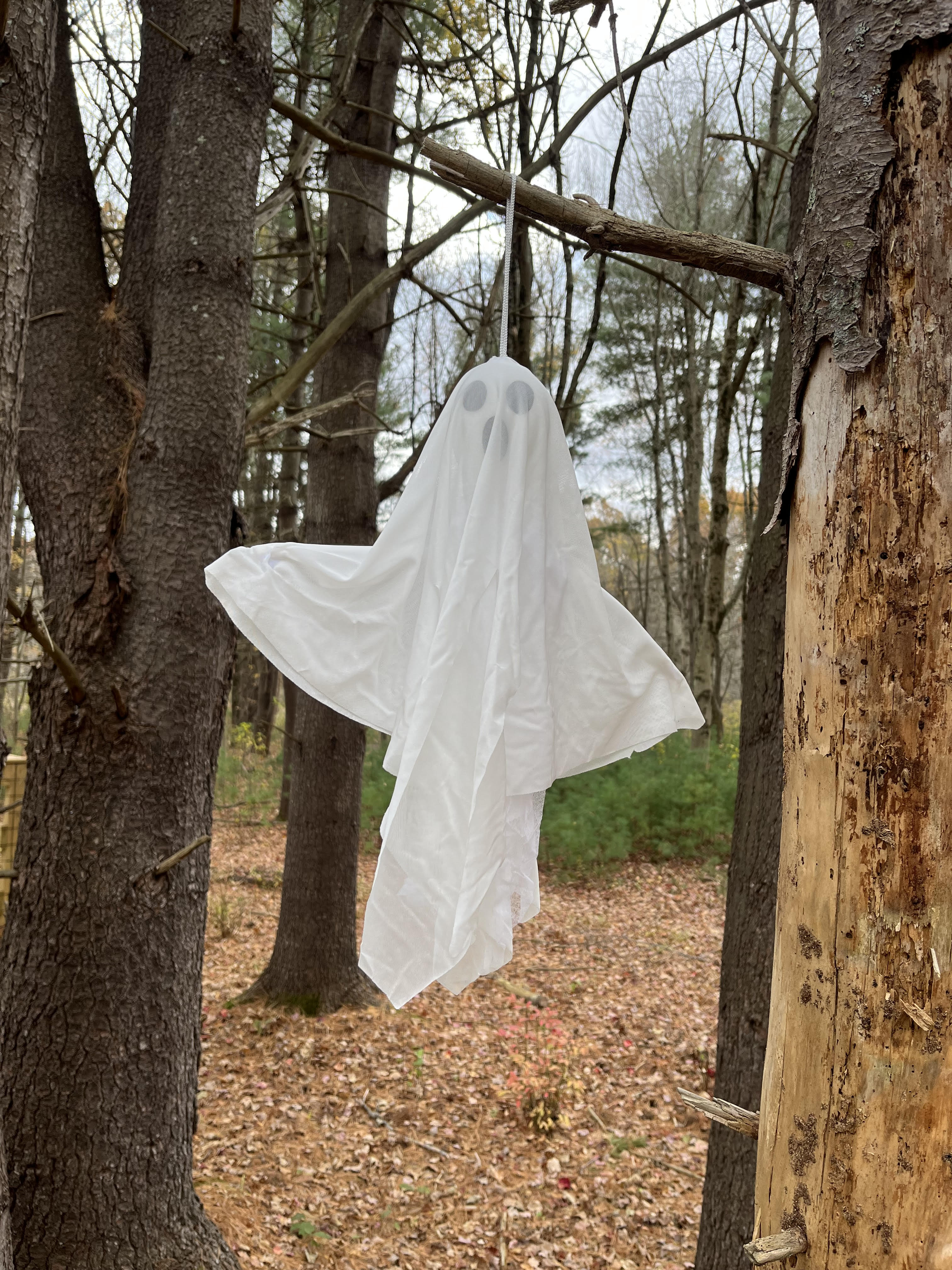
Photos: Suzanne and John’s Mom. A playful resident at our retirement place decorated the woods with little ghosts.
Do you like Halloween? I know some people don’t: they turn out their lights, lock up, and go away for the night. But I have always liked Halloween. I looked forward to it when I was a kid and was planning my costume for weeks, and also as a grownup handing out treats to trick-or-treaters. I especially love seeing the excited little ones in their costumes.
For some years, John has been master of ceremonies for the cutest little costume fashion show in the park near his house, and it’s all about the youngest children.
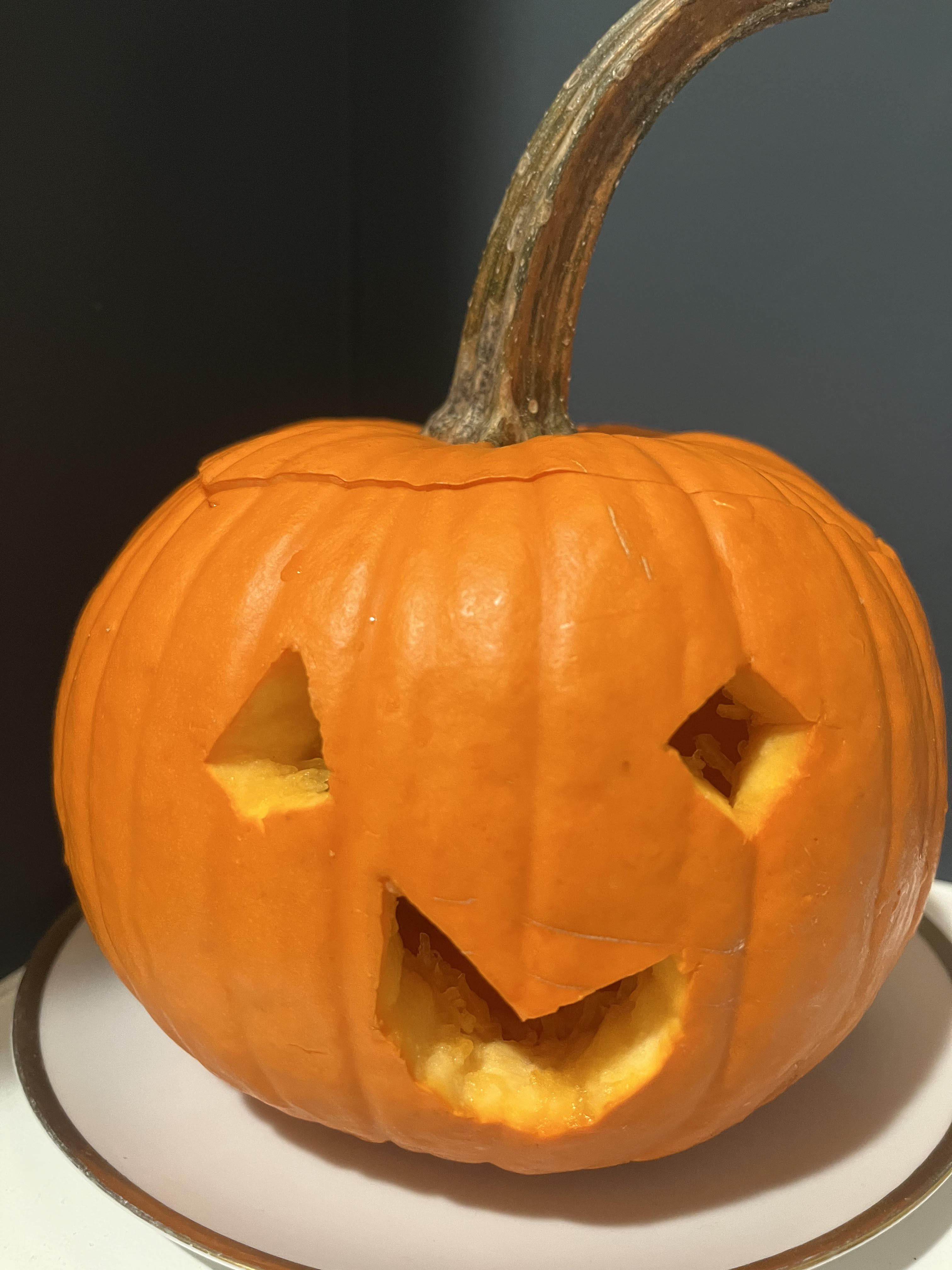
Neighbors everywhere stock up on goodies and hope for a day that’s not too cold or wet. Even come folks in my retirement place put on wigs and costumes, but for me, it’s only Halloween if there are little kids around. My Jack-o-lantern tried its best, but its flashing light didn’t show up in our bright hallway.
Photo: CBS. Topper was a television series based on the 1937 film Topper, which was based on two novels by Thorne Smith. Topper’s house was haunted by the ghosts of the former occupants.
At least as early as Ancient Greek playwrights, thespians have had to find ways to create ghosts onstage — and later, in film. Today’s story for Halloween explains how it can be accomplished.
Margaret Hall writes at Playbill, “Theater has always been good at making the unreal feel like it is in reach. Whether it be transporting an audience across time, space, or even dimension, the suspension of disbelief that theatre inspires is a rife playground for the imagination. Audiences eat up the opportunity to believe in the impossible. …
“That impossible belief has, for centuries, included a glimpse into the afterlife. Be it Hamlet’s ghostly father or the hallucinatory son in Next to Normal, theatermakers love to explore what may be just outside the realm of our awareness. Over the centuries, a whole host of techniques have been developed to demonstrate the concept of ‘spirit’ onstage. …
“Perhaps the most important technical advancement in the art of stage spirits is Pepper’s Ghost, an illusion that has been so successful that it has changed our very conception of what a ghost is supposed to look like.
“Before Pepper’s Ghost, spirits were most commonly portrayed as quasi-corporeal, walking the same floorboards as the living and obeying many of the same rules of physics that govern flesh and blood. After all, how is a ghost supposed to make the haunting sounds of footsteps if their feet never touch the ground?
“Pepper’s Ghost changed all of that. Named for the English scientist John Henry Pepper, who popularized the illusion in the 1800s, the technique is an early example of projection work onstage. … While the Ancient Greeks had to rely on body doubling and shadows to project different forms, Pepper’s Ghost harnessed light. Using a specially arranged room out of view of the audience, a plate of glass would be placed at an angle to reflect the interior of the hidden room out toward the audience.
“While the glass would remain hidden for much of a performance, at key moments the stage lighting would be angled to catch the reflection of a brightly lit actor in the hidden room. The audience would then perceive the hazy projection as a ghostly figure located among the actors on the main stage. Due to the necessary angles needed to make the glass undetectable, it was functionally impossible to make the projected actor appear as though they were standing on the same floor as the actors on the main stage. Instead, a floating ghost was popularized, as was the idea of a ghost fading in and out of visibility (such levels of solid-ness could be adjusted by dimming or brightening the light shone on the hidden actor).
“Pepper’s Ghost immediately became a sensation. Imagine how it must have felt to watch Macbeth swing to strike the ghost of Banquo for the first time, only for his sword to pass through him! … While the technique is now nearly 200 years old, it is still employed across the globe. …
“The principles of Pepper’s Ghost serve as the foundation from which many more digitally based techniques have since developed. The use of reflection, light, and spatial projection are practically the cornerstones for modern stage illusions.
“It’s no secret that projections and LED screens are all the rage on stage these days. Their ability to transform a space with very little transition time is prized, bringing elements of the filmmaker’s toolkit into the theatermaker’s arsenal. While some shows now rely on digital projections (remember Dear Evan Hansen?), many have found a middle ground, blending the digital and the practical to great effect.
“Consider McNeal. … While the dead remain six feet under in the new play, the show does deal with a modern kind of poltergeist: Artificial Intelligence and its impact on the art-making process. McNeal incorporates a number of cutting-edge digital techniques, including deep-fake technology (which digitally alters images and videos of real people), and generative artificial intelligence (which creates images out of written requests).
“At various points in the play, star Robert Downey Jr. is transformed on screens built into the set using deepfakes, appearing at various points to be Ronald Reagan, Winston Churchill, Barry Goldwater, and more. … In McNeal’s climax, director Bartlett Sher strips away the technology, going even further back in theatre illusion history than Pepper’s Ghost to call upon one of the simplest analog tricks: body doubling. After an hour of high concept digital effects, the switch back to practicality is shockingly effective.
“Though digital effects have become more common in recent years, for many ghostly shows, practicality is becoming the hot new trend. After all, when you can’t trust anything you see on a screen, it is easy to yearn for the simplicity of something happening right in front of your eyes. In Les Misérables, the ghostly personages of Fantine and Eponine in the finale are simply played by the original actors draped in white, as are the ghosts of Our Town. …
“While it is important to explore the options new technology can open, it is also key to remember that sometimes, the simplest answer is the smartest.”
More at Playbill, here. Is anyone old enough to remember the ghostly couple (and their ghostly St Bernard) from the 1950s TV show Topper?


 Suzanne's Mom's Blog