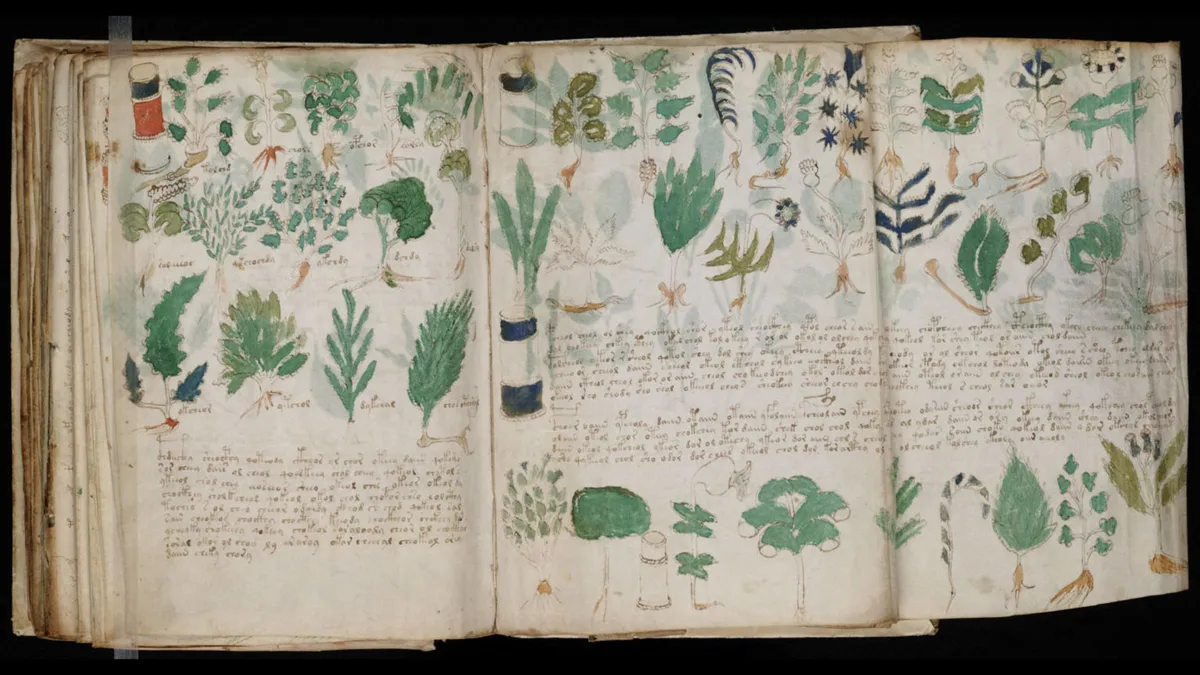
Photo: Art Collection 2 via Alamy.
The Voynich manuscript has never been deciphered.
We love the French tv series called Astrid, whose autistic heroine can solve any puzzle and has never yet been stumped by a mysterious code. I wish Astrid could apply her unique way of thinking to the puzzle described in today’s article because skepticism about the solution remains.
Tom Metcalfe writes at Live Science, “A unique cipher that uses playing cards and dice to turn languages into glyphs produces text eerily similar to the glyphs in the Voynich manuscript, a new study shows. The finding suggests that an equivalent cipher could have been used to create the mysterious medieval manuscript.
“The new cipher — called ‘Naibbe,’ from the name of a 14th-century Italian card game — does not decode the medieval Voynich manuscript, but it offers an idea for how the manuscript was made.
“The Voynich manuscript, which has been radiocarbon-dated to the 15th century, contains roughly 38,000 words written in glyphs that have never been translated. Despite more than a century of intense scrutiny, the manuscript has not been explained conclusively. However, it continues to intrigue people, with its bizarre and inexplicable illustrations of plants, astrology and alchemy, including supposedly ‘biological’ depictions of bathing naked women.
“In the new study, published Nov. 26 in the journal Cryptologia, science journalist Michael Greshko investigated one way the manuscript may have come together. He told Live Science that he got the idea for the Naibbe cipher while researching stories about the Voynich manuscript. …
“Naibbe first uses the number from the throw of a die to break a block of Italian or Latin into single and double letters — so “gatto” (Italian for “cat”) could become “g”,”at” and “to.” The cipher then uses the draw of a playing card to determine which of six different tables is used to encrypt the letters into ‘Voynichese’ — the strange and undeciphered glyphs that are apparently grouped into words in the manuscript. The tables are ‘weighted’ by the corresponding number of cards so that the statistical occurrence of the mock-Voynichese glyphs is the same as seen in the manuscript itself.
“Greshko’s effort is among the leading attempts to explain how the manuscript was made. But it still only approximated Voynichese text, rather than fully replicating it, he said. …
“The manuscript now lies at a nexus of attempts to understand lost languages, yet experts are not entirely sure if Voynichese is even real.
“One theory, taken seriously, is that the manuscript is a medieval hoax, illustrated with suitably mysterious and salacious drawings, and that the text of Voynichese glyphs is completely meaningless.
“The hoax theory has grown stronger in recent years as more attempts to decipher Voynichese — some of which have used machine learning and other computerized artificial intelligence methods — have failed to crack the code, if there is a code.
“But theories that Voynichese is based on a real language and can be deciphered are still prominent, and Greshko’s Naibbe cipher is one of the closest attempts yet.
“The mock-Voynichese output of the Naibbe cipher has several important similarities to true Voynichese. … Those commonalities suggested that a similar method was used to create the original Voynich manuscript, Greshko said. …
” ‘Dice and playing cards were chosen as sources of randomness because it was essential for the cipher to be ‘hand-doable’ with the technology of the time. …
” ‘My hope is that this becomes adopted as a computational benchmark,’ Greshko said. ‘The points of difference between the cipher and the manuscript may point the way to how the text was actually created.’
“Former satellite engineer René Zandbergen, a renowned expert on the Voynich manuscript who was not directly involved in Greshko’s study, said he appreciated Greshko’s efforts to create an encoding method to approximate Voynichese.
“But Greshko ‘also makes it clear that he is not suggesting that this is how the manuscript text was generated,’ Zandbergen said in an email. ‘He just demonstrates that such a method can be found, and we may assume that there may be others.’ Zandbergen added that he is ‘essentially undecided’ about whether the Voynichese text is meaningful or a hoax.”
More at Live Science, here.

 Suzanne's Mom's Blog