Feeds:
Posts
Comments

Posts Tagged ‘Goodwill’

Photo: Christie’s Images Ltd. 2025.
Eva Hesse, “Landscape Forms” (1959).

If you found a painting you loved in some cheap second-hand shop, what would you do with it? Even if it turned out to be valuable? I think if I bought it because I loved it, I’d want it on my walls. Everything in the world is not valued only in terms of gold.

In April, Laurie Gwen Shapiro reported at Hyperallergic about a brother-sister team who are in it for the gold.

“One afternoon last fall, 55-year-old Kara Spellman was working from her Upper East Side apartment when her phone pinged. Her big brother Glenn, 58, a longtime licensed appraiser and self-described ‘picker,’ who lives in the same building, had texted a photo and a short message: ‘Take a look at this.’

“The image was of a small abstract painting — 30 by 24 inches — titled ‘Landscape Forms’ and newly listed on ShopGoodwill.com, the online auction wing of the national thrift store chain. The brushwork was gestural, the color palette felt just right, and in the lower-right corner, a signature: E.H.

“Glenn had a hunch. Kara, director of Estates and Acquisitions at Hollis Taggart Gallery in Chelsea, had a stronger one.

“ ‘We both have a good eye,’ she told Hyperallergic, laughing. ‘The brushwork looked too specific to be a copy.’

“But instinct wasn’t enough. The siblings, who’ve teamed up before on treasure hunts, needed the catalogue raisonné — the official compendium of an artist’s authenticated work.

“Kara emailed the Watson Library at the Metropolitan Museum of Art and begged them to pull the volume by the end of the day. Miraculously, someone she knew replied right away: They’d do it. She jumped in a cab.

“ ‘There it was,’ she said. ‘Landscape Forms’ (1959). Signed. Documented. And officially marked: ‘Whereabouts Unknown.’

“The only visual in the book was an off-color image made from an unmarked slide in the artist’s papers at Oberlin College’s Allen Memorial Art Museum. In fact, as noted in the catalogue raisonné, it’s ‘one of 15 paintings known only by unmarked slides’ included in that archive. But it matched exactly. And it was lost for decades until it popped up at a Goodwill warehouse in Frederick, Maryland.

“The Jewish artist Eva Hesse, born in Hamburg in 1936, escaped the Nazis as a child via the Kindertransport to London with her sister. Their desperate parents followed soon after, and the family eventually resettled in New York. Hesse would go on to become one of the most influential figures of the postwar American avant-garde. Best known for her radical, impermanent sculptural work in materials such as latex, fiberglass, and cheesecloth, she died in 1970, at just 34. Fragile and emotionally charged, her most important pieces helped define Post-Minimalism and, though rarely offered at auction, have sold for millions. Most are held in the collections of major museums.

“But before all that, Hesse painted. ‘Landscape Forms,’ made while she was an MFA student at Yale under Josef Albers — who affectionately called her ‘my little colorist’— is part of that rare early body of work. …

“And then one day, it was gone. Was it lost? Stolen? A gift quietly passed along, then forgotten?

“ ‘I’m not an artist,’ Glenn said in a phone call late at night after a grueling 10-hour day looking at estates. ‘I’m a treasure hunter. A detective.’ …

“ ‘Once or twice a year, something outstanding shows up there,’ he said of ShopGoodwill. ‘You just have to know what you’re looking at.’ …

“For bigger finds, Glenn often partners with Hollis Taggart, his former boss and longtime friend. They agreed it was worth pursuing together. After winning the lot for $40,000 — not exactly a steal, but Hesse’s auction record is above $4 million — Glenn drove to Frederick, Maryland, himself. …

“Back in New York, Glenn brought the painting to Hollis Taggart Gallery. There, it underwent conservation: surface cleaning, minor restoration, and re-stretching.

“It was shown at two major art fairs, including the Armory Show last September. There was interest — almost a sale — but no one bit. …

“Now, after regrouping, ‘Landscape Forms’ is headed to Christie’s Post-War and Contemporary Art Day Sale in May, with an estimate of $60,000–$80,000. [Update: It sold for $107,100.]

“The Spellman siblings, Gen Xers who’ve been in New York for decades, grew up in Ballston Spa, near Saratoga Springs, and got their start as bottle diggers.

“ ‘There was an old slaughterhouse near the creek bed,’ Glenn recalled. ‘We’d find colored, hand-blown bottles and sell them downtown, because there was also a one-cent candy store in town. If we sold an old bottle for a quarter, we’d get 25 pieces of candy. A home run would be a dollar bottle, which equaled 100 pieces of candy!’ …

“Both are longtime fans of American Pickers (2010–), the History Channel’s reality TV series whose hosts travel across the country in search of valuable artifacts. ‘I still watch it religiously,’ Glenn added. ‘You pick up more than you’d think.’

“When asked how it felt to hold the Hesse in his hands for the first time, Glenn got quiet.

“ ‘It was very exciting,’ he said. ‘You get the thrill when you win it, but when you finally handle it, when you know it’s real, that’s the magic.’ ”

More at Hyperallergic, here. No paywall, but your donation helps keep great art coverage going.

Read Full Post »

Photo: Riley Robinson/CSM Staff.
“Day-to-day work building trust in the community set the stage for defusing the culture wars confronting Middletown Ohio’s public schools,” says the Christian Science Monitor.

This is a story about a town that had just enough builders of goodwill to get the majority to focus on the things most people valued, agreeing to disagree about everything else constructively.

Courtney E. Martin reports at the Christian Science Monitor, “The police officer gives Marlon Styles’ driver’s side window two reassuring pats once he’s safely inside. Mr. Styles rubs his freshly buzzed head, takes a deep breath, and then fishes his keys out of his suit pants pocket and drives away from the school board meeting. It’s the latest he’s ever left – nearly 1 a.m. – and this time, unlike all the rest, he is not wondering how to get more community members involved. He is wondering how to grapple with a potentially toxic animus in his fairly harmonious town. The culture wars have just come home, and Mr. Styles, the first Black superintendent of Middletown, Ohio, has to figure out what to do. …

“In America, [many] school board meetings are broken. In cities and towns across the country, the public comment period has morphed into yelling, and sometimes even physical violence, over national hot-button topics like critical race theory (CRT), mask mandates, and basic recognition for transgender students. …

“Some public servants are preparing for more conflict by wearing state-of-the-art bulletproof vests to meetings. But there are others, like Mr. Styles, who seek out the protection of the oldest technology there is: trusted relationships. …

“Marlon Styles was chosen as superintendent of Middletown City Schools in 2017 by a school board that felt its district needed an infusion of innovative thinking. Only 15% of Middletown residents have a college degree. The current public school system serves about 6,100 students, slightly more than half of whom are white; nearly 19% are Black, and roughly 16% are Latino. Almost all of them qualify for the free and reduced lunch program. [Public] schools wind up needing to address a host of basic needs, plus plenty of untreated trauma, on a daily basis, without enough resources or recognition. …

“School board president Chris Urso explains: ‘We knew we needed a change. Trust had really fallen. We wanted a leader who was credible, creative, caring, charismatic, and had content knowledge. All the C words! And Marlon was the whole package.’

“Mr. Styles was born and raised in Cincinnati. … His older sister was the first in the family to go to college, something Marlon aspired to but it wasn’t a given. ‘I was never the smartest kid in class,’ he readily admits. 

“He had a lot of energy, though, which he channeled into sports – basketball, football, and his favorite: baseball. Saturdays were spent at his maternal grandmother’s house; while eating Grandma Watson’s homemade vanilla ice cream at her kitchen table, he studied the art of relationships. Grandma Watson had a way of showing up for people, he says. If a family at the church lost their jobs or got a harrowing diagnosis, she would put out a quiet call and gather what they needed.

She wasn’t the type to give advice or offer life lessons. ‘Her body at work spoke about the heart she had,’ Mr. Styles remembers.     

“When it came time to go to college, Mr. Styles did get in, but he spent two years in remedial classes at Eastern Kentucky University before graduating from Thomas More University. He figured if he taught, then he could coach, so he enrolled in a teacher prep program. 

“He fell in love with the buzz of a classroom. Just like Grandma Watson, he liked sussing out what students needed and making it happen for them, motivating them, building them up. Eventually he earned a master’s degree and became a school principal. But Mr. Styles was rarely behind a desk. …

“His first mission as superintendent of Middletown City Schools was to ‘electrify the culture.’ The city of about 50,000 people has a reputation regionally for economic struggle and heroin addiction – once named one of ‘America’s fastest-dying towns’ by Forbes. …

“As he looked out on his nearly 400 employees during his first convocation, an idea popped into his head. ‘Pull out your cellphones,’ he commanded. ‘No really, pull them out! Now take a few selfies with your favorite co-workers smiling and having fun, and post them online with #MiddieRising.’ 

“The crowd erupted in giddy laughter and threw their arms around one another. Before long, the campaign #MiddieRising became a rallying cry for the whole city. …

“Mr. Styles also formed a committee of community members who volunteered to meet quarterly to hear briefings on Middletown schools. … Mr. Styles thought of them as his ‘positive gossipers.’ He explains, ‘Every time they left a meeting I would say, “Now go out and tell five people in your network something the district is doing to serve our kids.” ‘ …

“The pandemic was a strain on every community, of course, but Middletown City Schools, with Superintendent Styles’ indefatigable optimism and novel strategies for stoking morale, seemed to be mostly sticking together. Until Aug. 23, 2021.”

At the Monitor, here, read how the culture wars broke out in that meeting — first, over the issue of masking, then over everything else. Then read about all the people who came together to help the town find its balance again.

There were dark passages to traverse, particularly for the superintendent. You can’t tell people what to think, and some look at normal history lessons and believe it’s something called Critical Race Theory, actually taught only in colleges. “This woke CRT ideology is not education. It’s indoctrination,” shouted one person.

The Monitor “article was reported with support from University of California, Berkeley Greater Good Science Center for its initiative on intellectual humility.”

Read Full Post »

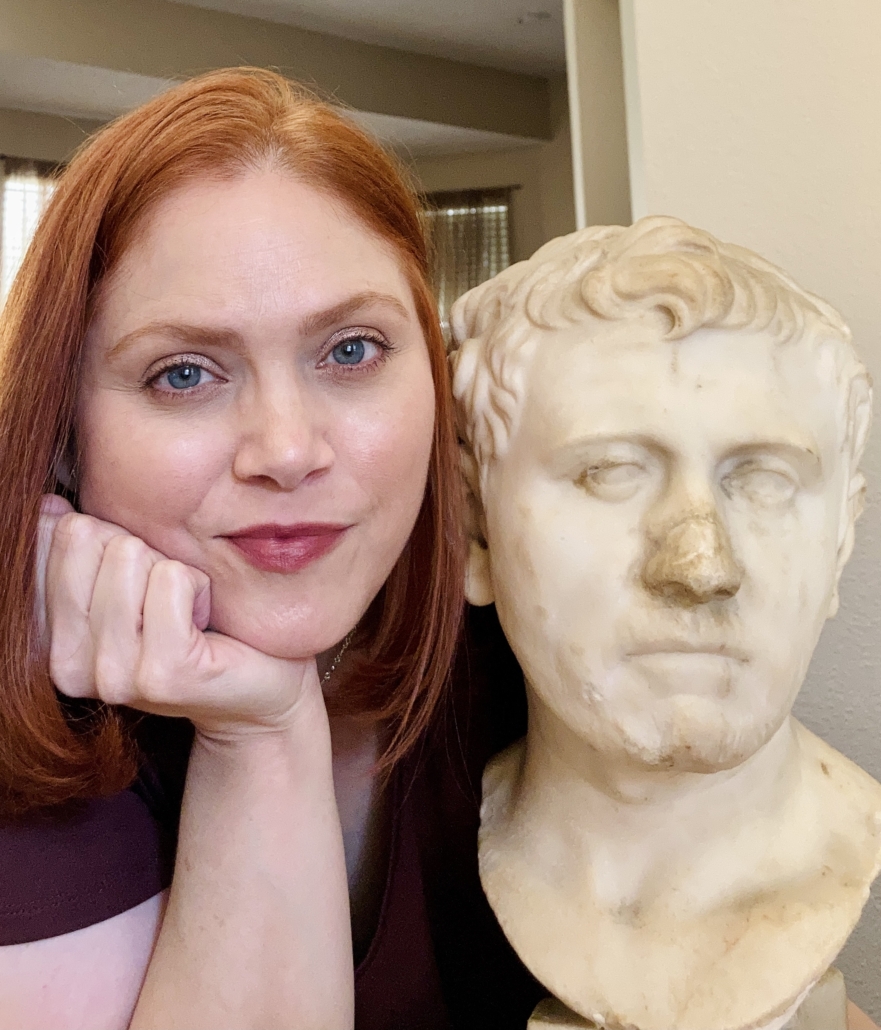
Photo: Laura Young via LiveAuctioneers.
Laura Young with the Roman sculpture she found at a Goodwill in Austin, Texas.

Here’s a fun story. You may have heard it before as it was all over the media for a while. This version is by Matt Largey, reporting for KUT, an NPR station in Austin, Texas.

“When Laura Young found a human head under a table at the Goodwill store on Far West Boulevard in 2018, she had no idea what she was getting herself into.

“The price tag said $34.99. Seemed like a deal. It was all white. Made of marble. Weighed about 50 pounds.

“ ‘Clearly antique — clearly old,’ said Young, who runs her own business as an antiques dealer and goes to a lot of thrift stores looking for treasures.

“So she bought the head and lugged it out to her car, buckled it into the passenger seat and took it home.

“Young wanted to figure out what the sculpture was, so she did some Googling and she started to piece things together. She contacted an auction house in London that confirmed it was really old — like first century old. Another auction house managed to find the head in a catalog of items from a German museum in the 1920s and 1930s.

“It was listed as a portrait bust of a man named Drusus Germanicus.

“And so began Young’s four-year ordeal trying to get rid of a 2,000-year-old sculpture.

“How did a 2,000-year-old sculpture of a Roman general’s head wind up in a Goodwill in Austin, Texas?

“ ‘There are plenty of Roman portrait sculptures in the world. There’s a lot of them around. They’re generally not in Goodwills,’ joked Stephennie Mulder, an art history professor at UT Austin. ‘So the object itself is not terribly unusual, but the presence of it here is what makes it extraordinary.’ …

“The marble bust was cataloged at a museum called Pompejanum in the German city of Aschaffenburg. The museum was a replica of a villa in Pompeii, which was buried in volcanic ash in the first century. The German king, Ludwig the First, had something of an obsession with Pompeii, so he built this villa in the 1840s to house a bunch of Roman art. Germanicus was among the collection.

“Almost 100 years later, World War II was raging. In spring of 1945, Aschaffenburg was the site of a battle between the Nazis and the U.S. Army. …

“ ‘We know that many of the objects [in the museum] were either destroyed in the Allied bombing campaign or looted afterward,’ Mulder said. ‘So unfortunately in this case, it might have been a U.S. soldier who either looted it himself or purchased it from someone who had looted the object.’ …

“Perhaps the person who took it died or perhaps they gave it away. But somehow, someone decided they didn’t want it anymore and dropped it off at Goodwill. Workers slapped a price tag for $34.99 on it and put it out for sale. …

“Back at home, Young had a problem: She was in possession of a looted piece of ancient art. She couldn’t keep it. She couldn’t sell it. And giving it back to its rightful owners was a lot harder than it sounds.

“ ‘At that point, I realized I was probably going to need some help,’ Young says. ‘I was probably going to need an attorney.’

“So she hired a lawyer in New York who specializes in international art law, Leila Amineddoleh.

“Negotiations began. It was complicated. It takes a long time to figure out all this stuff — even in the best of times. But the pandemic complicated things even further. It was slow going and in the meantime, she was stuck with this 2,000-year-old head on display at her house. …

“It looked great in the house, she says. In a weird way, Young started to get attached. She named him — half-jokingly — after Dennis Reynolds, a narcissist character from the TV show It’s Always Sunny in Philadelphia.

“ ‘He was attractive, he was cold, he was aloof. I couldn’t really have him. He was difficult,’ she says. ‘So, yeah, my nickname for him was Dennis.’ …

“Finally, they got a deal: The Germans would take Dennis back. The exact terms of the deal are confidential, but the head will stay in Texas — on display — for about a year. Last month, the movers came to get him. …

“Young says, ‘It’ll be a little bittersweet to see him in the museum, but he needs to go home. He wasn’t supposed to be here.’

“[You] can see Dennis at the San Antonio Museum of Art, which already has a significant Roman antiquities collection.

“ ‘It actually ended up being a really, really good fit. He’s just right down the road,’ Young says. …

“In a way, Dennis will always be with Young. Before she let him go, she had a half-size copy of him 3D-printed. ‘I do have a collection of busts at home,’ she says. ‘So he’s with my other heads.’ “

More at station KUT, here.

Read Full Post »