Feeds:
Posts
Comments

Posts Tagged ‘government’

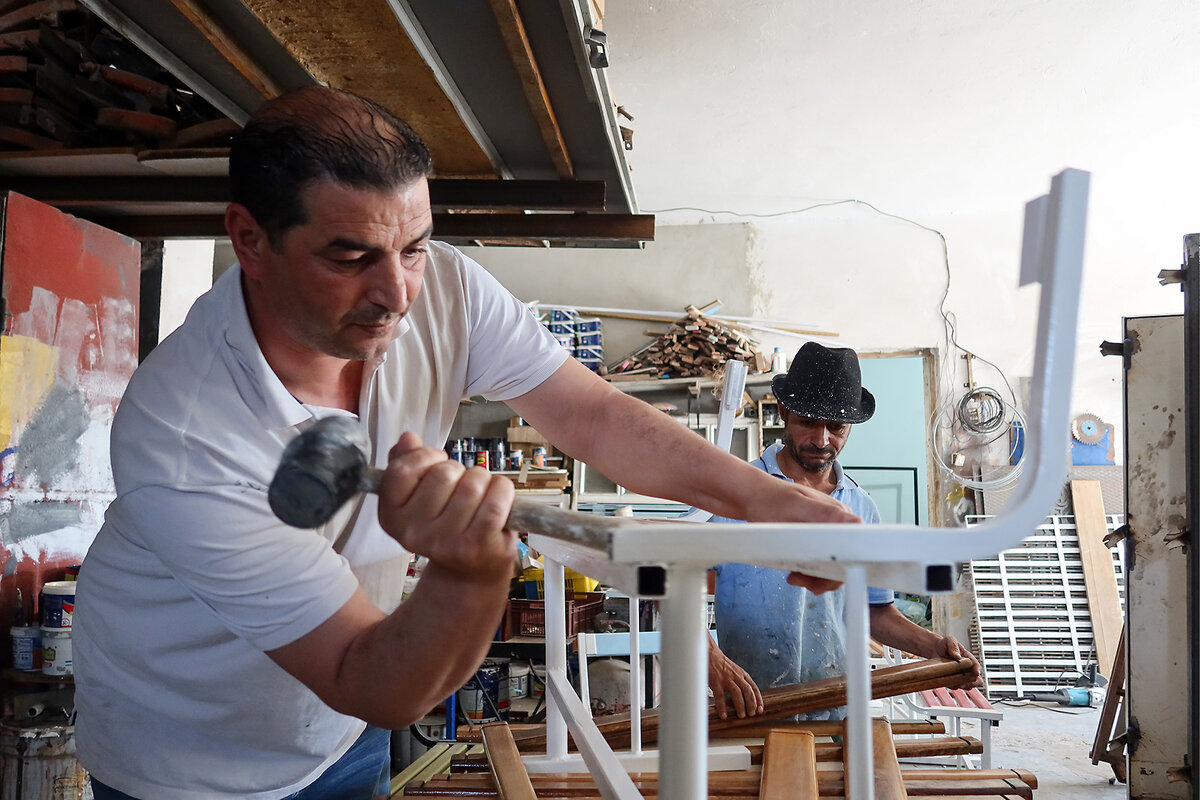
Photo: Erika Page/Christian Science Monitor.
Karim Arfa (left) works on a bench in his workshop in El Mourouj, a neighborhood of Tunis, Tunisia. He often shoulders jobs that government should have been tackling.

You were thinking from this post’s title that it was about the US? No. Not overtly. I certainly am preoccupied with harnessing the power of ordinary people in the US these days.

But no, this post is about Tunisia.

Erika Page writes at the Christian Science Monitor about how good, no-nonsense people can — and do — take civic problems into their own hands. Just because the work needs doing.

“Chadia Jarrahi can still taste the sting of embarrassment she felt when the principal sent her young sons home from school, their clothes too wet and muddy to attend class. From that day on, whenever the river was high, Ms. Jarrahi took the two boys piggyback across the ravine separating her village from the main road on the other side. …

“It’s a common story in the mountainous, interior regions of rural Tunisia, where fewer government resources are directed to infrastructure and services than along the more urban coast. The residents of Al Taraiya, in the northwestern province of Béja, had been fighting since the 1990s for a bridge connecting their community to the only nearby school, mosque, grocery store, and hospital. [Local] officials deemed the project too expensive.

“Then Karim Arfa caught wind of the residents’ plight. In recent years, the building and painting contractor has made it his mission to take on just that sort of impossible-seeming project. Using mainly scrap metal and his own creativity in his workshop in Tunis, he has built much-needed infrastructure and equipment, from furniture for schools to pedestrian bridges.

“Mr. Arfa’s work serves to assure those who have long felt abandoned by their national and local governments that regular people can come up with solutions to entrenched problems – even where resources are scarce. …

“Today, a bright pink bridge stretches from the winding highway to the rolling hills on the other side of the river. Ms. Jarrahi’s children play with other kids along the walkway; neighbors lead donkeys and motorcycles to and from the homes that are just visible across the valley. Residents no longer worry about missing work, running out of places to buy food, or not being able to go to the hospital when rain makes the river swell. …

“The bridge will help reduce absenteeism and school dropouts in the area, predicts Mohamed Jouili, a professor of sociology at the University of Tunis, over email. He also says Mr. Arfa’s initiative ‘encourages other members of the community to recognize their own agency and actively contribute to improving their environment.’

‘If everyone does something small, we can do it all,’ says {Karim] Arfa.

“Mr. Arfa himself grew up in a rural area of Tunisia, some 100 kilometers (62 miles) south of Al Taraiya. He nearly dropped out of school because of the difficulty of getting to and from class. … He eventually opened his own workshop on the outskirts of Tunis. But he never turned away from his rural roots. ‘I wanted to do something to repair their situation, as if I was repairing something for myself,’ he says.

“He started with a school dormitory that burned down in 2018, redecorating the space and then building a new library for the school in an abandoned room. From there, he began repairing desks and chairs in schools and maintenance hole covers for roads. After hearing about a young girl who died crossing a river on foot in 2019, he and his team of volunteers began building their first bridge, in the province of Kasserine.

Steep mountains meant the machinery couldn’t get to the bridge site, so they had to dig out the base by hand.

“ ‘Karim goes to the places the government doesn’t go,’ says Cherif Ait Daoud, a Tunis-based architect who helped design the bridge. …

“The bridge in Béja, Mr. Arfa’s sixth such project, was finished in 2023. ‘One year, seven days, and two hours ago,’ recalls Ahmed Terroui, a resident of Al Taraiya. He and others spent two months helping Mr. Arfa assemble the bridge, often after working long shifts as day laborers on nearby farms.

“The bridge’s railings are made of rods from old school desks, refurbished and repainted at Mr. Arfa’s workshop. Three-fifths of the steel is recycled. Only the cement, gravel, sand for the foundation, and the rest of the steel had to be bought. Officials had predicted that construction could total 2 million dinar (about $635,000). … Mr. Arfa and his team pulled it off for 41,000 dinar. …

“So far, he has relied on donations alone, either in the form of scrap metal or money. But it has been difficult to secure stable funding. 

“As trucks and motorcycles whir by, Basma Ammouri rolls dough into a ball, presses it into a wide circle, and sticks it on the inner wall of an open clay oven to bake. She set up her makeshift roadside bakery across the bridge from her home in Al Taraiya, just after it was inaugurated. She now has reliable access to customers who stop along the highway to buy her traditional tabouna bread. That income helps support her young children.”

When we think, “What can one person do?” it helps to remember people like Mr. Arfa. Even if you can’t build an actual bridge, you can build bridges to others. And then there’s the “stable funding” piece of the puzzle: even small monthly donations to worthy causes help people who do the work you value and lets them know how much they can plan for.

More at the Monitor, here.

Read Full Post »

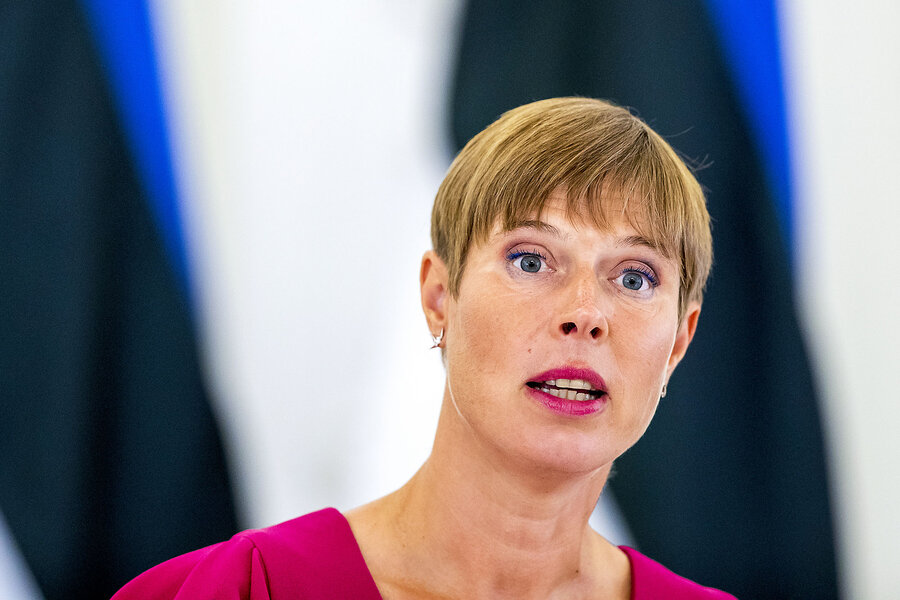
Photo: Mindaugas Kulbis/AP.
Estonian President Kersti Kaljulaid speaks during a news conference in Lithuania, Aug. 14, 2020.

Americans these days do not have much trust in government. It’s unfortunate because government does many good things. But a suspicious attitude has gained hold over the American mindset in the last few years. That’s why I look with envy at an Eastern European country that’s working really well because of a high level of trust — plus the efficient use of technology.

Lenora Chu explains at the Christian Science Monitor.

“Getting married is now one appointment easier in Estonia. The world’s most digitally integrated country launched the sacred union into the e-governance stratosphere last year – where it joined nearly every other government service you can imagine.

“Estonian citizens were already able to file taxes online, vote online, and access digital prescriptions. All of this digital activity hinges upon the Estonian smart identification system – which allows for state-recognized digital signatures – and a public trust in digital governance that’s been hard to replicate in other countries.

“ ‘I actually own my data – I can always track when someone looks at my data,’ says Kristiina Veerde-Toompalu. ‘I trust [my government].’ …

“Ms. Veerde-Toompalu got married in July, and applying online for the certificate saved her and her fiancé a special trip to her hometown’s city registrar. ‘We don’t have to go somewhere and announce our intention to get married,’ she says. …

“To deploy digital services successfully requires Estonians to trust the act of offering up to the cloud everything from birthdate and birthplace to tax information, salary, and medical diagnoses. That public trust took decades to cultivate, and ultimately relies on Estonia’s tight and transparent system of regulation.

“ ‘Paper files are not safer, because you cannot tell who looked at an analog file,’ says Kersti Kaljulaid, who served as president of Estonia from 2016 to 2021. ‘Estonian e-governance is a tightly regulated environment. … The data belongs to citizens, and you have control over who looks at your data, and you can ask them why they did. This is a luxury compared to an analog world, and I believe this is why we have this in-built trust.’

“It takes decades to build up the kind of comfort Estonia has with digitization, says Linnar Viik, a leading Estonian information technology scientist and government adviser since 1995.

‘Trust in digital channels didn’t happen overnight. It was kind of word of mouth and private and personal experience.’ …

“Trust also had to flow from leadership to the tech industry, and it did. ‘That is another layer of trust, whether you as a leader trust the experts on something you don’t understand. The politicians started to listen to the technology people and gave them space,’ says Mr. Viik.

“One such example: In 2000, Mr. Viik was allowed to convert Cabinet meetings from paper-based – at the time, they required knee-high stacks of printouts – to completely digital after one conversation with the prime minister.

“ ‘He asked, “Do we have any other examples around the world of paperless government?” ‘ recounts Mr. Viik. ‘I said, “No.” He said, “Cool, OK, do we have money for that?” ‘

“The Cabinet budget had $85,000 left for printing in that fiscal year, and Mr. Viik spent it on hardware, software, and training for Cabinet ministers and staff. What resulted was the paperless e-Cabinet: a fully wired room that drew global media attention. …

“Now Estonians not only vote and pay taxes online, but also buy property, register cars, sign job and rental contracts, and apply for unemployment benefits digitally. Nearly every service linked with a government office can be done digitally. And for many services,  citizens need not even apply, as certain entitlements are automated. That includes parental allowances and child support. Digitization also extends to health care, with every provider required to submit patient information to a centralized digital health authority. …

“ ‘The connotations [around trust] are different in different countries,’ says Mr. Viik. … ‘Other European Union governments – particularly Germany, which has a long history with government surveillance – want to mitigate all risk before digitizing. In Estonia, we would rather say, “Let’s start doing things,” and only then we can find out what are the problems we need to mitigate,’ he says.

“The paradox is that people already offer up enormous amounts of personal data to Google, Facebook, and other companies that are not only foreign but also governed independently, Mr. Viik says. ‘The institution you can control and govern is your own government – but you don’t trust? Why you don’t trust your government who is under your control?’ “

More at the Monitor, here. No firewall.

Read Full Post »

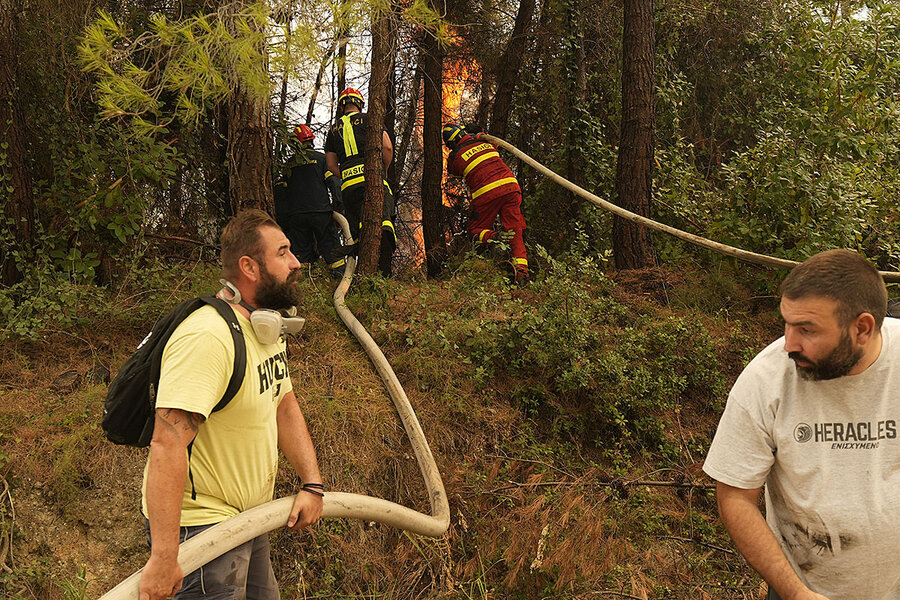
Photo: Petros Karadjias/AP.
Firefighters try to extinguish a fire in Avgaria village on Evia, an island about 115 miles north of Athens, Aug. 10, 2021.

The Greek government was doing nothing to fight the raging fires on Evia island, and some mainland folks watching the disaster on television couldn’t stand what they were seeing. So they took matters into their own hands.

Tony Rigopoulos and Dominique Soguel reported the story for the Christian Science Monitor.

“Volunteers were the first – and at times only – line of defense against the wildfires that engulfed the Greek island of Evia this week, leaving charred olive trees in a sea of ashes.

“Some were brave local youth. Others came from other parts of the country, shocked into action by the inadequacy of the government response as it scrambled to fight an unprecedented number of fires across multiple fronts, including the capital, Athens.

“Wherever they came from, the volunteers, as well as grassroots support from nearby cities and towns to get supplies into fire-stricken areas, have helped save lives and property from roaring blazes across the island, located just northeast of Athens. The destruction the fires caused is nonetheless catastrophic for many living on Evia, especially in its heavily wooded north. But the actions of volunteers helped prevent loss of life and keep a bad situation from becoming that much worse.

“[The fire] broke out on Aug. 3 and continued to smolder through Thursday. A sinister smoke hung over the small western port of Aidipsos early Wednesday as firefighters and volunteers from other parts of Greece arrived to help Evia.

“The blaze had spared the port, an important entry point to the island, but consumed more than 110,000 acres just beyond. Some villages continued to burn, adding to the bitterness of residents who say the government prioritized fighting a wildfire at a large forest near Athens and allowed the fires on Evia to grow into a huge front that was impossible to battle.

“Known for its fierce winds that stayed mercifully calm in recent days, the island’s north boasted beautiful pine forests that went up in flames all the same, along with vineyards and olive groves. Thousands of residents work either in small honey or resin production facilities. …

Said soccer coach Vaggelis Bekakos, ‘The volunteers saved Evia because there was no one there to help.’ …

“After the fierce wildfires of 2016, says the coach, residents of Limni created a volunteer corps of firefighters and rescuers who received proper training. They are bound by an oath to drop their day jobs and serve any time that there is a fire alert. Mr. Bekakos credits their heroic acts to save the town – broadcast on national TV – with inspiring villagers in other parts of the island to also fight the flames, rather than flee.

“ ‘We were asking the fire service to spray some water on a house that was beginning to burn and they would answer, “We have no such order. Our order is to evacuate the people, not to spray water,” ‘ he recalls. …

“Greece had to battle nearly 600 fires in the span of just eight days, issuing 65 evacuation alerts and evacuating 63,000 people, according to Nikos Hardalias, the deputy minister of crisis management. ‘What I know is that the choices we made saved lives,’ he told journalists on Tuesday. ‘We didn’t underestimate any fire. … We had to deal with a situation that was unique for the fire service: 568 fires!’ …

“Five days after the start of the fires, Marinos, a native of the southern part of Evia who now studies in Athens, went with his friends to the scorching north because there appeared to be no government effort to bring the flames under control.

“ ‘We took branches from trees to hit the flames until they died,’ says Marinos, who didn’t give his last name. ‘Later a man came from the village with his car, carrying the watering tank he uses for his vines. We used that water too. We used anything we could find. …

“ ‘It’s not only the houses, it’s the forest. Their whole life is now in the past. What can they do after this?’

“Maria Papadopoulou, a native of Athens, has devoted days to delivering food and water packages to those in need, shuttling villagers to safety, and rescuing and feeding the few animals that survived the inferno. She agrees that the loss of the forest is a huge problem. ‘The forest and the animals are gone forever,’ she says. ‘In a few days, all the volunteers will leave and the people of the villages will be really alone then. They will continue to live in this huge cemetery.’ ”

More at the Monitor, here.

Read Full Post »

Artists seem to think differently from people who aren’t artists, which is why Renée Loth likes the idea of embedding a few in government.

“Imagine a dancer working with police officers to better interpret a suspect’s gait,” she writes. “Or a musician teaching a city parking clerk how to listen deeply. Or an abstract painter rearranging a tangle of contradictory street signs. That’s the idea behind Boston’s new artist-in-residence program, which will embed local artists inside city departments to promote creative thinking about municipal government. …

“ ‘Artists are all about asking questions,’ says Julie Burros, Boston’s cabinet-level chief of arts and culture. ‘They bring a unique set of tools to solving problems.’

“A jury of seven arts professionals and partners from the Massachusetts College of Art and Design [met in February] to winnow a field of 10 finalists to three artists, who will each receive a $20,000 stipend for a six-month residency. …

“Boston is in the throes of a comprehensive planning process that is working to inject fresh ideas into city transportation, housing, and zoning policies. Burros is directing the city’s two-year cultural plan, Boston Creates, and is a prime force behind the artist-in-residence program.

“But Boston is hardly in the vanguard of this approach. The concept dates back to at least 1976, when activist Mierle Ukeles accepted a nonsalaried position as the first artist in residence of the New York City sanitation department.

“Over the decades, Ukeles created artworks that engage questions of nature, class, and culture; her ‘Flow City,’ a video installation at a Hudson River transfer station, confronts visitors with their own role in the massive waste management task of city government. Environmental education is a dull, dutiful business — until it’s in the hands of a performance artist. …

“In 16th century Europe, wealthy rulers of church and state often commissioned artists to live and work in their courts — you might say that Michelangelo was embedded in the Vatican. Today’s artists in residence may not paint the ceiling of City Hall, but they will surely contribute to Boston’s renaissance.”

More at the Boston Globe.

Art: Pep Montserrat for The Boston Globe

Read Full Post »