Feeds:
Posts
Comments

Posts Tagged ‘gravity’

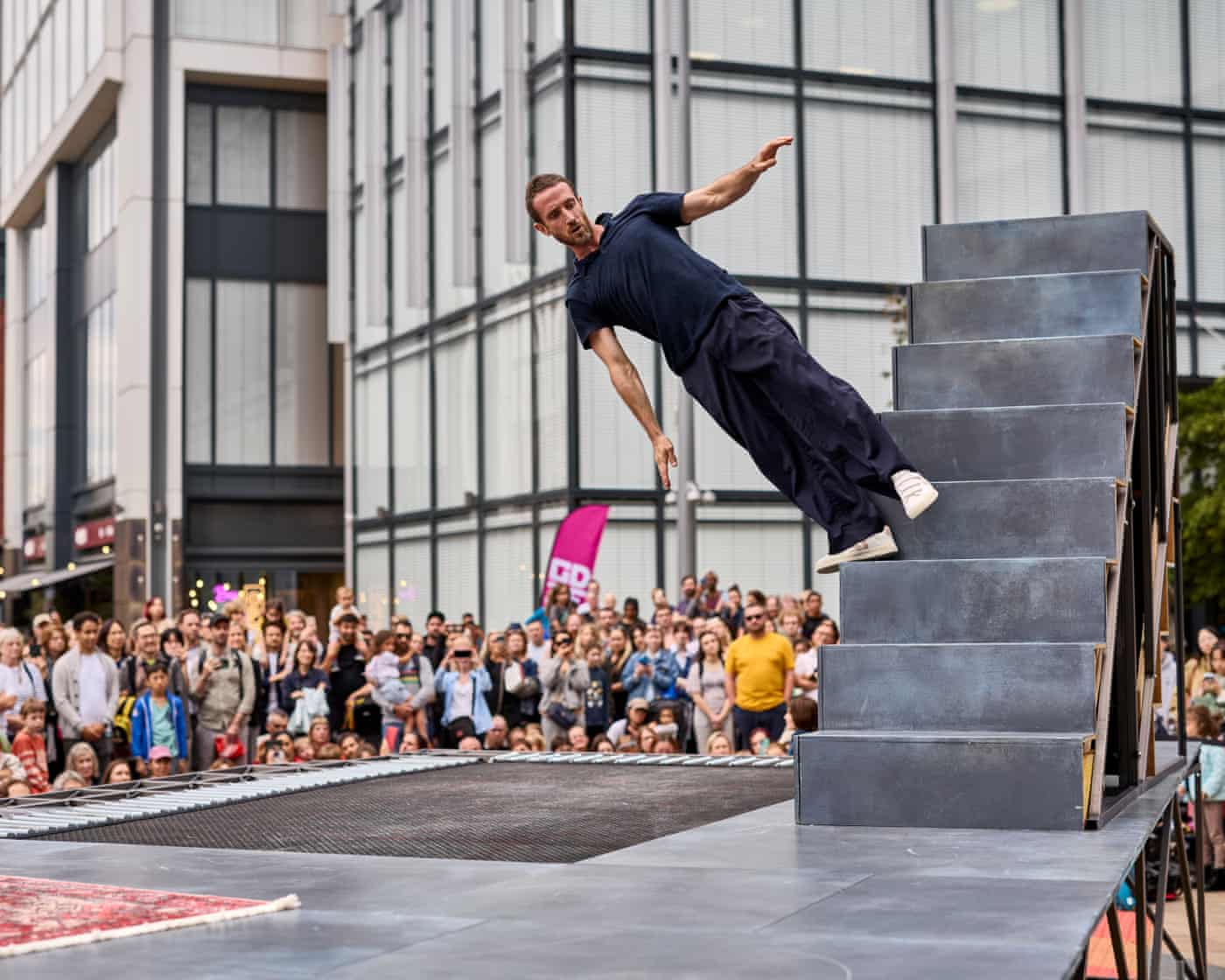
Photo: David Levene/The Guardian.
Olivier Mathieu in Yoann Bourgeois’s “Touch.”

Today’s story is about trampoline choreography, which looks to me a bit like using the flying trapeze without a net.

But who am I to talk? Growing up, we had a trampoline on the porch with no kind of protection. A low, wood ceiling overhead. A concrete floor below. Sometimes I wonder how we managed to grow up at all.

Lyndsey Winship writes at the Guardian, “You may have seen a certain video online of a man climbing some stairs. Actually, he’s repeatedly falling from them but then magically bounces back up, weightless as a moon-walker. Out of sight is a trampoline, which gently catapults his looping, twisting body up the staircase each time he falls, turning a would-be simple journey into an epic, poetic odyssey that has caught the internet’s imagination. Pop star Pink saw it and immediately got on the phone to its creator; Martin Short even made his own version on Only Murders in the Building.

“The act is the work of French choreographer-director Yoann Bourgeois, 43, whose live performances have been touring festivals for years. But the popularity of his videos online has propelled him into new realms. …

“Some people run away to the circus; others have it arrive on their doorstep. Bourgeois’ parents separated when he was growing up in Jura, eastern France, and their house was sold to a circus group, Cirque Plume. Bourgeois was already interested in theatre (and later studied dance) and he began to train with the group. ‘In a way I was looking for a way to get back home,’ he says, via a translator. … ‘I really wanted to continue to be a child. I’ve searched for a life where I can continue to play.’ …

“What Bourgeois plays with are the invisible physical forces that surround us – gravity, tension, suspension – and the interaction between those forces, the performers’ bodies and symbolic ideas. For example in ‘Ellipse,’ the dancers are in costumes like lifesize Weebles with semi-circular bases, rocking and spinning, but never falling. … In ‘Celui Qui Tombe (He Who Falls),’ the performers stand on a wooden platform that rotates, at some speed, then tilts, forcing their bodies to lean at precarious angles to keep their balance. …

“The short piece Bourgeois is bringing to London is called ‘Passage,’ and features a revolving mirrored door and pole dancer Yvonne Smink hanging, swinging, balancing and turning the simple act of crossing a threshold into something of infinite possibilities. Much like the way sculptor Antony Gormley hit upon a universal idea in his use of the body, Bourgeois works with the same kind of directness. …

“Here he is talking about suspension: ‘In physics, suspension means the absence of weight. But if we speak about time, suspension means absolute presence. And I think this cross between absence of weight and absolute presence is like a small window on eternity. That’s what I search for: to catch the present, to intensify the present.’

“Even though Bourgeois seeks to be live in the ephemeral moment, you can see why the recorded versions have gone viral. He admits his work looks good on screen. …

“He’s reaching even more eyeballs now with his pop star collaborations. For the Harry Styles video ‘As It Was,’ Bourgeois designed another revolving platform that saw Styles and his lover being pulled together and apart. ‘Behind the superficial pop veneer of the song, there’s a great sense of despair,’ he says.

“Bourgeois designs his own stage machines, but the revolving floor is, he points out, a very old theatrical device. The question of what’s truly new in art came to the fore when he was accused of plagiarism in a video posted online comparing scenes from his work with scenes from other artists. There are some striking similarities, but Bourgeois is robust in his defense, saying that the works referenced motifs from the history of art, which he considers to be in the public domain. Many circus performers will use the same props. ‘If you use just a frame of a video, it’s easy to make a comparison,’ he says. ‘What is original is the treatment and the creative process.’ …

“What’s certain is that Bourgeois can turn universal ideas into something eye-catching that connects deeply with audiences – imbued with the wonder of circus and the grace of dance.”

More at the Guardian, here.

Read Full Post »

newtonsprincipia_1460-1080x718-1

Photo: Wikimedia Commons
Isaac Newton’s own first edition copy of his book
Mathematical Principles of Natural Philosophy (1687) with handwritten corrections for the second edition. The young Newton was self-distancing from plague when he had his inspiration about gravity.

Folks, I keep a pipeline of possible blog topics, but not all the curiosities I saved back in December, say, seem right for this moment in history. So in case you are online a lot and have already seen some of my picks from current headlines, I’ll do my best to come up with different angles.

Did you see this one about Isaac Newton during the plague? Maybe a few people self-distancing right now will make earthshaking discoveries, too.

I first read the Newton tidbit in a rare-book story at Hyperallergic: “Issac Newton saw an apple fall from a tree and had an epiphany that would rewrite physics and the way we understand our universe. He later published his findings on the laws of motion in the 1687 book Mathematical Principles of Natural Philosophy. Now, by sheer accident, a rare first-edition copy of this groundbreaking book was found in a library on the French island of Corsica.

(Fun fact before we continue: Newton made his discovery while ‘socially distancing’ himself during the Great Plague of London in 1665. He was a 20-something Trinity College student at the time.)

“Vannina Schirinsky-Schikhmatoff, director of conservation at the Fesch Public Heritage library in Ajaccio, was researching an index from the library’s founder Lucien Bonaparte — one of Napoleon’s brothers —when she discovered a copy of Newton’s 17th-century book.”  The Hyperallergic piece is here.

In a rather somber column at the Washington Post, Alexandra Petri adopts Newton’s discoveries as a metaphor for how we connect to others in this moment.

“There was a plague, so Isaac Newton went home,” Petri writes, “and for him it was an annus mirabilis, which in Latin is a ‘year of miracles.’ He discovered the theory of universal gravitation, began his study of optics and formalized what would become calculus. …

“I am told, at such a time, Isaac Newton sat at a country estate with an apple tree. His reflections upon the forces between distant bodies, propelling them together and apart, gave us gravity and enfolded the moon and the apple in a shared system of invisible laws.

“He saw a spider’s web of formulas spinning across untold space, in which the stars hung like dewdrops, and from them beams of light pierced his own seclusion. All kinds of lofty things entered the brain of Isaac Newton, some of them traveling great distances, and when he emerged, science was permanently different. Such was the life of Isaac Newton during the plague year.

“I am secluded, too. Perhaps, for a proper miracle, I should go look at a tree. I go for a quiet walk six feet away from everyone I encounter. … Other people pass along, distantly together in this space. We nod at one another. How far is too far? How close is too close? The force that propels us together in ordinary moments is currently propelling us apart. …

“I wanted to see my parents. I happen to be fond of them, which I realize is a symptom of luck. But I do not know what I may be bringing with me. I am terrified I will get too close. Thus, I take a telescoping metal stick for roasting marshmallows and brandish it at the end of my extended arm, to mark out six feet. So armed, I go for a walk with my dad, swinging it between us on the sidewalk, trying to trace an arc of safety. Is this funny? It feels almost funny, but for some reason, I am crying. …

See your family, without hugging? Please, we are of Scandinavian extraction! We have been training for this moment our entire lives! …

“This must be a year of miracles — not the common miracles we only see after they vanish, the miracles of people in a restaurant or a room or a theater together. No, other miracles: the shield we build for one another by briefly deserting those places. The connections that persist across distances, the formulas that make a familiar face appear in glowing pixels on a screen. Who would have thought that our old enemy the conference call would be an ally, in the end? Who would have thought that phone calls, long disdained, would come to the rescue? This is an advantage we possess over Newton.

“I cannot see anything easier than inventing gravity during a time of plague. How can you think of anything during such a time but bodies and the distances and forces between bodies. I feel nothing now but the pull of distant bodies too far away to touch. I feel nothing but the invisible ties that bind us across spaces, the imperceptible, far-off vibrations in the web that signal: Yes, there is someone here.”

More by Petri.

There may be a firewall, but you can get a month free at this newspaper, and it sure is good to have it during our the Covid-19 plague. Very reliable journalism.

Read Full Post »