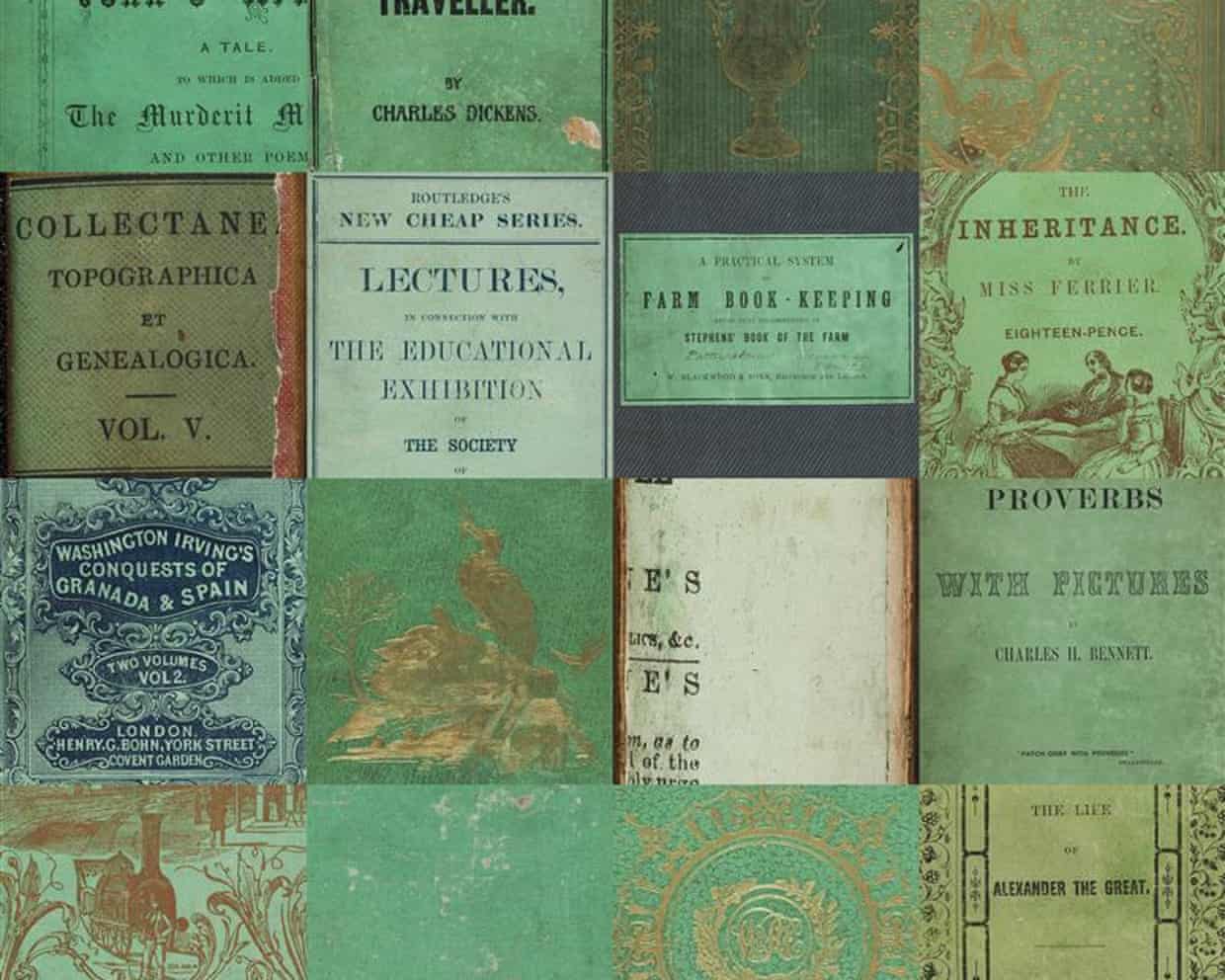
Photo: University of St Andrews.
Books bound with potentially toxic green covers.
With all the benighted book banning going on these days, you would think that the vigilantes had learned the written word would land people in the hospital. But reading is not lethal, and thinking about new ideas won’t kill anyone.
Having said that, I admit there is some reading material that may be dangerous to touch. Ella Creamer reports at the Guardian that “arsenic was historically mixed with copper to create a vivid green for book covers.”
“A new tool to quickly identify books that are poisonous to humans has been developed by the University of St Andrews,” Creamer writes. Historically, publishers used arsenic mixed with copper to achieve a vivid emerald green color for book covers. While the risk to the public is ‘low,’ handling arsenic-containing books regularly can lead to health issues including irritation of the eyes, nose and throat along with more serious side-effects. The toxic pigment in the book bindings can flake off, meaning small pieces can easily be inhaled.
“In recent years, many libraries have prevented access to all suspect green books as a precaution, as testing has until now been costly and time-consuming. … The new device can quickly and cheaply detect the presence of toxic pigment.
“ ‘A device used in the School of Earth Sciences to detect minerals in rocks was the starting point,’ said Pilar Gil, who led the research. ‘The Eureka moment was discovering the unique reflectance pattern from emerald green pigment in the visible spectrum. The idea was then to apply this discovery to an instrument which we could use and share with the sector.’
“Two scientists from the university’s astronomy and physics school, Graham Bruce and Morgan Facchin, developed a portable tool. ‘Our device shines different colors of light on to the book,’ said Facchin. ‘The amount of light reflected at each color is like a fingerprint of the pigment in the book.’ …
“The handheld device can screen books to test for the pigment in a fraction of a second. ‘Our team has been asked to look at thousands of books, of which more than 100 have been identified as containing emerald green pigment,’ said Bruce.
“At St Andrews, emerald green books are stored in Ziploc polythene bags. ‘When the books are used, we check first if there are any other copies available which are not bound in emerald green,’ reads the university’s website. ‘If not, the book is handled with special precautions such as the use of nitrile gloves.’ …
“ ‘The retention of green books from public view is not only a matter of safety, but it also restricts access to the information contained,’ said conservator Erica Kotze, who instigated the project. ‘This means that the books which have been tested and found not to contain the pigment can remain available to users.’
“A free exhibition exploring the project, Poisonous books – Dangers from the past, is running at the Wardlaw Museum in St Andrews until the end of July.”
More at the Guardian, here. No paywall, but please consider donating to support factual news.

 Suzanne's Mom's Blog