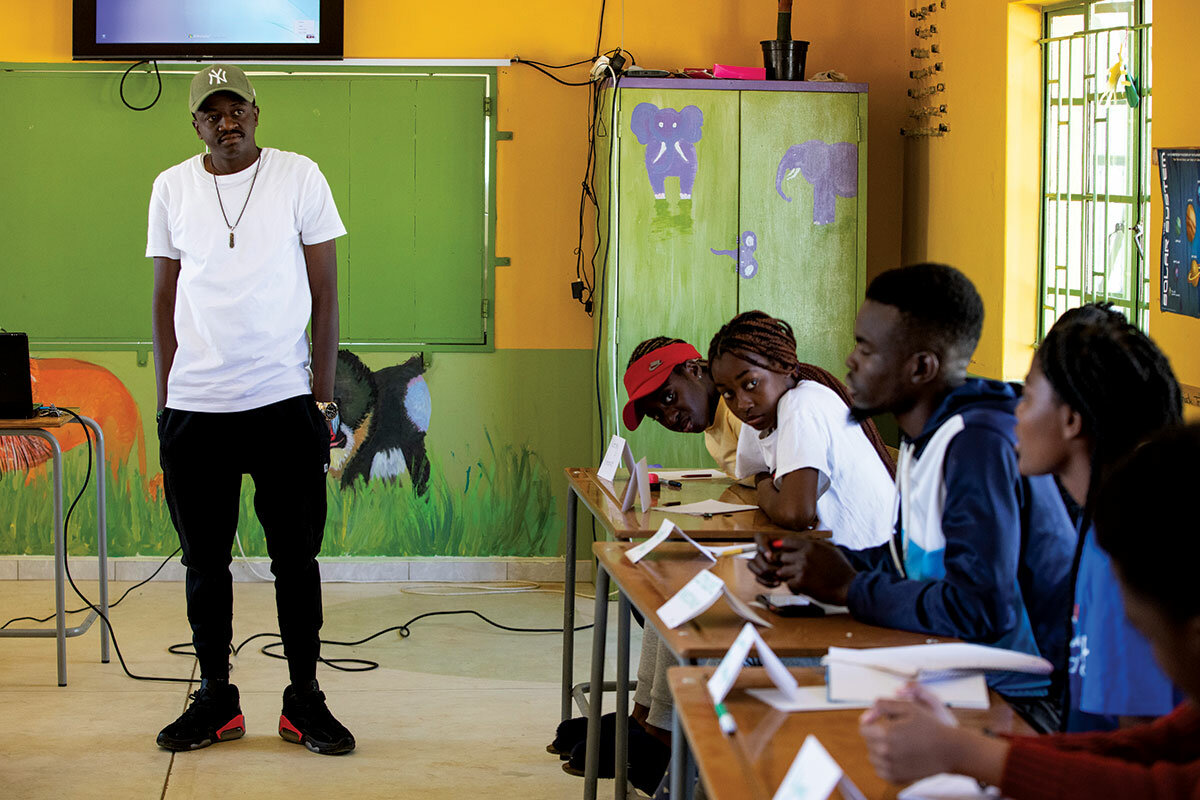
Photo: Melanie Stetson Freeman/CSM Staff.
The Christian Science Monitor says, “Deon Shekuza is a peripatetic presence at climate summits as well as at the grassroots – like the class on green hydrogen he taught to young teens in an informal settlement in Windhoek, Namibia, last July.”
Climate activism is no longer mainly the purview of the industrialized Northern Hemisphere or those with enough income and time to worry about it. Now people on the front lines are leading the way. For them it’s a matter of survival.
Sara Miller Llana writes at the Christian Science Monitor about Deon Shekuza, a climate influencer in Namibia, who is “as comfortable proselytizing green energy to youth on the hardscrabble roads and villages of this former German colony as he is in Namibia’s government ministries and the halls of United Nations conferences.
“Paid with respect if not a salary, he’s part of a rising breed of young climate activists across the Global South whose work, suggests one climate expert, may well determine the temperature of your world.
“Africa, which has contributed least to climate warming, is the continent most threatened by the droughts, floods, and heat intensified by climate change. In that extremity, the relentlessly positive Mr. Shekuza sees great opportunity for progress for Namibia.
“In the dusty chaos of an informal settlement on the edge of this capital city one recent morning, he faces his biggest challenge: capturing the imaginations of young teens on a complex topic. The kids have gathered in a bright community center classroom, not for school credit and certainly not for fun on their Saturday off, but to hear Mr. Shekuza teach green hydrogen 101. Namibia has staked its future on this next big solution for a global clean energy transition. …
(The process, simply put, would use solar or wind power to extract hydrogen molecules from desalinated seawater, producing green ammonium that would be used for regional and global fuel markets to power transportation and electricity production.)
“No one here knows what green hydrogen is, let alone how it might be the route to social justice that Namibia’s leaders proclaim. Grasping for something understandable, Mr. Shekuza gestures out the window at the ancient and humble street scene of women laden with bushels of branches gathered from the forest for heating and cooking fuel. ‘This is exactly what we do not want for our people, right? Some energy sources keep you in the past, and some energy sources move you into the future. This is why we are here talking about green hydrogen.’
“After 90 minutes, Mr. Shekuza is satisfied. These kids might not exactly understand Namibia’s renewable energy policy, but they understand green hydrogen potential: jobs for them in a new economy that could turn Africa’s perpetual sunlight into clean fuel for electricity and transportation here and for export. …
“For activists across Namibia – like the Inuit in the Arctic, or youth from small island nations – caring and conserving is the easy part. These youth grew up living sustainable lives well before it was trendy. Many were born on the land, in the bush, on the coast, with no playgrounds except the natural environment around them. They conserved not for environmentalism, but for survival. …
“Mr. Shekuza and young African activists like him across the continent who are part of the Climate Generation, as we’re calling it, see a chance – the kind Mr. Shekuza tells the children in the informal settlement to seize, the kind he has seized for himself. …
“Mr. Shekuza can barely afford to do the work he has cut out for himself. For all his social confidence, he hesitates at the doorstep of his home before inviting visitors in for the first time ever. Descending from sunny daylight down a step at the side of a large old house, he enters the tiny basement space he shares with his mother.
“With a revealing flourish of humility, he pulls the worn blue curtain separating his mother’s bed from his floor space: ‘This,’ he says, ‘is climate activism in Africa.’
“In his windowless corner lies his bed. … On the chipped yellow paint of a cement wall are dozens of badges from U.N. conferences. A single business suit hangs from the curtain rope.
“This is the headquarters of his nongovernmental organization. With just the grants and fees he cobbles together from government and U.N. funding, the 33-year-old college dropout educates himself, hatches ideas for mentoring youth, and speaks via Zoom to august groups, all on the floor here. For an online speech on climate justice for a British Museum conference, he had no option but to give his speech right there, cross-legged on his sleeping pad, dressed in a traditional African tunic, surrounded by clothes, caps, shoes, and [policy] documents. …
“The environment, he says, was always a part of his interest: Nature was his escape from the noise and dilapidation of poverty in his rural hometown of Grootfontein. … ‘We are people who never look at the environment like something that is separate, because you grew up looking at it as part of you,’ he says. …
“He co-founded the NGO Namibian Youth on Renewable Energy (NAYoRE); gave himself the title ‘youth advocate for sustainable development’; worked with other organizations and networks on biodiversity, farming, and climate change; and started crisscrossing the globe on invitations to attend and address government, U.N., and private conferences. …
” ‘[Young people] may see me with a fancy English up here, but my lifestyle is no different from that kid in the shack. So when I speak for the youth, I’m coming from experience and I’m speaking something solid.’
“He pulls out a binder on agriculture in Namibia and how to use regenerative practices in one of the most water-stressed nations on the planet. It’s the latest document he’s read, and he’s read all of it: ‘I have dedicated hours and hours and hours … like trying to upgrade and up-skill myself. And I did that in and out of school, but I found the most benefit came out of it.’ …
“On a late Friday afternoon, Mr. Shekuza meets at a cafe with Micky Kaapama, whom he has been tutoring to be a climate activist, or, as they put it, a ‘biodiversity enthusiast.’ The glamorous fashion model studied biology and, crucially, has 12,000 Instagram followers. …
“As if trying to convince her of what she has to gain, he pulls out his phone to show an invitation from the Namibian president’s office that he’s just received. Addressed to Deon Shekuza, ‘Youth Advocate for Sustainable Development,’ it’s for a luncheon with Hyphen, a German- and British-financed Namibian company that signed a deal last May with Namibia to build the largest green hydrogen project in the country. It’s an $11 billion agreement.
“But there’s a hitch in the impressive invite. He has no idea how he can even afford to get to the event five hours away in Keetmanshoop.”
Find out what happens at the Monitor, here. No firewall.

 Suzanne's Mom's Blog