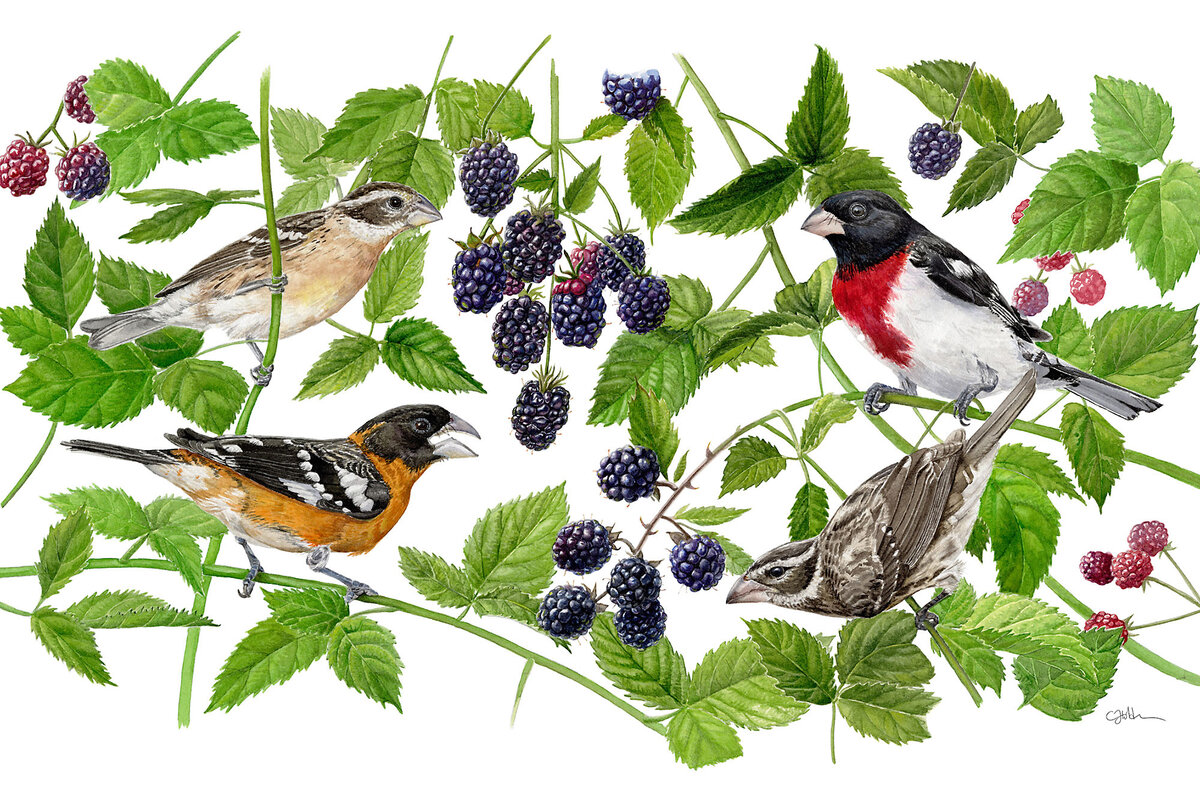
Art: Charlotte Holden.
A watercolor by Charlotte Holden, one of the artists in the Bartels Science Illustration Program at the Cornell Lab of Ornithology in Ithaca, New York, was used on the 2023 mug sent to members of the Ornithology Lab.
Our family has a lot of bird mugs. You may have some, too, especially if you have supported any environmental organization. As important as it is to protect creepy crawly insects, say, or an ugly fungus, those things don’t make great tea cups. Everyone, however, loves birds.
Today’s story is about the contemporary artists behind the bird art on your holiday cards, calendars, and coffee mugs.
Stephanie Hanes wrote at the Christian Science Monitor, “When international researchers recently discovered that a population of hummingbirds in South America was actually two distinct species – a finding made after much trekking and tracking and genome sequencing – they called on Jillian Ditner to help explain their work.
“Ms. Ditner is a bird illustrator at Cornell University’s Lab of Ornithology. And in her rendering, she could highlight the distinctions between Patagona gigas, the southern giant hummingbird, and Patagona sp. nov., the new northern giant hummingbird. …
“The birds look nearly the same. But look closely, and the plumage on the right has a bit more reddish-brown saturation. There is more distinct coloration around the northern’s neck; a beak that extends just a bit longer.
This is one of the skills of the bird illustrator. More so than a photographer, Ms. Ditner explains, these artists can accentuate and highlight differences in species.
“They can exaggerate just a bit the ideal features that help reveal an animal’s distinct parts; play with that boundary between reality and understanding.
“ ‘Photographs are always going to be limited,’ she says. ‘With scientific illustrations – you can take endless angles of a photograph and put them in one picture … there’s the ability to condense a lot of detail into one visual.’
“Ms. Ditner runs Cornell’s unique Bartels Science Illustration Program, a year-long fellowship for bird artists that has seen skyrocketing popularity since its founding two decades ago. (This year, Ms. Ditner received 215 applications for the solo spot; that’s up from a few dozen, she says, when she started in her position six years ago.) The Bartels program is part of Cornell’s Lab of Ornithology, which many birders in the area just call ‘the Lab.’ …
“At a time when a global library of digital images lives in one’s pocket, when attention is fought over and commoditized, there is something precious about the act of deep observation and the hand-drawn beauty that science illustration requires.
“The bird artists at the Lab are specialists in that larger field of science illustration, a profession that includes everything from botanical sketches and renderings of the solar system to medical drawings and wildlife art.
“Despite advances in both photography and artificial intelligence, the scientific illustration field is growing, say those who work in the field. According to The Franklin Institute, Philadelphia’s renowned natural history museum, new technology has only increased the need for science illustrators, who can help bring either nanoparticles or galaxies to a comprehensible scale; a handful of colleges have science illustration programs.
“Charlotte Holden, an artist and longtime bird lover, was one of the Bartels Illustrators in 2002. During her time in the program, Ms. Holden worked with researchers, studied bird anatomy, and honed her realism style by combining bird images with illustrations of their native flora. Like many who go through the program, her work appeared in Cornell’s Living Bird magazine, on posters, and on other materials. …
“Although Ms. Holden has been watching birds ever since she was a child outside of New York City, it was only by drawing, she says, that she began to recognize details like a bird’s different feather groups, or unique colors.
“It’s like life, she says. It’s hard to see the details when everything is in motion. Ornithological art slows us down. It has a long history that blurs science and art and wonder; a moment to pause and appreciate the world around us. …
” ‘Art in itself is just very inspiring,’ says Maria Klos, a 2023 Bartells Illustrator who now lives in California. ‘It seems to always draw people in.’
“One of Ms. Klos’ projects during her time in the program was to draw a pair of life-size American condor wings, which are now attached to one of the Lab’s exterior walls. Visitors can put their arms up against the image to see how their own ‘wingspans’ measure up; one more moment of art, bird, and human together.
“Both Ms. Klos and Ms. Holden have continued their jobs as professional illustrators; both recently put on shows of their art and both say they are inspired to continue drawing nature professionally. The Bartels program has opened doors to new professional contracts, they say, but also a new way of seeing the world.
“ ‘It fosters a deeper connection to nature … when you just sit with it and observe it,’ Ms. Klos says. ‘You see things that you might have been overlooking for a long time, or might never have noticed if you didn’t sit down with it and draw it.’ ”
More at the Monitor, here. No paywall.

 Suzanne's Mom's Blog