Feeds:
Posts
Comments

Posts Tagged ‘hollywood’

Photo: Tracy Nguyen for NPR.
In general, Hollywood cares little for the “circular economy,” but this helicopter at Beachwood Services, originally used in 
Black Hawk Down, has been repurposed in Terminator 4Suicide Squad and The A Team, among other movies and TV shows.

As I was working on a post in which actor Benedict Cumberbatch bemoaned the wastefulness of Hollywood, I ran across a contrary example. Apparently, some folks in that world care about the environment or maybe just see a buck to be made by repurposing sets.

A big part of Hollywood’s problem relates to being in a hurry and taking the easy way out.

First Cumberbatch at the Guardian.

Catherine Shoard writes, “Benedict Cumberbatch has called the Hollywood film industry ‘grossly wasteful,’ taking particular issue with its squandering of resources in the aid of set building, lighting – and bulking up physiques for blockbusters.

“ ‘It’s horrific eating beyond your appetite,’ Cumberbatch told Ruth Rogers on her food-focused podcast, Ruthie’s Table 4, adding that when he was shooting Marvel’s Doctor Strange, he would eat five meals a day. In addition, he would snack on boiled eggs, almonds and cheese, in order to try to ingest enough protein to transform his body.

“ ‘Going back to responsibility and resourcefulness and sustainability, it’s just like, “What am I doing? I could feed a family with the amount I’m eating,” ‘ Cumberbatch said.

“ ‘It’s a grossly wasteful industry,’ he continued. ‘Think about set builds that aren’t recycled, think about transport, think about food, think about housing, but also light and energy. The amount of wattage you need to create daylight and consistent light in a studio environment. It’s a lot of energy.’ “

So there’s that.

On the other hand, according to National Public Radio, “Beachwood Services, owned by Sony Pictures Entertainment, rents out sets and props for reuse that were originally built for its own productions.”

That spark of hope was reported by Chloe Veltman.

“For decades,” she says, “it was standard practice in Hollywood for art departments to build sets for movies and TV shows from scratch, and then break them down at the end of production and haul the pieces off to the landfill.

” ‘The dumpsters just line up at the end of the show,’ said veteran Hollywood art director Karen Steward of many productions she worked on, from the 1988 high school comedy Johnny Be Good, to the 2013 political action thriller Olympus Has Fallen. ‘And there’s no talking about it, because it’s time to get off the soundstage.’

“Steward is part of a group of like-minded Art Directors Guild members who have been pushing for more sustainable practices for years, along with other allies. At first, she said, it was hard at first to get much traction. ‘We’re all about not wasting time, and hurry up, and get it done, and time is money.’

“But Steward said things are becoming easier, as the industry is gradually coming to grips with its impact on human caused climate change. …

” ‘To find a true circular solution, a true zero waste idea, is what we’re working toward,’ she said.

“According to Earth Angel, an agency that helps productions in the U.S. and around the globe reduce their carbon footprints, the average TV show or movie in 2022 created about 240 tons of waste, with an estimated half of that amount coming from the disposal of props and sets.

” ‘There are definitely more innovative, efficient ways of working,’ said Earth Angel founder and CEO Emellie O’Brien. ‘

‘We often just don’t give people the space and the breathing room to uncover those solutions.’

“One such solution is to reuse old sets rather than always building new ones. Beachwood Services, owned by Sony Pictures Entertainment, rents out sets and props for reuse that were originally built for its own productions. Located in Santa Clarita, north of Los Angeles, its warehouses are packed with scenic gems. …

“Art directors sometimes resist the idea of reusing old sets, because they want to realize their own creative vision. But Sondra Garcia, Beachwood’s director of scenic operations, said the service allows them to alter what they rent to suit their needs.

” We tell people, “You’re going to put your own spin on it. You’re going to paint it. You’re going to reconfigure it. And then it is your design,” ‘ said Garcia. ‘The most important thing to remember is to recycle stuff because it’s less wasteful, and producers like it because it saves money.’

“And when those sets get too old to rent out to big-budget productions, they often wind up at places like EcoSet. Productions pay for the Los Angeles-based company to haul away their unwanted sets, props and construction materials. Instead of going to landfills, those treasures are then donated to whoever wants them. …

“But these solutions to Hollywood’s chronic waste problem only go so far.

“Ecoset’s owners don’t know what happens to all of the free stuff the business gives out — whether it’s recycled again or thrown away. Also, many warehouses around the region that used to keep old sets and props in circulation have downsized — Sony’s Beachwood Services formerly had five warehouses and now there are two — or have shuttered in the past couple of years, owing to rising real estate costs. …

” ‘I don’t think anyone in our industry would shy away from really hard challenges or else we wouldn’t be in our industry,’ said Everything Everywhere All at Once producer and sustainability champion Jonathan Wang. ‘But I do think it’s tricky.’

“Wang said despite people’s best intentions, a lot of materials still get thrown out in the rush to meet hectic production deadlines — including on his own sets.

” ‘I think it’s important to just acknowledge that we’re all figuring it out,’ Wang said. ‘We’re trying to do it better.’ “

More at NPR, here, and at the Guardian, here. No firewalls, but both those outlets need our support.

Read Full Post »

Photo:  Jake Michaels.
Pam Elyea and her husband, Jim, have run the theatrical properties business History for Hire for almost 40 years, but now rent is going up and business is down.

When I was in the Junior Antrim Players production of Alice in Wonderland (age 10), my mother volunteered to do props. [Scroll way down here for fun information on the Junior Antrim Players and famous actors who got their start there.] You know, finding all those odds and ends that a script says are needed onstage to carry the story — a gavel for the Knave of Hearts trial, paintbrushes for painting the roses red, the caterpillar’s hookah. For opening night, she provided real tarts from a local bakery, but found out she’d have to do that for the dress rehearsal, too. Props are a big deal.

Matt Stevens wrote recently at the New York Times about prop mavens calling themselves History for Hire.

“When the Netflix series Wednesday needed a guillotine recently, it did not have to venture far. A North Hollywood prop house called History for Hire had one available, standing more than eight feet high with a suitably menacing blade. …

“The company’s 33,000-square-foot warehouse is like the film and television industry’s treasure-filled attic, crammed with hundreds of thousands of items that help bring the past to life. It has a guitar Timothée Chalamet used in A Complete Unknown, luggage from Titanic, a black baby carriage from The Addams Family.

“Looking for period detail? You can find different iterations of Wheaties boxes going back to the ’40s, enormous television cameras with rotating lenses from the ’50s, a hair dyer with a long hose that connects to a plastic bonnet from the ’60s, a pay phone from the ’70s and a yellow waterproof Sony Walkman from the ’80s.

History for Hire, which Jim and Pam Elyea have owned for almost four decades, is part of the crucial but often unseen infrastructure that keeps Hollywood churning. …

“ ‘People just don’t realize how valuable a business like that is to help support the look of a film,’ said Nancy Haigh, a set decorator who found everything from a retro can of pork and beans to a one-ton studio crane there for Once Upon a Time in Hollywood, which she won an Oscar for. ‘But it’s because people like them exist that your moviegoing experience has such life to it.’ …

“When the director, George Clooney, really wanted an old Moviola editing machine, [Good Night, and Good Luck set decorator Jan Pascale recalled] the Elyeas found her one at a local school. And they had not only the telex machines that the production needed, but also workers who knew how to get them to work. …

“ ‘I don’t know what we would do without them,’ said Pascale, who has won an Oscar for Mank. …

“But with fewer movies and television shows being shot in Los Angeles these days, and History for Hire getting less business, the Elyeas fear they may not be able to afford to renew their lease. …

“[Jim’s] parents owned an antique store, and Jim had always been a collector. So when a friend who was a production designer asked Jim to come work on sets, he was sold. …

“The couple opened their prop-rental business out of their apartment. Their first big break came when they got the gig to rent flak vests, field radios and medic equipment to Oliver Stone’s 1986 film Platoon. (They now admit that they may have exaggerated their size and expertise.) …

“On a recent afternoon inside the warehouse, Dave McCullough, a prop maker, was hunkered over a work station fitting a microphone stand to a base it was not designed for. He would later use a 3-D printer to make a new tally light — the light which tells performers which camera is on at any moment — for an original RCA TK60 television camera from the 1960s and consider whether to use a heat gun to make it a slightly richer shade of red.

“ ‘What is great about being in a building like this is I’ve got the last century of objects as a reference,’ said McCullough, who has worked at History for Hire for nine years. ‘A lot of the things here had multiple lives before they got to us.’ …

“A Broadway-bound musical centered around Soul Train recently needed to rent some TV cameras, Pam said. While researching the cameras, the History for Hire team discovered that the show was one of the first to employ female camera operators. So they sent over a camera — and a photo. And now, audience members will see a female camera operator in the show, a spokesman for the musical, Hippest Trip: The Soul Train Musical, confirmed. …

“The Elyeas would have to rent many drum sets and many, many, many drum sticks to cover the $500,000 they pay annually to rent the building where they store them all. Pam said that she is fine with some work going other places. … But Pam said that she would need more local production in Los Angeles to keep her doors open. …

“ ‘Neither Jim or I are really ready to throw in the towel yet,’ she said. Maybe, she said, they will sign a two-year lease, rather than a five-year lease. And then they’ll see how it goes.”

More at the Times, here.

Read Full Post »

Photo: Kevin Winter/Getty Images
After a bad year for wildfire, the Oscars gave the Los Angeles firefighters some well-deserved recognition.

After wildfires devastated the Los Angeles area last winter, Hollywood decided to give the firefighters some love. For men and women who are professionally calm in the face of extreme danger, being around celebrities felt a bit scary.

Jada Yuan reported the story for the Washington Post. “When 12 of greater Los Angeles’s firefighters took the stage at the Oscars … they got a standing ovation so big you could hear it the lobby bar. Screams filled the Dolby Theatre, which had been evacuated in early January when one wildfire ripped through the Hollywood Hills.

“Onstage, Los Angeles Fire Department Capt. Erik Scott earned his laughs, joking, ‘Our hearts go out to all of those who have lost their homes … and I’m talking about the producers of “Joker 2.” ‘ He and his fellow firefighters would take Monday off, but after that, it would be back to work — back to 5 a.m. wake-up calls, back to heartbreaking days, back to being on constant alert in a city that has barely recovered from the destruction wrought by the fires this winter. …

“Was Scott tearing up as the crowd cheered? ‘Maybe!’ he told the Washington Post … laughing sheepishly in the Dolby lobby after the bit. ‘I was not expecting for them to have that standing ovation for that long. I put my head down, and they got louder.’ … He kept emphasizing that they’re mere representatives of thousands of firefighters in the L.A. area. …

“This Hollywood awards season has been as Tinseltown-focused as ever, but for good reason. The devastating wildfires that swept through Pacific Palisades and Altadena, destroying tens of thousands of homes and businesses and killing 29, broke out two days after the Golden Globes. At first, it seemed like awards season might have to be put on hold. Every subsequent event was paused, rescheduled or reassessed as organizers tried to figure out how to honor the artistic achievements of an industry that is the lifeblood of this city without seeming indifferent to the struggles of so many.

“Inviting first responders to the awards shows and honoring their hard work and sacrifices — beginning with the Grammys and continuing through the Critics Choice and Screen Actors Guild awards, all the way through to the Oscars — has allowed the Los Angeles music and film communities to give thanks. …

“Many of the firefighters on the Oscars stage had been deployed for 28 days straight after the fires began, either actively fighting fires in the hardest-hit areas or getting information to the public. A month later, they were back out there, responding to life-threatening mudslides from heavy rains that even swept one firefighter’s car into the ocean.

“They’ve got a story to tell while the stage is theirs. Since the fires, Scott says he’s been dealing with a lingering cough and wheezing, as are others, because even a mask can’t protect you from breathing in toxic smoke for 28 days straight. … He has been put on breathing treatments, and researchers from the University of Arizona have given him and many others a full blood panel to test for heavy metals as part of a multiyear cancer study because of all the particles from vehicles with lithium batteries that were floating in the air.

“The immediate dangers are over, but the long-term ones will persist, and they are similar to those faced by first responders on and after 9/11 — something Scott is eager to explain to anyone who will listen, from the Hollywood A-list on down. … Scott said, ‘It’s part of the inherent dangers of our chosen profession.’ …

“ ‘Firefighters in general, we want to come to work, do our job, put the fire out, and we’re there to help people,’ Capt. Adam VanGerpen said. ‘We’re not looking for recognition. We don’t need praise. So we’re not used to that. It’s overwhelming for the amount of recognition that we’re getting, not just by these awards, but by just the general public coming by the fire station.’ They had so many supplies dropped off at various fire stations that they had to get flatbed trucks to spread the love around. …

“In the field, the LAFD had plenty of celebrity encounters, often with no fanfare and no cameras present. Jay Leno brought barbecue on his vintage fire truck to the Palisades base camp multiple times and would spend all night serving food. Gary Sinise did the same. Singer Steven Tyler invited the LAFD members to his Grammys after-party and then showed up at Station 69 in the Palisades and just hung out. VanGerpen’s favorite, though, was ‘J.T.’ — Justin Turner — the former Dodger who came out with his wife to serve firefighters food till 8 p.m. and then just chilled in the kitchen at the station, FaceTiming everyone’s kids. ‘He’s like a hero to these guys. That’s probably the No. 1 guy these guys want to see.’ “

More at the Washington Post via MSN, here.

Read Full Post »

janes_closeup

Art: Bradshaw Crandell
Jane Hall, a screenwriter at Hollywood’s most glamorous studio, would be lost to us but for her daughter’s painstakingly researched biography. Here she is on the cover of the October 1939 edition of
Cosmopolitan magazine.

I’ve been thinking about the unacknowledged accomplishments of women.

Having just finished a great biography on Frances Perkins, a trailblazer in FDR’s administration, I find myself not at all surprised that she is almost unknown today. Perkins is just one more example of accomplished women throughout history who have failed to get their just due. It’s complicated.

Being dismissed by men is not the only reason, Dear. Sometimes you were dismissed by women, too. Sometimes you didn’t sign your poem or your art and so became known as “Anonymous.” Sometimes, like Perkins, you were determined to do the most possible good for the most people in need by the most effective means.

Thinking about this led me to a New Yorker article on women in the early days of Hollywood.

Margaret Talbot writes, “One of the stranger things about the history of moviemaking is that women have been there all along, periodically exercising real power behind the camera, yet their names and contributions keep disappearing, as though security had been called, again and again, to escort them from the set.

“In the early years of the twentieth century, women worked in virtually every aspect of silent-film-making, as directors, writers, producers, editors, and even camera operators. The industry — new, ad hoc, making up its own rules as it went along — had not yet locked in a strict division of labor by gender. Women came to Los Angeles from all over the country, impelled not so much by dreams of stardom as by the prospect of interesting work in a freewheeling enterprise that valued them. …

“Some scholars estimate that half of all film scenarios in the silent era were written by women, and contemporaries made the case, sometimes with old stereotypes, sometimes with fresh and canny arguments, that women were especially suited to motion-picture storytelling.

“In a 1925 essay, a screenwriter named Marion Fairfax argued that since women predominated in movie audiences — one reason that domestic melodramas, adventure serials featuring acts of female derring-do, and sexy sheikh movies all did well — female screenwriters enjoyed an advantage over their male counterparts. They were more imaginatively attuned to the vagaries of romantic and family life, yet they could write for and about men, too.

“After all, men ‘habitually confide in women when in need either of encouragement or comfort,’ Fairfax wrote. ‘For countless ages woman’s very existence — certainly her safety and comfort — hinged upon her ability to please or influence men. Naturally, she has almost unconsciously made an intensive study of them.’

“Alice Blaché, the French-born director behind some six hundred short films, including ‘The Cabbage Fairy’ (1896), one of the first movies to tell a fictional story, … wrote in 1914, ‘There is nothing connected with the staging of a motion picture that a woman cannot do as easily as a man, and there is no reason why she cannot completely master every technicality of the art.’

In a way, the early women filmmakers became victims of the economic success that they had done so much to create.

“As the film industry became an increasingly modern, capitalist enterprise, consolidated around a small number of leading studios, each with specialized departments, it grew harder for women, especially newcomers, to slip into nascent cinematic ventures, find something that needed doing, and do it.

“ ‘By the 1930s,’  Antonia Lant, who has co-edited a book of women’s writing in early cinema, observes, ‘we find a powerful case of forgetting, forgetting that so many women had even held the posts of director and producer.’ …

“Trying to figure out who actually worked on films is not as easy as you might think. Credits were assigned haphazardly in the early days of filmmaking. …

“In the tendentious but mostly persuasive book ‘Nobody’s Girl Friday: The Women Who Ran Hollywood’ (Oxford), J. E. Smyth … tots up an impressive array of women film editors, costume designers, talent agents, screenwriters, producers, Hollywood union heads, and behind-the-scenes machers. … It’s little wonder that studios of the era catered to female audiences, with scripts built around the commanding presence of such actresses as Bette Davis and Joan Crawford, and with stories thought to reflect women’s prevailing concerns.

“Smyth quotes Davis, who pulled enough weight in Hollywood to have been dubbed the Fourth Warner: ‘Women owned Hollywood for twenty years,’ she said in a 1977 interview, so ‘we must not be bitter.’…

“Smyth burrows enthusiastically into humble sources that, she suggests, other scholars have looked down on: studio phone directories, in-house newsletters. Researchers on similar quests have come upon evidence in still more unlikely forms and places. Reels of film forgotten or lost sometimes turn up randomly — interred in an archive in New Zealand, or sealed into a swimming pool in a remote town in the Yukon.” The search goes on.

It’s a long article. Read it here. And while we’re on the subject, be sure to read Robin Cutler‘s wonderful book, Such Mad Fun, about her mother’s role as a writer in Hollywood.


Read Full Post »

Art: Thomas Hart Benton
One of my favorites: Spring on the Missouri, 1945, oil and tempera on Masonite panel. On loan to the PEM from the North Carolina Museum of Art.


When I was moonlighting as a theater reviewer, I always liked to “sleep on it” before writing anything, just in case my unconscious had anything useful to add.

Well, I slept on the big Thomas Hart Benton exhibition I saw yesterday, and sleep confirmed that certain lesser-known aspects of his work are troubling. I still adore the wavy energy of his landscapes, people, horses, trains, clouds, smoke, even fence posts. I still love the way Benton honors ordinary people and ordinary jobs and the way his paintings comment on social injustice.

But I really did not like the gruesome murals of invading armies that Benton created to jolt overly complacent Americans after Pearl Harbor. There was something cheap about them.

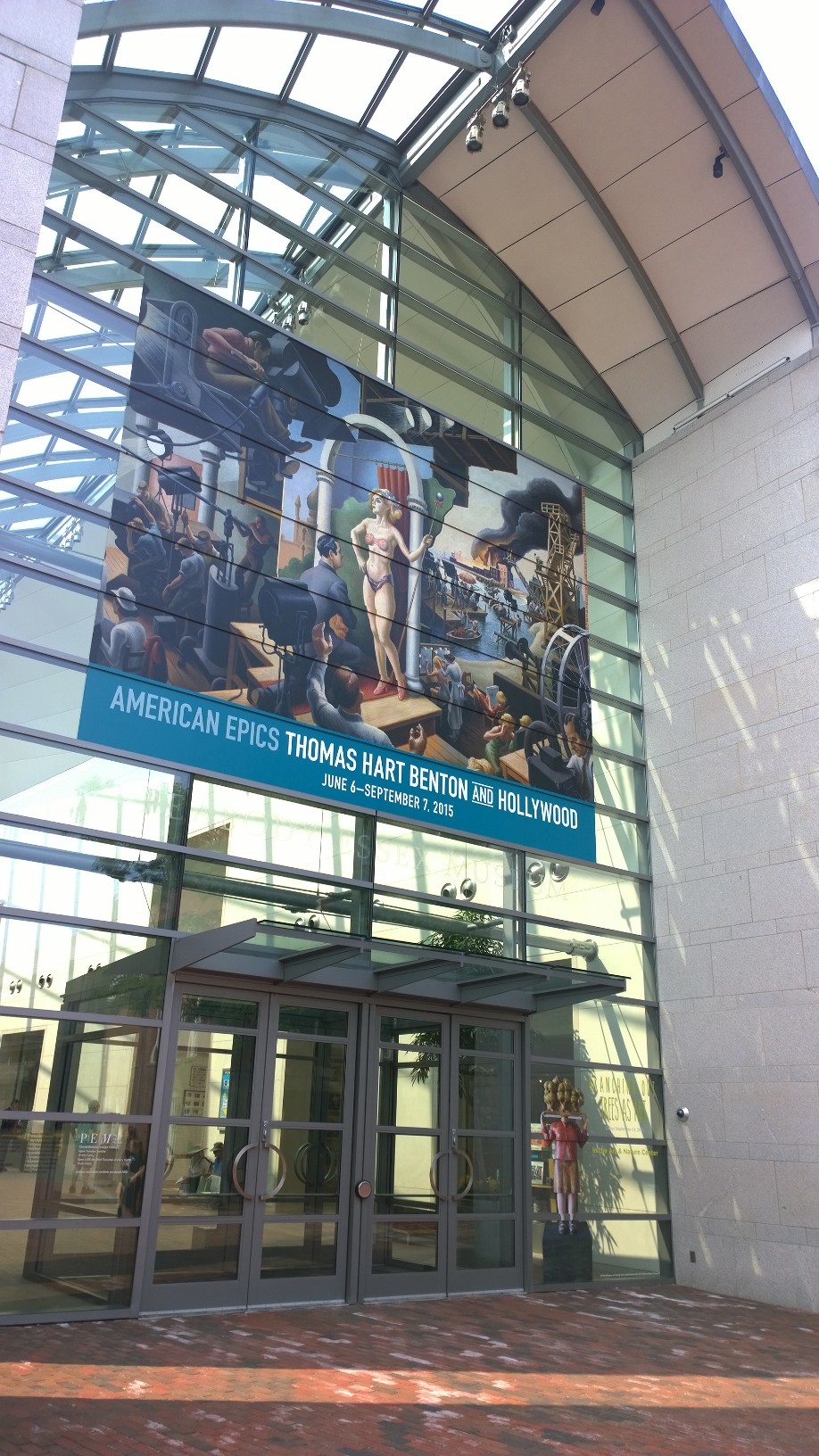
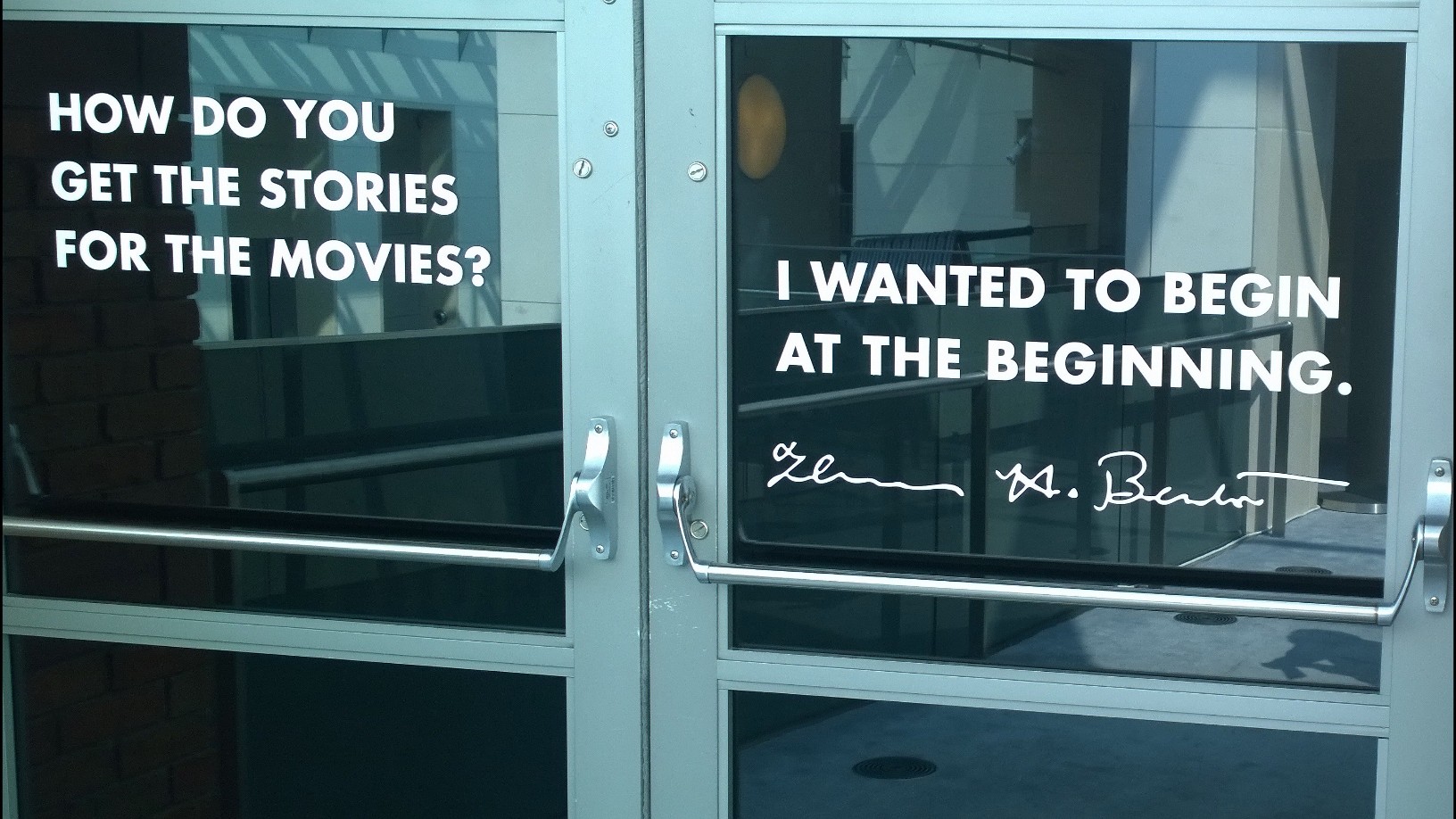
Of course, there was a lot more than that to the exhibition “American Epics: Thomas Hart Benton and Hollywood,” a sweeping retrospective of most of the artist’s work: murals showing Indians or slaves being mistreated, paintings of the the vibrant life of the West and Midwest, detailed depictions of the inner workings of Hollywood sets, designs for the Henry Fonda version of The Grapes of Wrath, illustrations for an edition of Huckleberry Finn, posters touting the contributions of African Americans to the war effort.

The day before, I had been hearing about Irving Berlin’s dedication to the war effort, and I think these two different artists conveyed, more viscerally than I had previously experienced, the underlying fear prevalent at that time. Since I grew up after it was all over, I probably unconsciously assumed that everyone always knew the Allies would win.

Do go to the show at the Peabody Essex Museum in Salem. You have until September 7. An enormous array of Benton’s work has been gathered from near and far — and there are some intriguing movie clips. (I was moved by a character’s tears to put The Grapes of Wrath on my Netflix list.)

Details of the exhibition here, at the PEM website.

071215-Thos-Hart-Benton-show

071215-Thos-Hart-Benton-at-PEM

Read Full Post »