
Feeds:
Posts
Comments

Posts Tagged ‘hybrid’

Photo: Miami Herald/Getty.
The English language in Miami is changing.

Here’s something for readers interested in the evolution of languages. Miami has such a vibrant Spanish-speaking community that it’s developing its own version of English.

Phillip M Carter of Florida International University describes the new dialect at the Conversation, ” ‘We got down from the car and went inside.’

“ ‘I made the line to pay for groceries.’

“ ‘He made a party to celebrate his son’s birthday.’

“These phrases might sound off to the ears of most English-speaking Americans. In Miami, however, they’ve become part of the local parlance.

“According to my recently published research, these expressions – along with a host of others – form part of a new dialect taking shape in South Florida. This language variety came about through sustained contact between Spanish and English speakers, particularly when speakers translated directly from Spanish.

“Whether you’re an English speaker living in Miami or elsewhere, chances are you don’t know where the words you know and use come from…. Borrowed words are far more pervasive than you might think.

“They’re all over English vocabulary: ‘pajamas‘ from Hindi; ‘gazelle‘ from Arabic, via French; and ‘tsunami‘ from Japanese.

“Borrowed words usually come from the minds and mouths of bilingual speakers who end up moving between different cultures and places. …

“One bilingual confluence famously changed the trajectory of the English language. In 1066, the Norman French, led by William the Conqueror, invaded England in an event now known as ‘the Norman Conquest.’

‘Soon thereafter, a French-speaking ruling class replaced the English-speaking aristocracy, and for roughly 200 years, the elites of England – including the kings – did their business in French.

“English never really caught on with the aristocracy, but since servants and the middle classes needed to communicate with aristocrats – and with people of different classes intermarrying – French words trickled down the class hierarchy and into the language.

“During this period, more than 10,000 loanwords from French entered the English language, mostly in domains where the aristocracy held sway: the arts, military, medicine, law and religion. Words that today seem basic, even fundamental, to English vocabulary were, just 800 years ago, borrowed from French: prince, government, administer, liberty, court, prayer, judge, justice, literature, music, poetry, to name just a few.

“Fast forward to today, where a similar form of language contact involving Spanish and English has been going on in Miami since the end of the Cuban Revolution in 1959.

“In the years following the revolution, hundreds of thousands of Cubans left the island nation for South Florida, setting the stage for what would become one of the most important linguistic convergences in all of the Americas.

“Today, the vast majority of the population is bilingual. In 2010, more than 65% of the population of Miami-Dade County identified as Hispanic or Latina/o, and in the large municipalities of Doral and Hialeah, the figure is 80% and 95%, respectively.

“Of course, identifying as Latina/o is not synonymous with speaking Spanish, and language loss has occurred among second- and third-generation Cuban Americans. But the point is that there is a lot of Spanish – and a lot of English – being spoken in Miami.

“Among this mix are bilinguals. Some are more proficient in Spanish, and others are more skilled English speakers. Together, they navigate the sociolinguistic landscape of South Florida in complex ways, knowing when and with whom to use which language – and when it’s OK to mix them.

“When the first large group of Cubans came to Miami in the wake of the revolution, they did precisely this, in two ways.

“First, people alternated between Spanish and English, sometimes within the same sentence or clause. This set the stage for the enduring presence of Spanish vocabulary in South Florida, as well as the emergence of what some people refer to as ‘Spanglish.’

‘Second, as people learned English, they tended to translate directly from Spanish. These translations are a type of borrowing that linguists call ‘calques.’
Calques are all over the English language.

“Take ‘dandelion.’ This flower grows in central Europe, and when the Germans realized they didn’t have a word for it, they looked to botany books written in Latin, where it was called dens lionis, or ‘lion’s tooth.’ The Germans borrowed that concept and named the flower ‘Löwenzahn‘ – a literal translation of ‘lion’s tooth.’ The French didn’t have a word for the flower, so they too borrowed the concept of ‘lion’s tooth,’ calquing it as ‘dent de lion.’ The English [brought] ‘dent de lion’ into English, calling it ‘dandelion.’

“This is exactly the sort of thing that’s been happening in Miami.”

Since people whose first language is Spanish live all over the US, I think any of us could come up with similar blends if we thought about it. Maybe there are some specific to English as spoken in England.

At the Conversation, here, you can read about the three kinds of calques the researchers identified in Miami. No firewall.
Read Full Post »

Photo: Philippe Clement/Getty Images.
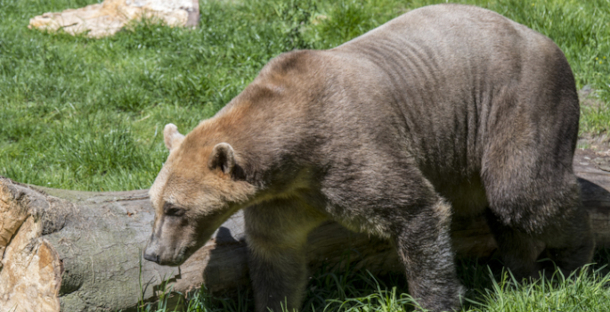
Pizzly” bears have a physical appearance that is a mix of grizzly and polar bears.

I love the environmental radio show Living on Earth, and I’m grateful that they post transcripts of programs even though natural speech requires a lot of editing. One thing I try to edit out is every “So” at the start of a sentence. When did we start doing that? I first noticed the verbal tic in 2005 at a new job. When did you?

From Living on Earth

“HOST BOBBY BASCOMB: The Arctic is warming faster than any other region on earth, it actually rained on the Greenland ice sheet in August for the first time ever. And sea ice recently reached its minimum extent for 2021. It was the 12th lowest amount of ice since scientists began keeping records. And for the endangered polar bear, a warming Arctic is bad news. With their habitat melting, polar bears are having trouble finding food. At the same time grizzly bears are moving north and, in some cases, mating with polar bears, creating a hybrid animal known as a pizzly bear. Larisa DeSantis is a paleontologist and associate professor of biology who studies pizzly bears at Vanderbilt University. …

“How do these hybrids compare with the parent species of grizzly and polar bears?

“LARISA DESANTIS: A pizzly bear is essentially an intermediate between these two. It’s a hybrid species, and it’s actually fertile. … Polar bears tend to have really elongated skulls. And this is because they’re really well suited for being able to hunt seals in sea ice. [They] get into those holes and effectively hunt those seals. The grizzlies have much shorter skulls, and they’re able to exude really high bite forces to be able to eat really hard foods when needed. And so essentially, this pizzly is intermediate between those two, you can also see that their coloration is sort of intermediate. [They’re] a bit lighter in coloration than a grizzly, but darker in coloration than a polar bear. … They’re better swimmers than grizzlies, not as good as polar bears. [As] we’re dealing with a warming Arctic, we really don’t know how these pizzlies will do in the future, and they may be better suited for the warming Arctic than the polar bear.

“BASCOMB: Now, many hybrid species, like ligers, or mules, are sterile and can’t produce offspring themselves. But I think you just said that pizzly bears actually can reproduce. Does that make them their own species? …

“DESANTIS: The polar bear and the grizzly bear are really sort of a unique situation. They diverged roughly around 500,000 or 600,000 years ago. They’re pretty closely related to one another in the grand scheme of things. And they also look quite different from one another, right? These are different bears, we know they’re different species. They do completely different things in their ecosystems. They’re of different ecological niches, for example. … But you’re absolutely right, you know, they can produce these fertile hybrids, that’s really interesting. And we know that it’s actually able to persist. …

“BASCOMB: So then would you say pizzly bears are their own species?

“DESANTIS: I wouldn’t go that far. They are a hybrid. And hybrids occur pretty frequently in nature. And typically we see hybridization occurring, you know, over and over and over in particular regions where two different species are coming together. And so it’s not surprising that we see hybrids of these two bears, especially since they’re closely related. And this is because essentially, the brown bears, the grizzly bears, are moving north due to Arctic warming. The polar bears are actually having to retreat from the sea ice, the lack of sea ice, and they’re having to come further inland and often travel further south or look for other food resources. [New studies show] that they’re trying to eat [seabird] eggs. …

“This elongated skull [is] not well suited to eating just sort of any type of food source, right? It actually has biomechanical constraints that prevent it from, you know, eating really hard things. And so it’s sort of having to scavenge potentially, to find different food resources. It’ll find these bowhead whale carcass sites, that’s where the grizzly bears can also be as well. And they’re coming into increased contact and occasionally mating. …

“BASCOMB: With polar bear populations declining so dramatically with the loss of sea ice, and with climate change, as you were just saying, how likely is it that they will ultimately be replaced by pizzly bears or even grizzly bears if it gets much, much warmer? And for that matter, how would a different apex predator in the Arctic affect the whole ecosystem?

“DESANTIS: [We] really don’t know the answer to that. But what we need to do is actually monitor the polar bears, continue to monitor grizzlies, and also monitor these pizzlies, and see how they do. So as I mentioned, hybrids normally aren’t better suited than either parent species, right? But in this case, with the environment changing, they may be our hope for an Arctic bear. And what we do know about predators across the globe, and through time is that apex predators especially are really key to the functioning of ecosystems, right. This is why wolves were reintroduced to Yellowstone, because the elk populations were sort of out of control, wreaking havoc on the vegetation, things were out of balance. [The pizzly] may give us hope for an Arctic bear in a world in which we have Arctic warming.”

More at Living on Earth, here.

Read Full Post »

Once again, Sweden is ahead of the curve, as it tests two versions of an electric road. The idea is to move away from fossil fuels and creative a more sustainable energy future.

Green Car Congress is a website that covered the story in June.

“Sweden inaugurated a test stretch of electric road on the E16 in Sandviken, thus becoming one of the first countries to conduct tests with electric power for heavy transports on public roads.

“The test stretch on the E16 is two kilometers long. The technology is similar to light rail, with contact lines 5.4 meters over the roadway. The truck has a pantograph on the roof that feeds 750 VDC to the truck’s hybrid electric system. The current conductor can connect automatically at speeds up to 90 km/h (56 mph). The test stretch is equipped with posts 60 meters apart that hold up the electric lines over one of the lanes.

“At a rest area, there is a transformer for low-voltage direct current of the same type as in the light rail network. Other traffic on the road will not be affected. …

“An electrified road is one in which the electricity supply for vehicle propulsion is continuously supplied in order to keep the vehicle moving and to avoid recharging requirements. …

“The technologies for electric roads have developed rapidly over the last few years, and are now mature enough that some of them can be tested. Last year, the Swedish Transport Administration, in consultation with Vinnova [Sweden’s innovation agency for sustainable growth] and the Swedish Energy Agency, decided to give support to two test facilities. The two systems differ as to how electric power is transferred to the heavy vehicles.

  • The test on the E16 in Sandviken is being carried out by Region Gävleborg, and involves a pantograph on the roof of the truck cab feeding the current down to a hybrid electric motor in the truck.
  • Outside Arlanda, the eRoadArlanda consortium company will test a technology that involves an electric rail in the roadway charging the vehicle during its trip. …

“The tests will continue up through 2018. They will provide knowledge of how electric roads work in practice, and whether the technology can be used in the future. The experiment is based on the Government’s goal of energy efficiency and a fossil fuel-free vehicle fleet by 2030, and will contribute to strengthening Sweden’s competitiveness.”

More here.

 Photo: Green Car Congress

Read Full Post »