Feeds:
Posts
Comments

Posts Tagged ‘ian rankin’

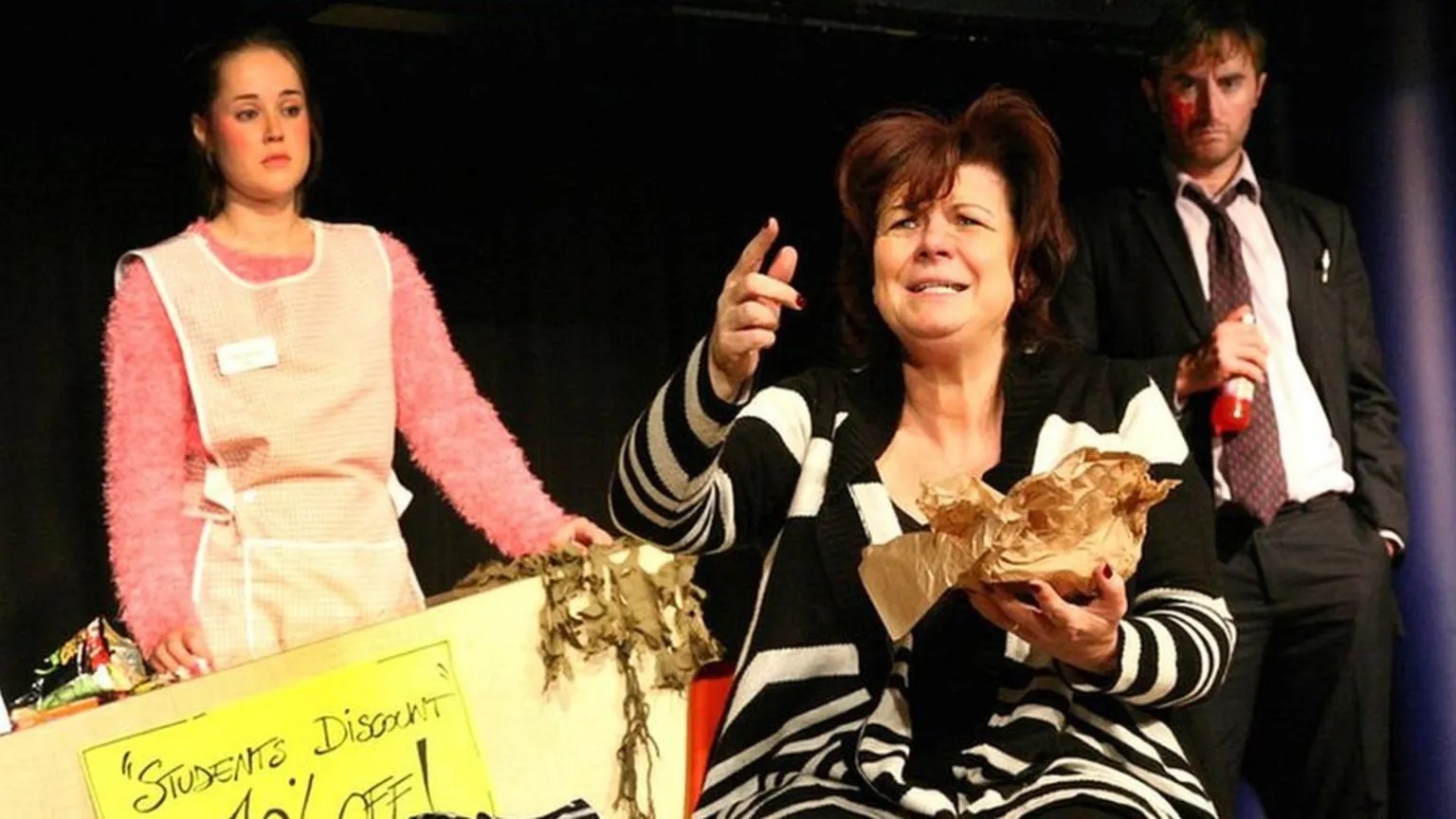
Photo: Lesley Black.
Theater company A Play, A Pie and a Pint produces up to 40 plays a year as well as two pantomimes in the Oran Mor venue in Glasgow, Scotland. Actor Elaine C Smith is pictured above.

I’m in the middle of reading a novel by one of my favorite mystery writers, Ian Rankin, who writes about Scotland. Besides his plots and characters, I love the Scottish slang. Sometimes I even have to look up expressions or words — Teuchter, Slainte, Howff. And it’s not just Gaelic words that are fun, but the Scottish way of putting English words together. For example, “getting mortal” means getting extremely drunk, smashed.

The murder mystery takes place during the offbeat theater festival known as the Fringe, which is why a recent BBC article about a Scottish theater group caught my eye.

Pauline McLean writes, “Established in 2004, A Play, A Pie and a Pint produces up to 40 plays a year as well as two pantomimes in the Oran Mor venue in Glasgow. It has given a platform to established names [and] has also helped new writers get a foothold in the industry, like Liam Moffat, whose play Jack opens the new season. …

“For Juliet Cadzow it is a bitter sweet moment. Her husband David MacLennan was the theatre director who came up with the idea. He died in 2014 after being diagnosed with motor neurone disease. …

“This is what he wrote at the time: ‘The actor Ralph Richardson once described acting as the art of keeping the audience from coughing. And Alfred Hitchcock said the length of a film should be directly related to the endurance of the human bladder. That’s why Colin Beattie and I started “A Play, A Pie, and a Pint.” ‘

“The first show was a play called Hieroglyphics, by Anne Donovan, author of Buddha Da. It was her first stage play. …

“Lunchtime theatre was already popular across Europe but the Scottish offer of a pie made it different, and brought its own challenges.

” ‘It was waiter service when it first started and everyone came and sat at long trestle tables and they were served their pie and It took time when it was busy,’ [actor Linda Duncan McLaughlin] says. ‘They wouldn’t have stopped serving before the play went up. So the waiters were trying to be quiet and and the audience were trying to be quiet but they were still eating.’

“But the concept quickly took off. ‘I think the fact that it was weekly helped,’ says Juliet. ‘If you didn’t like the play that was on that week, there would be a new one next week. And the audience were quite vociferous.

‘They would say to David “I didn’t like that one,” but they’d still come back the next week.’

“Those involved in the shows also liked the challenge of creating a 50-minute show with limited resources and rehearsals. Linda Duncan McLaughlin has written plays, as well as performing in them.

“She says: ‘You’ve got to get what basically is a full play into a fifty minute timeframe. You only have three actors, so if you wanted to write six parts, you’re going to have to be really good at writing doubling up parts and you have to make sure the actors can cope with that. It is limited but it’s a great discipline for a writer. And it really focuses your mind.’

“For some performers, it’s a chance to return to their roots, although Robbie Coltrane admitted his week long run in Peter MacDougall’s play My Father’s Old Suit in 2005 was a daunting one.

” ‘The idea of 500 Glaswegians drinking and having their dinner?’ he recalled in a 2010 documentary. ‘It’s like one of those Frank Sinatra concerts where all you can hear is the knives and forks clattering.’

“[Icelandic] writer Jon Atli Jonassan found the 2009 run of his play The Deep helped him into filmmaking. … ‘No one wanted to make it, but after the production here, we got interest from filmmakers. It was the most expensive film ever made in Iceland and was shortlisted for Best Foreign Film at the Oscars.’ …

” ‘If you’d asked us that first week, I’m not sure we would have been confident that we’d still be going twenty years hence,’ says Linda, who is co-chair of the Scottish Society of Playwrights. ‘It does offer an opportunity for new work to be on every week of the year for forty eight weeks of the year, which no other organization can offer. So it really does have a strong, vital part to play in Scottish theatre culture and long may it continue.’ “

More at the BBC, here.

Read Full Post »

1158

Photo: Duolingo
Duolingo’s popular Scottish Gaelic course launched just before St Andrew’s Day.

There’s an asylum seeker from Afghanistan I’ve been working with on English. Virtually, of course. She was already very good when we started in March, and she’s now applying to grad schools in the US. An English proficiency test is part of that process.

Imagine my surprise when I heard that the free online language program Duolingo — the one that I used for a while so as to understand Erik when he speaks to my half-Swedish grandchildren — is the designated online exam for two of the universities where my young friend is sending applications!

In the same way that the previously maligned Wikipedia gradually became a trusted source, Duolingo has risen to language program of choice.

And every year, it adds options. Scottish Gaelic, anyone?

Libby Brooks writes at the Guardian, “Almost double the number of people in Scotland who already speak Scottish Gaelic have signed up to learn the language on the popular free platform Duolingo in over a month, concluding a proliferation in courses, prizes and performance in Gaelic and Scots during 2019, as younger people in particular shrug off the cultural cringe’ associated with speaking indigenous languages.

“The Duolingo course, which was launched just before St Andrew’s Day on 30 November and looks likely to be the company’s fastest-growing course ever, has garnered more than 127,000 sign-ups – 80% from Scotland itself, compared with just over 58,000 people who reported themselves as Gaelic speakers in the 2011 Scottish census. …

“Says Sylvia Warnecke, a senior lecturer in languages at OU Scotland, … ‘In the academic world, the recognition of Scots as an important part of our linguistic and cultural landscape has existed for quite a while, but that’s not the case in other areas, like education, where Scots has always been considered “bad English,” or in popular culture, where it’s used to add humour.’

“Warnecke identifies a growing momentum, bolstered by the official recognition of the Scots language by the Scottish government and awareness of Scots as a language in its own right.

“Last year also featured the first Scots language awards, held in Glasgow in September, where the winner of the lifetime achievement award was the writer Sheena Blackhall, who was recently also named as the first Doric makar, or poet laureate.

“Doric, or north-east Scots, was forbidden in schools and dismissed as slang for decades, but is now a key part of Aberdeenshire council’s language strategy. The first language of the Sunset Song author Lewis Grassic Gibbon, Doric is taught in schools across the north-east. …

“Blackhall and Warnecke point to the impact of social media: at last year’s Edinburgh fringe, Twitter curated an exhibition celebrating the best of the #ScottishTwitter hashtag, which has become an online institution for those experimenting with the Scots language. …

“The range of written Scots has been transformed, says [Dr Michael Dempster, the director of the Scots Language Centre and Scots scriever at the National Library of Scotland], since the 70s and 80s, when writers would employ the language to portray a particular type of character. ‘That was an act of stereotype, while the narrative voice remained in standard English. Now people are writing in Scots throughout. They started picking it up from Irvine Welsh, although his writing was not in standard Scots, but now you have younger writers like Chris McQueer, who is consciously working in Scots and readers are really appreciative of that.’ …

“A team of Glasgow University researchers have been charting the richness and diversity of Scotland’s local dialects, launching their initial findings in the Scots Syntax Atlas last month.

“Encompassing ‘fit like’ of north-east Scotland, ‘gonnae no’ in Glasgow, and ‘I might can do’ from the Borders, the atlas offers a means of tracing the development of local speech patterns. For example, the influence of Irish immigration can be heard in Glaswegian Scots phrases such as ‘She’s after locking us out.’ ”

I have to say I love this sort of thing. And reading the article reminds me: I need Ian Rankin to come out with a new Scottish mystery soon. I want to know what ex-detective John Rebus is up to in retirement. And I need to hear those intriguing “Borders” phrases and the accent in my head.

Check out the Guardian article here.

Read Full Post »

Asakiyume has alerted me to a great story about an anonymous library patron in Scotland who creates sculpture from old books and deposits them in libraries by stealth. The artist makes reference in his (her?) sculptures to Scottish mystery writer Ian Rankin and dragons and all sorts of literary things. You will flip over the pictures here.

Asakiyume says she likes the quotations that the mystery artist leaves with the sculptures: “I liked ‘Libraries are expensive,’ corrected to ‘Libraries are expansive,’ and also the quote from Robert Owen … (founder of some utopian communities) … ‘No infant has the power of deciding … by what circumstances (they) shall be surrounded.’ ”

The messages remind me of the mysterious tea cups of Anne Kraus, which I described here.

Now although Asakiyume knew I would love the book art, she may not have known that I have a family reputation for stealth projects, like secretly leaving a small Zimbabwean soapstone sculpture of parents and baby in John’s house after Meran gave birth.

Recently, I was telling Erik about a few of my escapades, and he got a look on his face suggesting that he was a little worried about the family he had married into.

When I was on the publicity committee for a local theater producing a musical about George Seurat, I purchased Seurat greeting cards and left them in stores’ card racks around town. They got sold, but the sales staff would have had to wing the price as there was no price on them.

Then there was the year that I sent a series of postcards from different cities under different names to an ice cream shop and in each card suggested a type of frozen dessert the shop should carry. Every card had a different reason why customers might want that dessert.

It worked, and the shop must have made money off the dessert as they stocked it for years afterward.

Photo: ThisCentralStation.com

Read Full Post »