Feeds:
Posts
Comments

Posts Tagged ‘idaho’

Photo: Matthew Podolsky
Conservationist Alfred Larson, 96, has installed hundreds of bluebird next boxes in southern Idaho, allowing scientists to study Mountain Bluebirds as the species recovers from a decline.

In my area of New England, I don’t often see bluebirds. I see lots of bluebird houses people put up to entice them, but few bluebirds. You can imagine how excited I was one wintry day a few years back when a whole flock showed up in our deciduous holly. It was amazing. And never repeated.

A conservationist in his 90s who wanted to learn more about Western and Mountain Bluebirds has turned southern Idaho into a bluebird haven. Now, that’s something I’d like to see!

James Crugnale writes a the Audubon website, “In 1978, Alfred Larson was looking for a hobby that would keep him busy after he retired from his job at a sawmill plant near Boise, Idaho. He remembers reading an article in National Geographic that captured his imagination—about crafting wooden nests for bluebirds to save them from dizzying declines. Around this same time, he and his wife Hilda welcomed a new guest to their backyard: a Western Bluebird.

“ ‘We noticed a bluebird going in and out of a cavity of an old, dead snag,’ Larson says. … I had heard about bluebird trails out East that Lawrence Zeleny had set up. If I put up boxes on my ranch, I’d have a captive group of birds to take pictures of.’ …

“Four decades later, at the age of 96, Larson is monitoring almost 350 nest boxes on six different bluebird trails across Southwest Idaho. From the Owyhee Mountains to Lake Cascade, he and his fellow community scientists peek into the rustic abodes every nine days to band any residents and jot down notes on behavior and growth. Larson organizes the data and shares it with the Cornell Lab of Ornithology‘s Nestwatch program. …

“Prior to the big nest box craze, all three North American species—Western, Mountain, and Eastern—saw a major dip in population numbers, due to ‘the elimination of dead trees with the invention of gas-powered chainsaws in the 1930s . . . along with the widespread use of pesticides to kill insects,’ says bluebird photographer and expert Stan Tekiela. Studies in the 1970s tied DDT to the death of hundreds of Mountain Bluebird chicks in western Canada. …

“Many of Larson’s trail buddies are wary of the day he decides to retire again. Boyd Steele, a volunteer who regularly assists Larson with the nest boxes, says the nonagenarian has been steadily passing down his knowledge. But his devotion to bluebirds will be hard to replace. ‘I don’t think there’s anybody who is as dedicated as Al,’ Steele says.

“Filmmaker Matthew Podolsky echoes that sentiment. After being introduced to Larson through a graduate advisor at Boise State University, he and his peer Neil Paprocki tracked the local legend with a camera for weeks. The resulting 30-minute documentary, titled Bluebird Man, of course, went on to be nominated for an Emmy Award in 2015.”

More here, at the Audubon website.
Read Full Post »

Photo: Richard Lane/Basque Library, University of Nevada, Reno
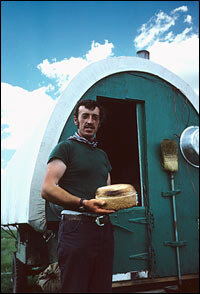
A herder holds freshly baked bread. His sheep wagon was a camp on wheels with beds, a table, and a wood stove. In the early days, a team of horses pulled the wagons.

I was driving to Providence and listening to the radio when I heard a story about Basque men who emigrated to the American West years ago because they needed jobs and because Idaho, Nevada, and other states needed shepherds.

Although the Basques actually knew nothing about being shepherds, they persisted, and today significant Basque communities remain.

Kimberlee Kruesi writes at the Associated Press, “Idaho is home to one of the biggest concentrations of Basques in the United States. … Basques began settling in southwestern Idaho as early as the late 1800s, with many coming from the Basque region on the border of Spain and France to work as sheepherders in Idaho. Nearly 8,000 residents of the Gem State identify as Basque today. …

“The Basque Museum and Cultural Center is packed with exhibits that explore the lives of the first Basque sheepherders, including a sheep wagon and full-size sheepherder’s tent. …

“The Basque Market … has become famous for preparing large portions of paella, served with homemade baked bread every Wednesday and Friday right on the patio. …

At National Public Radio, the Kitchen Sisters reported on the life of Basques in Nevada.

“Francisco and Joaquin Lasarte came to America in 1964 from Basque country in northern Spain. Francisco Franco, the Spanish dictator who repressively ruled the country for nearly 40 years, made life miserable for the Basque people, suppressing their language, culture and possibilities.

“The result was a massive exodus, and the only way to come to the United States for many Basque was to contract as sheepherders. There was a shortage of shepherds in the American West. …

“Neither Lasarte brother had any sheepherding experience when they arrived in America.

” ‘You lonely, you by yourself,’ Francisco Lasarte said. ‘My God, you with 2,000 sheep and two dogs and you don’t know what to do, where to go.’

“The brothers were contracted for five years to this life. It was a sentence.

“Each brother had his own flock, and they rarely saw each other or anyone else for months on end. Mostly they ate lamb and bread cooked in a Dutch oven in a hole they dug in the ground. You can still find these holes up in the mountains of Idaho, Montana, Nevada and California.

” ‘You say Basque to a Westerner and you think sheepherder,’ said Mark Kurlansky, author of The Basque History of the World. “In Basque country very few people were shepherds.’ …

“William Douglass, former director of the Center for Basque Studies at the University of Nevada, Reno, describes this solitary life.

” ‘Teenagers were ripped up out of their communities back home, brought to a foreign land, with a foreign language, put up on top of a mountain … crying themselves to sleep at night during the first year on the range.’

“The Basques have a family-oriented, communal culture, gathering around big tables to eat, drink and sing. This solitary life in remote mountains ran against the grain.” More at NPR, here.

Photo: Kimberlee Kruesi/The Associated Press
The Basque Center displays both the United States flag and Basque flag in Boise, Idaho.

Read Full Post »