Feeds:
Posts
Comments

Posts Tagged ‘information’

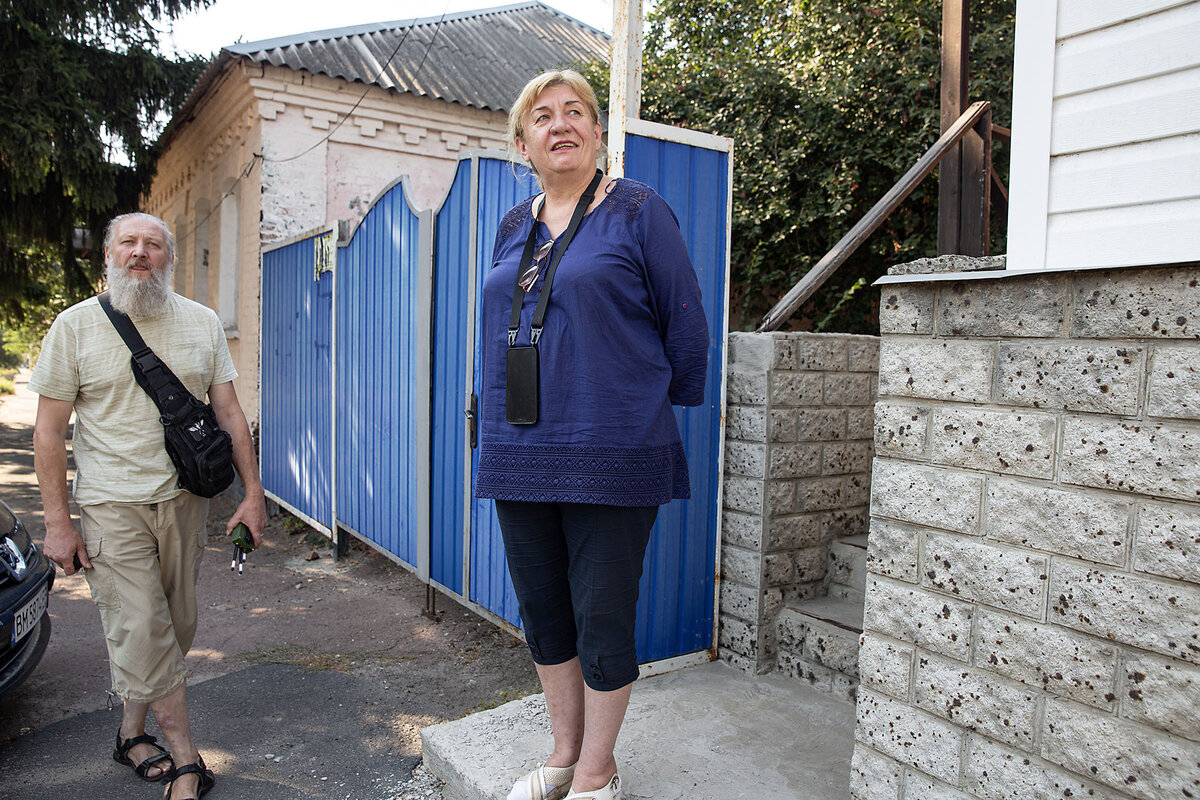
Photo: Dominique Soguel.
Nataliia Kalinichenko and her husband, Yurii, outside the office of the print weekly Bilopilshchyna, which they have continued to publish despite the war.

And while we’re on the subject of Ukraine, I want to share a story while it’s fresh, because in a war zone, you never know how long a piece of good news will last.

Dominique Soguel (with support from Oleksandr Naselenko) reports at the Christian Science Monitor, “The streets of [Bilopillia, Ukraine], just seven miles from the Russian border, are nearly deserted. Air-raid sirens have been a round-the-clock reality for weeks, and people take them seriously: When the warnings blare, everyone lies flat to take cover or scrambles to underground shelters.

“But for Nataliia Kalinichenko and her husband, Yurii, there’s no break from getting the news out to the community. They have safety routines; Ms. Kalinichenko asks friends or relatives to monitor social media platform Telegram for news of incoming Russian attacks, while Mr. Kalinichenko uses a drone detector while driving. But their mission is to keep locals informed through publication of their print weekly, Bilopilshchyna.

“Before the war, the newspaper featured 12 to 16 colorful spreads with articles on local entertainment, politics, and practical information like bus schedules. Now, it is a stark black-and-white publication filled with military and civilian obituaries and snapshots of local buildings destroyed by Russian attacks.

“ ‘With the onset of Russia’s invasion, our community’s information needs changed dramatically, as did our ability to meet them,’ says Ms. Kalinichenko, who joined the newspaper in 1996 and became its editor-in-chief a decade later. ‘Safety became the primary concern.’ …

“The information landscape has transformed over the past 2 1/2 years. Televisions, once tuned to Russian and Ukrainian channels, lost their appeal. The first Russian strike on the town’s television tower in March 2022 marked the beginning of a series of barrages. Telegram, which now tracks incoming missiles, has become a lifeline – though it requires electricity and an internet connection. Both have been hard to reliably access amid Russia’s offensive. …

“Inevitably, the community has shrunk. The agricultural district of Bilopillia was once home to about 16,000 residents. Now the figure is between 3,000 and 8,000, according to Ms. Kalinichenko. Residents come and go depending on attacks and electricity supplies. New arrivals from other regions temporarily swell the numbers.

“The Kalinichenkos are determined to stay put and keep the paper running as a team. On the walls of their office hang photographs documenting the paper’s history, including a period when it was known as the Flag of Stalin. Piles of newspapers are testament to disruptions in postal delivery services, and a collapsed ceiling from a recent blast prevents Ms. Kalinichenko from sitting at her usual desk.

“At a nearby shop, salesperson Nina Davydova and her teenage daughter, Victoria, discuss the toll of constant strikes. Though Victoria gets her news only through Telegram, Nina says Bilopilshchyna is still popular.

“ ‘People really like to buy the newspaper,’ she says, pointing out that she has already sold six copies this morning, even though Russian attacks were particularly intense. ‘Grandmothers will buy five to six copies so that they can bring it to their neighbors who cannot walk.’

“The newspaper sells at 20 locations in the Sumy region, which shares a 28-mile border with Russia. While many readers have fled, they continue to pay for a subscription in order to remain connected to their homeland, says Ms. Kalinichenko. Even in its reduced format, it serves as a vital source of information for local agricultural communities.

“Serhii, a sardonic shopkeeper, displays the latest copies alongside shrapnel that damaged his shop, which sits a few blocks from Nina’s. ‘If people would not buy it, I would not sell it,’ he says. ‘About five people buy it every day. But people also come from surrounding villages on market days to buy 10 copies at a time.’

“Articles pay tribute to slain soldiers and quote analysts to dispel rumors and dismantle Russian disinformation. One recent instance involved pollution of the river Seim – caused by industrial activities upstream in Russia. Russian trolls on Telegram spread the notion that drinking water had also been compromised, but that was not actually the case. Experts quoted in the paper helped debunk that notion.

“ ‘For villagers with no internet, it is an important source of information and local news,’ says Serhii.

“That assessment is echoed by customer Dymtro Potiomkyn, who grew up with the paper on the family table. He recalls it being a way for people to buy and sell goods locally. Today, it publishes information about what kind of social help is available locally. He buys the paper in person, while his mother gets it delivered by mail.

“ ‘This newspaper is crucial for villages that are right on the border with Russia,’ says Mr. Potiomkyn, who runs a funeral business in the region. ‘Some have been without electricity or internet for years. It’s literally their only source of Ukrainian news.’ “

I know from my own four-month remote gig with a Ukrainian news outlet that Telegram is important to the information landscape there. I also know about Ukrainians’ concern that the outside world gets false information from social media posted by Russians. That’s why Americans like me were helping Ukrainian journalists put their own Twitter and Facebook updates in colloquial English. My experience here.

More at the Monitor, here. No paywall. Subscriptions are reasonable.
Read Full Post »

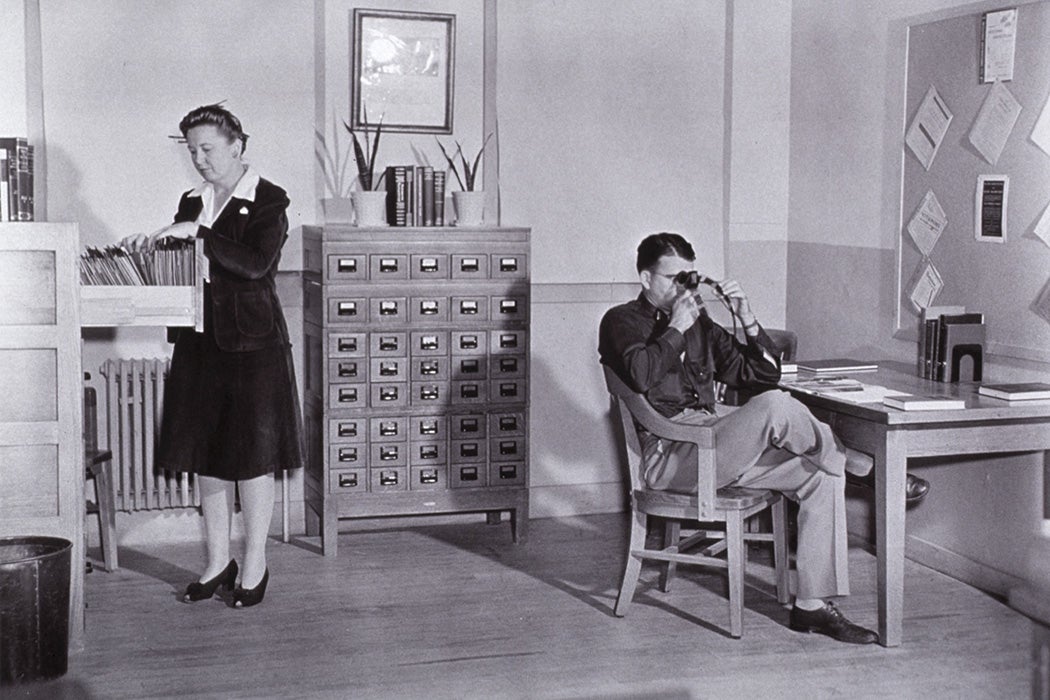
Photo: JSTOR.
A librarian at the San Antonio Aviation Cadet Center and a patron examining microfilm. US librarians and the invention of microfilm were important to the war effort in the 1940s.

The enduring appeal of fictional detectives like Miss Marple has something to do with the idea that they are very unlikely sleuths. The “mild-mannered” (like Superman’s alter ego Clark Kent) are always undercover, and criminals never notice they are being casually but carefully observed.

Librarians, too, often described as “unassuming,” are not exactly James Bond material. But as we learn in today’s true story, they may provide vital intelligence in wartime.

Katie McBride Moench at JSTOR Daily writes, “In war, as in everything, information is power. And for the United States and its allies in World War II, an epic battle from an analog age, that meant obtaining and transmitting by hand useful intel. ….

“Enter the librarians, tapped by US government officials to help in this effort. These librarians adopted technology from other fields to photograph an array of documents, including those that were rare and/or archival, and found means of sending them across continents. They used both microfilm and microphotography — technologies that came to play a key role in the wars of the twentieth century.

“To the librarians of the World War II-era, microforms were a revelation; microfilm, for instance, was revolutionizing universities. Before its adoption, scholars generally traveled to sites housing materials they wanted or hired locals to do research on their behalf. Microfilm, the product of scaling text or graphics down into miniature forms, made it possible to streamline this process and ship scans anywhere. All that was needed was a microfilm reader on the receiving end to enlarge a scan to the point of readability. This innovation vastly broadened the scope of information researchers around the world could now access.

“It became clear to President Franklin Roosevelt in the months before the US entered the war in 1941 that there was a lag in intelligence gathering. To rectify this, Roosevelt tapped William ‘Wild Bill’ Donovan, a veteran and lawyer, to develop the Office of Strategic Services (OSS) — the precursor to the Central Intelligence Agency. Donovan worked with Archibald MacLeish, a Librarian of Congress who saw the potential for librarians to serve as valuable assets. …

“Under the auspice of the Interdepartmental Committee for the Acquisition of Foreign Publications (IDC), co-created by Donovan and Roosevelt, he enlisted the help of librarians and researchers from across the US.

Adele Kibre, the daughter of a connected Hollywood family, was one such recruit, working out of the IDC’s Stockholm office. Kibre attended the University of California, Berkeley; thereafter she went to the University of Chicago for graduate school, getting a PhD in medieval linguistics in 1930. Like many women of her day, she was denied a career in academia and instead conducted research for other scholars. On one such assignment, she visited the heavily restricted Vatican archives to photograph rare manuscripts; there she saw fellow researchers using microphotography.

“ ‘I acquired the habit of visiting the photographic studio in order to observe philologists, paleographers, and art historians rapidly filming their research materials with miniature cameras,’ Kibre is reported to have said, according to Kathy Peiss’s Information Hunters. Kibre followed suit with a microfilm-producing micro-camera and sent the films back to her employers. …

“Of course, microfilm was only part of the puzzle of increasing the information the US government gathered. … Kibre and IDC staff cultivated relationships with members of resistance movements and Allied sympathizers, creating a pipeline of scientific information leading to the US. Kibre was celebrated for the volume of sources she assembled. She relied on her experience talking her way into archives, museums, and rare books storerooms and on her knack for building relationships with the guardians of these institutions. She cultivated ties with government agencies, librarians, and booksellers sympathetic, or at least agnostic, to the Allied cause. …

“In total, the Stockholm station delivered more than 3,000 books and documents to the US during the war. … The IDC likewise established a station in Lisbon, where its work represented a collaboration between Ralph Carruthers and Reuben Peiss [uncle of author Kathy Peiss] of the OSS and Manuel Sanchez of the Library of Congress. 

“Arriving in Portugal in early 1943, Sanchez spent his first few days shaking the undercover agents trailing him. Once he evaded them, he began buying printed matter he believed would be of value to the Library of Congress. He also cultivated a partnership with the Andrade brothers; they owned a bookstore and were Allied sympathizers.

“The three men habitually crossed into Franco-controlled Spain to elude suspicion during book-buying expeditions. Meanwhile, Carruthers, an expert on microfilm, photographed thousands of pages of text, and Peiss, a librarian, developed systems of information classification and retrieval for the mass of intel collected. So extensive was their work that staff members worked ’round-the-clock shifts to photograph obtained documents, using micro-cameras to create microfilms that would be shipped on a Pan Am Clipper.”

More at JSTOR Daily, here. No firewall.

Read Full Post »

When pandemic restrictions caused the cancellation of African musicians’ concerts, many took the coronavirus battle into their own hands, without having to be asked by any government to create a public service announcement.

Public Radio International’s The World reports on the wave of Covid-19 songs giving Africans reliable information and warning against fake health news on social media.

“When graduate student Dipo Oyeleye heard the song ‘We Go Win (Corona)‘ by Cobhams Asuquo, a Nigerian singer-songwriter,” the radio show reported in September, “he knew what his next research project would be: a study of the myriad coronavirus songs that flourished in Africa at the pandemic’s onset on the continent. …

” ‘I love artists using the moment to create music that actually helps to disseminate the right information to the general public,’ Oyeleye told The World.

“Originally from Nigeria himself, Oyeleye studies at the University of Wisconsin, Madison, where he is now researching COVID-19 songs from Nigeria to Uganda, Democratic Republic of Congo to Ghana, among many other places across the continent. Oyelele has been able to compile and track the impact of at least 50 songs from various African artists.

“Unlike the US, where very few artists have taken on COVID-19 as a subject in songs, African musicians quickly turned to their songwriting as a form of communication and to disseminate crucial public health information: social distancing, washing hands and staying home during lockdowns. 

” ‘This is a major [pandemic that] directly affects everybody, including the musicians. Some of them had to cancel their shows. I think the personal became political,’ Oyeleye explained. 

“Having battled epidemics such as the Ebola virus, most Africans are used to governments that call on musicians to produce ‘edutainment,’ or songs with a message to sensitize the public. 

“But Oleyele says that what makes the coronavirus songs different is that it was not ‘necessarily initiated by the governments. It’s just, you know, individuals lending their voices to help prevent the spread of the virus.’ 

“Some artists took a direct public health approach, while others used humor or religion to ease fears and connect with various communities. And some songs were specifically meant for people who could only communicate in local languages. There’s really something for everyone. …  

” ‘Wash your hands / love each other / we go win o,’ [Asuquo] croons at the piano.

“In [a] reggae-inspired song, Bobi Wine opens with the bad news that ‘everyone is a potential victim’ of the virus, but also a potential solution … and calls it ‘patriotic’ to social distance and isolate if sick with possible virus symptoms.” More at PRI’s The World, here. Extra details at the Washington Post, here.

I’m impressed with these musicians. Will we get songs to slow the spread here, too?

Read Full Post »