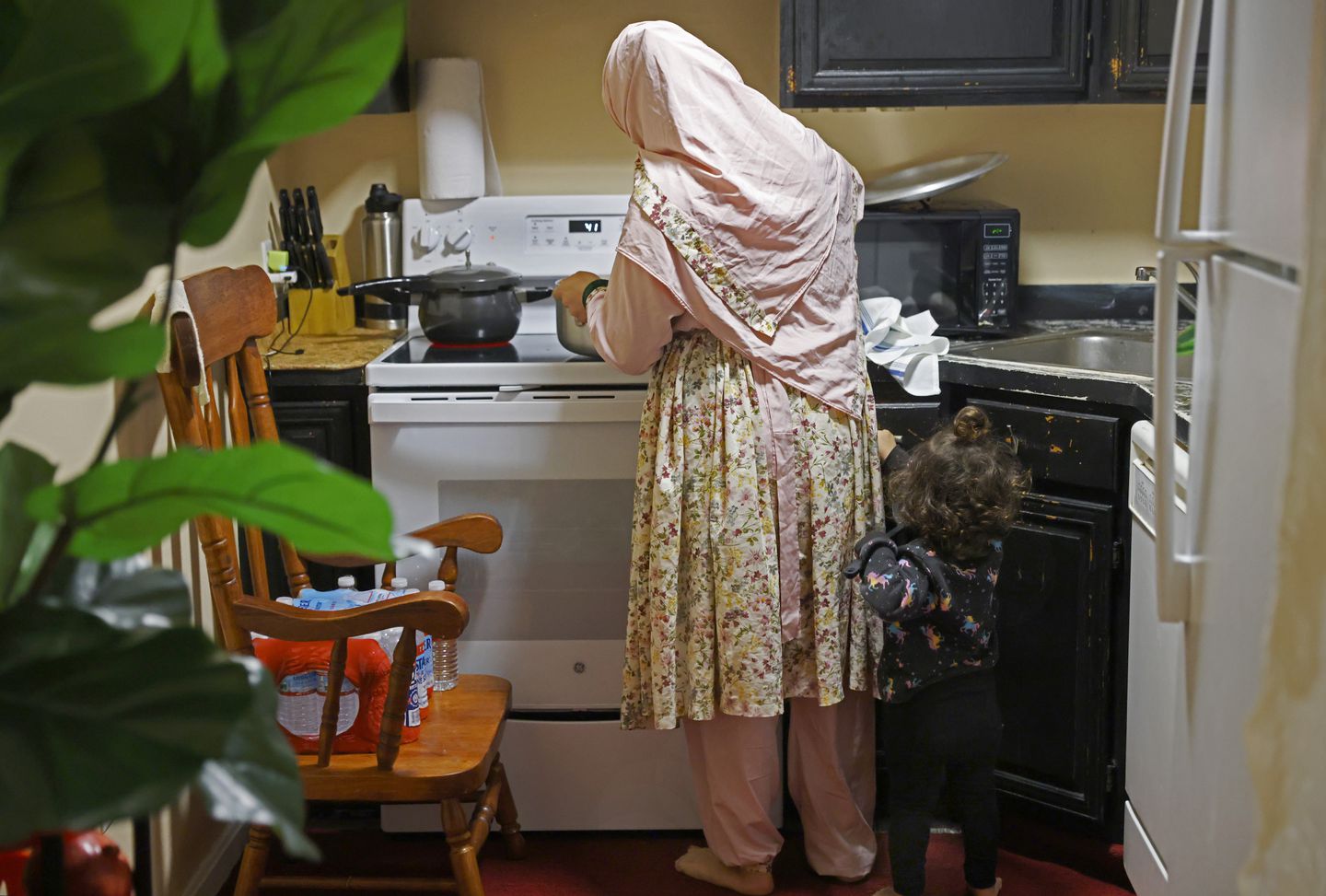
Photo: Pat Greenhouse/Boston Globe.
Samya prepares an evening meal. Back in Afghanistan, Samya and Noori’s fathers are out of work and their families struggle to find enough to eat. Noori sends them $200 to $400 a month.
In today’s story, an Afghan who worked as an interpreter for US troops builds a new life for his family in Lowell, Massachusetts, a longtime “gateway” city for new Americans.
Alexander Thompson reports at the Boston Globe, “Scarcely any of the 40 Afghans who trooped off planes at the Manchester, N.H., airport on an unseasonably warm day on Nov. 18, 2021, had ever heard of Lowell.
“Among the dazed and weary refugees at the airport was an irrepressibly optimistic former US military interpreter called Noori. His wife, Samya, and two young daughters, Taqwa and Zahra, were at his side. They were exhausted, but they were safe.
“Noori recalled that he didn’t know a single person in New England. He didn’t have a job. Or a car. Or an apartment. Or a winter coat. But he had his family. ,,,
“After a harrowing escape and a grueling journey halfway around the world, Noori and his fellow Afghans quickly found that life in Lowell is no Hollywood movie.
“ ‘We thought that in America all the facilities of life were going to be provided for you,’ he said. ‘It’s true that it has, if you work [for it].’
“Noori and several hundred other Afghan refugees who have been resettled in Lowell have set about doing what they could not in their own country. They’re building lives in peace while forging a united community that is, slowly, bridging the divides of language and creed that have riven Afghanistan for decades.
“ ‘The United States of America did not build a nation in Afghanistan, and now the Afghans who are here are trying to build a new nation here in the United States,’ said Jeff Thielman, president of the International Institute of New England, which resettled many of the Afghans.
“And in the past year, Noori has gone from being just another Afghan in the crowd to a community leader, always eager to help his compatriots even as he navigates his own obstacles in the new country he’s proud to now call home. …
“Getting his license at the end of March was a huge relief. It felt like a hard-earned victory after the family’s first few months in Lowell, which had been difficult at times.
“Noori was lucky that the Lowell Community Health Center hired him days after he arrived as a Dari and Pashto language interpreter for their influx of new Afghan patients. But rent, Wi-Fi, and heat were expensive. They also desperately missed their families back in Afghanistan.
“ ‘Whenever I’m talking to my mom, she was crying because we are away from her, so this is the hardest part,’ Samya said, with her husband interpreting from Pashto.
“[Samya’s] and Noori’s fathers are out of work and their families struggle to find enough to eat amid Afghanistan’s worsening humanitarian crisis. Noori sends back $200 to $400 a month.
“Worse still, as Noori would acknowledge many months later, the family was feeling trapped and helpless in a tiny apartment. Fortunately for Noori and the other 275 refugees who eventually settled in Lowell, there was a group of Afghans who had arrived in the area years earlier and who offered support and guidance. The group’s de facto leader, named Mohammad Bilal, is another former military interpreter, who arrived in 2014.
“Among the first things Bilal and the others did was establish a WhatsApp group for the new arrivals.
“ ‘We will just call to the community if there is someone available, just please help this family. … They were going to get [the refugees] food, they were there to get them to the hospital,’ Bilal said. ‘Whatever their need was, we were helping them.’
“Noori had an extra advantage: Major White [who helped him escape] was still looking out for him. White knew Noori needed a car, so he set up a GoFundMe page that raised $14,000 and bought Noori a used Ford Focus. …
“By May, doing checkups with every new Afghan, [Dr. Rob] Marlin and Noori were the clinic’s dynamic duo. Marlin brings the medical knowledge and Noori the linguistic and cultural savoir-faire. Each patient reveals aspects of Afghan life in Lowell. …
“Before one checkup, Noori pointed out to Marlin that a man’s name indicated he is a member of the persecuted Hazara ethnic group. That prompted Marlin to probe deeper about the man’s roommates and whether he feels safe.
“ ‘He will often find out something that I didn’t ask about, that I hadn’t thought about,’ Marlin said.”
Read more about the Marine who aided the family’s spine-tingling escape and about their new life, here.

 Suzanne's Mom's Blog