Feeds:
Posts
Comments

Posts Tagged ‘istanbul’

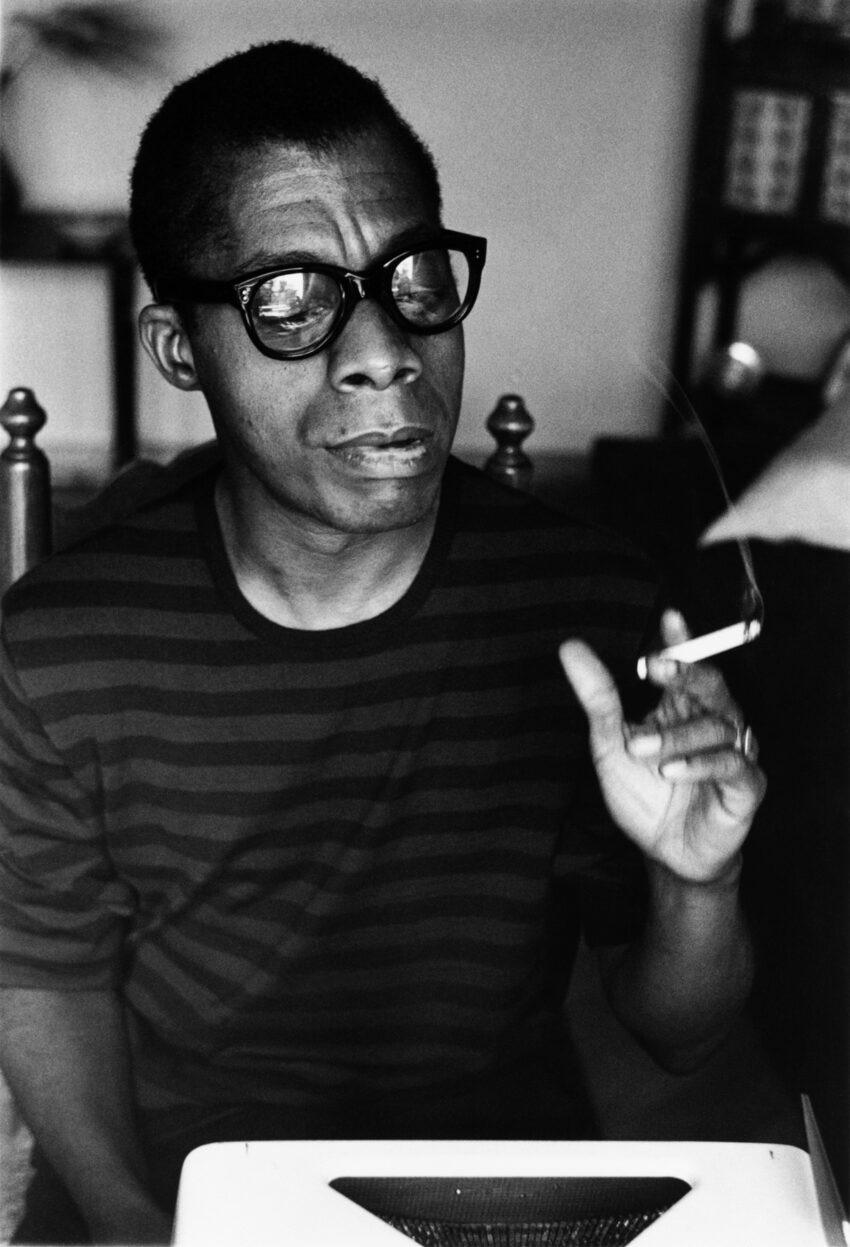
Photo: Sedat Pakay, Hudson Film Works II.
James Baldwin in Istanbul in 1966.

James Baldwin didn’t kid himself about life in America for a gay Black man in the 1960s. He traveled widely and lived for long stretches in countries he found more hospitable. (A 2016 post, here, addresses an effort to preserve a house he bought on the Côte d’Azur.)

I knew about France but not Turkey, which Azareen Van der Vliet Oloomi writes about in the Yale Review.

At the beginning of the “11-minute black and white documentary, James Baldwin: From Another Place, directed by Sedat Pakay and filmed in Istanbul in May 1970, … he turns his back to the cam­era and opens the curtains. A sharp Mediterranean light floods in. Baldwin scratches the small of his back, and we hear him say in voiceover: ‘I suppose that many people do blame me for being out of the States as often as I am, but one can’t afford to worry about that because one does, you know, you do what you have to do the way you have to do it. And as someone who is outside of the States you realize that it’s impossible to get out, the American powers are everywhere.’

“The camera pans over the glittering Bosphorus Strait as American ships glide silently through the passage connecting Asia and Europe.

“Pakay’s film has long been almost impossible to see in the United States, aside from a short clip on YouTube. But in February, it began streaming on the Criterion Channel, and its reappearance is a useful occasion to re-examine one of the most important, and yet relatively unknown, aspects of Baldwin’s career: his time in Turkey.

“At the time Pakay made his film, Baldwin had been living in Istanbul intermittently for almost a decade. He first arrived there in 1961, broke, emotionally spent, and struggling to complete his third novel, Another Country. The Turkish actor Engin Cezzar, who had met Baldwin in New York in 1957 when he was cast as Giovanni in the Actors Studio adaptation of Giovanni’s Room (Baldwin’s sec­ond novel), had given him an open invitation to visit, and follow­ing a demoralizing trip to Israel, Baldwin showed up on Cezzar’s doorstep.

“He quickly made himself at home, and over the next ten years lived irregularly in Istanbul, Erdek, and Bodrum, socializing with the Turkish intelligentsia and a small circle of Black artists and activists who were living in Turkey or passing through.

“Istanbul offered Baldwin a refuge during the tumultuous decade of the 1960s. In a 1970 conversation with Ida Lewis for Essence mag­azine, Baldwin said of his decision to move to the city, ‘It was very useful for me to go to a place like Istanbul at that point in my life, because it was so far out of the way from what I called home and the pressures.’ …

“Baldwin had first left the United States, for Paris, in 1948, and had lived out of the United States for years prior to his arrival in Istanbul. But the clarity and safety afforded by his time there allowed him to more sharply articulate America’s assaultive realities and to give expression to the connections between his personal wounds and the scars of racialized political history. …

“[His] layered inner landscape mir­ror the city’s multifaceted character, with its refusal of neat distinc­tions between tradition and modernity, East and West, Christianity and Islam.

“Istanbul was a liminal space of healing for Baldwin, a writing haven that he saw as having saved his life. As [Magdalena Zaborowska, author of James Baldwin’s Turkish Decade] notes, this may explain why the Baldwin we see in Pakay’s documentary is far more relaxed and at ease than the Baldwin we are accustomed to seeing in American media from that era.

“And yet, Baldwin’s decade in Turkey remains an enigma and a lacuna in our collective imagi­nation. Zaborowska’s is the only book-length treatment of Baldwin’s time there, and even people familiar with Baldwin’s writing are often unaware he ever lived in Istanbul. … What does the warm, vul­nerable, and playful Baldwin captured on film by Pakay tell us about his need to leave America time and again in search of safety?

“The respite Turkey offered Baldwin, combined with Istanbul’s vibrancy and the warmth with which he was received, sparked one of the most prolific periods of his artistic life. In 1961, when he first arrived, he was haggard and exhausted. 

“His trip to Israel had deep­ened his disillusionment with Christianity, and he was still mourn­ing Eugene Worth, a Black socialist and dear friend, who, in 1946, had killed himself by jumping off the George Washington Bridge. In addition, Baldwin had been trying without success to complete Another Country, his courageous and groundbreaking exploration of bisexuality and interracial love.

“Worth’s death, which Baldwin memorializes in Another Country, had devastated Baldwin for years, and he had tried and failed again and again to finish the novel until he was delivered from the strain of severe writer’s block in Istanbul. Baldwin wrote the book’s final sentence while at a party at Cezzar’s house in what he described as ‘the city which the people from heaven had made their home.’ …

“The years Baldwin spent off and on in Turkey coincided with one of the country’s most vibrant and expansive periods. The 1950s in Turkey had been a period of economic decline, ruthless author­itarianism, and iron-fisted censorship, a confluence of negative forces that gave rise to mass mobilization and to student-led pop­ular protests. …

“By 1965, free elections had been restored, and liberal constitutional reform had significantly expanded freedom of speech. The nation’s position as a strategic U.S. ally had been salvaged, but its cultural flowering continued, along with anti-imperialist and anti-capitalist move­ments similar to those that were emerging elsewhere around the world. Baldwin’s work and lived experience spoke directly to the political and aesthetic debates of the time. In Turkey, in a context of cultural ferment, Baldwin was revered as a major American and transnational writer, rather than being put in a position of having to prove his legitimacy over and over.

“Still, even in Turkey, Baldwin could not fully escape America. During the Cold War, relations between the United States and Turkey were founded on military collaboration and cooperation; the United States sent ships to Turkish waters to counter the threat of Soviet expansion, making Turkey a source of anti-Soviet mil­itary aid. As Baldwin said to Sedat Pakay, ‘American powers are everywhere.’ His feelings fluctuated between entrapment, the sense that no matter how far he traveled from the violence in the United States he could not, existentially speaking, ‘get out,’ and the feelings of transcendence and revival that Cezzar’s warm hos­pitality and Turkey itself afforded him.”

More at the Yale Review, here. No firewall.
Read Full Post »

Photo: Istanbul Metropolitan Municipality
The new Istanbul subway machines add credit to your subway cards while crushing, shredding, and sorting your recyclables.

Creating a more sustainable world doesn’t have to be painful for the individual or expensive for government. In Turkey, a city government wanted people to recycle more, and so it got the idea of rewarding subway riders who help out. Ceylan Yeginsu has the story at the New York Times.

“Istanbul [has] rolled out an alternative currency for commuters who need to top up their subway cards but are short of cash: recyclables.

“The city is installing ‘reverse vending machines’ at metro stations that allow passengers to add credit to their subway cards simply by inserting a plastic bottle or aluminum can into the machine. Once a value has been assigned to the recyclables, the machine will crush, shred and sort the material. …

“This is how the vending machines [work]: A 0.33-liter plastic bottle, for example, roughly equivalent to 11 ounces, would add 2 Turkish cents to a subway card, while a 0.5-liter bottle would add 3 cents and a 1.5-liter bottle would add 6 cents. (A subway journey costs 2.60 Turkish lira, about 40 United States cents; 100 Turkish cents, or kurus, make up 1 Turkish lira.) …

“Istanbul’s mayor, Mevlut Uysal, said the machines would track the number of bottles recycled by each passenger and reward those recycling the largest number of containers with free or discounted events such as theater tickets.

“Turkey is Europe’s third-largest producer of household and commercial waste, after Germany and France, and it is the worst in the region at recycling, according to a 2017 report by the consultancy group Expert Market, which is based in Britain. …

“Elif Cengiz, a manager for the waste management project, called Zero Waste, said … that the municipality had made waste management a priority in recent years because of rising concern over the damage that waste is causing to the environment.

“The country’s recycling drive has started to produce results, saving 30 million trees in 15 months since last June, Mustafa Ozturk, the under secretary for the Environment and Urban Planning Ministry, said, [adding] ‘The use of recycled material in production contributes to productivity and separate storage for paper waste also saves storage space and decreases waste collecting costs for local administrations.” More at the New York Times, here.

I’d love to see the perennially cash-strapped Massachusetts Bay Transportation Authority (MBTA) try the reverse-vending idea instead of constantly raising fares.

Read Full Post »

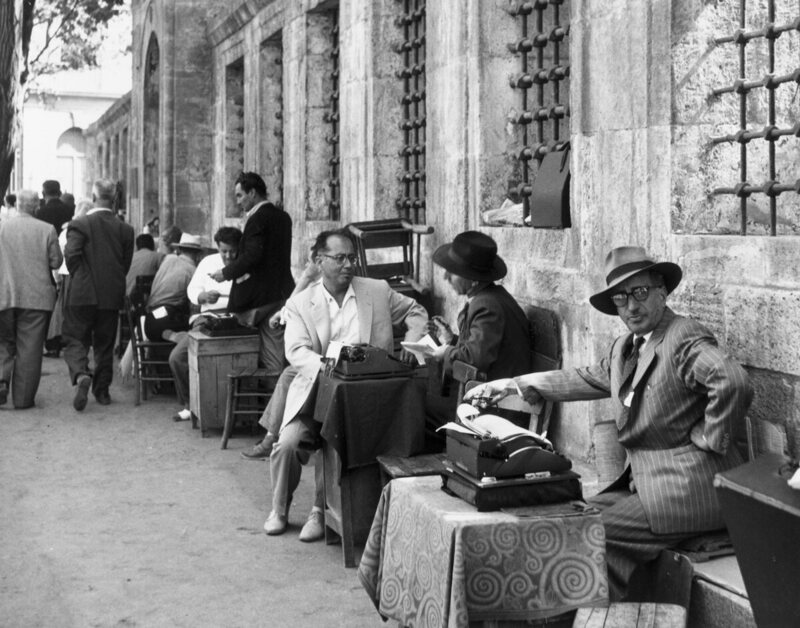
Photo: Bruch / Stringer
A street in Istanbul where people could go to have documents typed up while they waited, 1959. The tradition is only just dying out now.

In Turkey, public scribes have offered a document-typing service for generations. Now, partly because of the opposition of lawyers and partly because of new laws providing legal access to the indigent, the tradition is fading away.

Joshua Allen writes at Atlas Obscura, “On a side street near Istanbul’s Çağlayan Courthouse, an electric sign reading ‘Petition Writer’ points to the open door of 67-year-old Hayrettin Talih’s tiny, one-room office. …

“Talih sits in front of a manual typewriter, in the same pose as a black-and-white photograph of himself, from 40 years earlier, which is tacked on the wall beside him.

“Occupying the chairs opposite his desk are a couple of older citizens who are explaining a property dispute with a relative. Talih listens, demands clarification where necessary, and finally applies his fingers to the chattering typewriter, producing an affidavit that the couple will use to start proceedings at the courthouse, and hopefully get their rightful dues.

“Although he is not a lawyer, Talih has clients who clearly trust him to translate their experiences into Turkish legalese, which is replete with archaic Ottoman words — much like the Latin phrases beloved of English-speaking lawyers. An understanding of this obscure language is vital to Talih’s work as a public scribe or arzuhalci, a profession he entered almost 50 years ago. Now, he is one of the last of his kind. …

“Public scribes were a necessity in the Ottoman era, when the language used in state documents was even farther removed from ordinary speech and a large percentage of the population was illiterate. On top of legal work, the scribes also made a living by writing love notes and letters for soldiers who travelled to fight in the wars that consumed the Ottoman Empire in the late 19th and early 20th centuries. …

“The scribes say that they do not claim to be lawyers, as they merely help clients to express themselves on paper. ‘Let’s say I wrote something I don’t know about, and the person lost all his expenses and lost the case. Won’t he turn around and complain about me for putting him in that loss? It’s better not to write something you don’t know,’ Talih says.

“[Scribes] defend their profession as the only option for those who cannot afford a lawyer. … But according to İmmihan Sadioğlu, a lawyer at the Istanbul Bar Association, … the legal labyrinth cannot be navigated by an amateur, and the specific wording that the scribes use in the initial documents can be crucial. …

“After all, there is a government system in Turkey that covers the costs of those who cannot afford to pay a lawyer. … As this government support becomes better known, Sadioğlu and her fellow lawyers believe that the last scribes will see the writing on the wall.

“ ‘If a disadvantaged person can access justice easily, then he won’t look for other solutions. As for the state, it should increase the level of funding for legal aid,’ Sadioğlu says. ‘Someone who can receive a better and higher quality service from a free lawyer will not consider risking his rights by using a scribe.’ More at Atlas Obscura, here.

Don’t you love the fedora in the old photo? I think I’d ask for the help of a scribe just to sit and admire that hat.

Read Full Post »

About a year ago we had the great pleasure of attending a panel discussion featuring Orhan Pamuk, winner of the 2006 Nobel Prize for Literature. We took our seats at the New Yorker magazine’s lecture series, and because I had read his novel Snow, I was expecting someone quite dour and grim.

Instead he was hugely entertaining and funny as he talked about literature and his latest project, creating a museum to replicate one he had invented for his 2008 novel, The Museum of Innocence.

Writes Gareth Harris in the September 2010 Art Newspaper, “Turkey’s most famous living novelist is holding a pair of dentures in a room packed with ephemera reflecting everyday Turkish life of the past three decades. Orhan Pamuk, winner of the Nobel Prize in Literature 2006 and author of My Name is Red (1998) and Snow (2002), is standing among a sea of objects—sewing machines, clocks, soda-bottle tops, buttons, lottery tickets, china dogs, birdcages, cigarette lighters and false teeth—that will soon go on display in The Museum of Innocence, a four-storey building in the Çukurcuma neighbourhood, central Istanbul. This venue, not just a chamber of curiosities, is the real-life incarnation of the museum painstakingly assembled and detailed in his book The Museum of Innocence (2008).”

I expect that, for someone who has read the novel, the museum experience will be both delightful and unnerving. I know I felt delighted and unnerved years ago after reading a nonfiction book about a Rhode Island community and then trying to reconcile the characters who had seemed so real with the people who had been described. Storybook characters coming to life. At first the real people seem shadows. Then as you get to know them, the storybook characters become the shadows, superficially imagined imitations.

April 30, 2012, update here.

Read Full Post »