Photo: Peter Quadrino. A Texas club has been reading Finnegans Wake for 12 years. And making progress.
I have a bunch of reactions to today’s story about a book group reading the same James Joyce novel for 12 years and still going. One is that I would have benefited from reading Finnegans Wake with others because there was so much I didn’t understand. Another is that my stereotype about Texans needs constant correction: of course, there are people in Texas who tackle literature!
Sean Saldana wrote about this book club at Texas Standard, which I follow on Mastodon.
“In 1939, Irish author James Joyce published Finnegans Wake, a piece of literature that defies comprehension.
“ ‘riverrun, past Eve and Adam’s,’ it begins, ‘from swerve of shore to bend of bay, brings us by a commodius vicus of recirculation back to Howth Castle and Environs.’
“The book starts and ends with a sentence fragment, combines multiple languages and has no clear or linear plot. It’s a work that’s so dense, one group that started in Austin has been working on it for more than a decade.
“Every other week, Quadrino hosts a Zoom call where people from around the world gather and attempt to understand one of the most infamous books in English literature.
“The group spends the first 15 minutes of each meeting socializing. Then they all go around in a circle and each person reads two lines until they’re done with that week’s page.
“After that, they spend about an hour and a half researching, annotating and trying to make sense of Joyce’s experimental prose.
“ ‘We used to read two pages per meeting,’ said Quadrino. ‘Then at a certain point there was just so much going on in the pages and so much in the discussion that we had to lower it to one page per meeting.’ …
“The book’s complexity has made it a point of fascination for literary enthusiasts in the eight decades since it was first published. Houston, New York, Boston, Seattle, Dublin, Kyiv and many other cities around the world host groups dedicated to reading and analyzing Finnegans Wake. …
“ ‘I never really consider what it’s going to be like when we finish because I don’t want it to end,’ explained Quadrino, ‘and if we do finish we’ll just circle right back to the beginning and keep reading.’ ” More at Texas Standard, here.
Would you want to join a book group like that? I have heard of similar ones. Humans just don’t want to be defeated by complexity. The Athenaeum in Boston reads Proust’s Remembrance of Things Past over and over, too.
Photo: Alex Majoli/Magnum. “Since at least the time of Greek philosophers, many writers have discovered a deep, intuitive connection between walking, thinking, and writing,” says Ferris Jabr at the New Yorker.
Charles Dickens kept few notes about where his plots were headed. From what I’ve read about him, he kept it all in his head, forming and saving his ideas on long walks wherever he was at the time.
In today’s article, we learn a bit about the science of that.
Ferris Jabr writes, “In Vogue’s 1969 Christmas issue, Vladimir Nabokov offered some advice for teaching James Joyce’s Ulysses: ‘Instead of perpetuating the pretentious nonsense of Homeric, chromatic, and visceral chapter headings, instructors should prepare maps of Dublin with Bloom’s and Stephen’s intertwining itineraries clearly traced.’ He drew a charming one himself. Several decades later, a Boston College English professor named Joseph Nugent and his colleagues put together an annotated Google map that shadows Stephen Dedalus and Leopold Bloom step by step. The Virginia Woolf Society of Great Britain, as well as students at the Georgia Institute of Technology, have similarlyreconstructed the paths of the London amblers in Mrs. Dalloway.
“Such maps clarify how much these novels depend on a curious link between mind and feet. Joyce and Woolf were writers who transformed the quicksilver of consciousness into paper and ink. To accomplish this, they sent characters on walks about town. As Mrs. Dalloway walks, she does not merely perceive the city around her. Rather, she dips in and out of her past, remolding London into a highly textured mental landscape, ‘making it up, building it round one, tumbling it, creating it every moment afresh.’
“Since at least the time of peripatetic Greek philosophers, many other writers have discovered a deep, intuitive connection between walking, thinking, and writing. … ‘How vain it is to sit down to write when you have not stood up to live!’ Henry David Thoreau penned in his journal. ‘Methinks that the moment my legs begin to move, my thoughts begin to flow.’ Thomas DeQuincey has calculated that William Wordsworth — whose poetry is filled with tramps up mountains, through forests, and along public roads — walked as many as a hundred and eighty thousand miles in his lifetime, which comes to an average of six and a half miles a day starting from age five.
“What is it about walking, in particular, that makes it so amenable to thinking and writing? The answer begins with changes to our chemistry. When we go for a walk, the heart pumps faster, circulating more blood and oxygen not just to the muscles but to all the organs — including the brain. Many experiments have shown that after or during exercise, even very mild exertion, people perform better on tests of memory and attention. Walking on a regular basis also promotes new connections between brain cells, staves off the usual withering of brain tissue that comes with age, increases the volume of the hippocampus (a brain region crucial for memory), and elevates levels of molecules that both stimulate the growth of new neurons and transmit messages between them.
“The way we move our bodies further changes the nature of our thoughts, and vice versa. … When we stroll, the pace of our feet naturally vacillates with our moods and the cadence of our inner speech; at the same time, we can actively change the pace of our thoughts by deliberately walking more briskly or by slowing down.
Because we don’t have to devote much conscious effort to the act of walking, our attention is free to wander. …
“This is precisely the kind of mental state that studies have linked to innovative ideas and strokes of insight. Earlier this year, Marily Oppezzo and Daniel Schwartz of Stanford published what is likely the first set of studies that directly measure the way walking changes creativity in the moment. They got the idea for the studies while on a walk. …
“In a series of four experiments, Oppezzo and Schwartz asked a hundred and seventy-six college students to complete different tests of creative thinking while either sitting, walking on a treadmill, or sauntering through Stanford’s campus. In one test, for example, volunteers had to come up with atypical uses for everyday objects, such as a button or a tire. On average, the students thought of between four and six more novel uses for the objects while they were walking than when they were seated. …
“Where we walk matters as well. In a study led by Marc Berman of the University of South Carolina, students who ambled through an arboretum improved their performance on a memory test more than students who walked along city streets. A small but growing collection of studies suggests that spending time in green spaces — gardens, parks, forests — can rejuvenate the mental resources that man-made environments deplete. Psychologists have learned that attention is a limited resource that continually drains throughout the day. A crowded intersection — rife with pedestrians, cars, and billboards — bats our attention around. In contrast, walking past a pond in a park allows our mind to drift casually from one sensory experience to another, from wrinkling water to rustling reeds.”
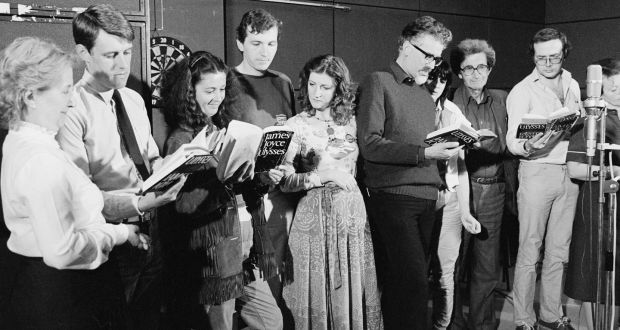
Photo: Raidió Teilifís Éireann (RTÉ ), Ireland’s National Public Service Broadcaster.
RTÉ Players recorded James Joyce’s mammoth work Ulysses in 1982 for the Joyce centennial. It was rebroadcast today. Still going.
I didn’t know this before, but apparently many Irish people didn’t initially love James Joyce. They didn’t understand his writing any more than you or I did. But when a radio production brought his characters to life, they realized they knew these guys.
Denis Staunton has the story at the Irish Times.
“Britain had just defeated Argentina in the Falklands, Israeli forces were shelling Beirut. … But Dublin’s mind was elsewhere on June 16th, 1982, as the city celebrated the centenary of James Joyce’s birth with a mammoth Bloomsday festival. …
“Joyce’s words were everywhere in the city that day because from 6.30 am until the following afternoon, RTÉ Radio broadcast a complete reading of Ulysses lasting almost 30 hours.
“Listening on transistor radios and Walkmans, many Dubliners who had long been intimidated by the book found that they not only understood it but enjoyed it and recognised themselves in it. …
“The Irish Times [wrote], ‘The voices of the RTÉ readers became the medium for Joyce’s living words. The writer’s poor sight and fondness for singing surely must have affected the conspicuous musicality of his prose: he wrote to be listened to rather than read, so that Ulysses in its radio shape was shown to be an epic ballad.’
The recording, … broadcast in full on RTÉ Radio One Extra from 8 am [today and] available on rte.ie/ulysses, includes every word in the novel. But it is as much a dramatisation as a reading, with 33 actors playing more than 400 parts.
“As a 20 year-old actor in the RTÉ Players when the company spent most of 1981 on the project, I played a number of small parts including Ned Lambert and Lyster, the Quaker librarian and various voices that ensured I was at most of the rehearsals and recordings. …
“The director was Willie Styles, a former actor from New Zealand who had trained at London’s Royal Academy of Dramatic Art (Rada) before moving to Dublin … He was RTÉ’s most talented radio drama director by a distance and one of the most accomplished in the world, winning a succession of international awards as he embraced each technological advance. He worked on Ulysses with Marcus McDonald, a sound engineer who shared both his fastidiousness and his appetite for experimentation in sound.
“The textual adviser was Roland McHugh, an entomologist whose interest in the acoustics of grasshoppers led him to become an expert on Finnegans Wake. McHugh’s first challenge was to go through the text working out which words should be spoken by whom, with some chapters involving multiple narrators as well as characters. He decided that the Sirens chapter, which is set in the Ormond Hotel, should have four narrators.
“ ‘If you listen to it, the thing starts with Miss Douce and Miss Kennedy talking and you’ve got a narrator for them. And that goes on for about four pages, I think, and then you switch to Bloom, and he gets a separate narrator. So we’re jumping backwards and forwards between those two narrators until we get about halfway through the thing, and then a third narrator comes in and mostly says short things about the coach that Blazes Boylan is travelling in. And then towards the end there’s a fourth for the piano tuner. Those four narrators seemed to me to make a lot more sense of the thing,’ [McHugh] said. …
“Laurence Foster, an actor in the company who later became an energetic and innovative head of radio drama at RTÉ, says the medium makes specific demands on an actor.
“ ‘You have to get inside your own head – it’s a very selfish medium. You have to believe what you’re saying. You have to see through the mind’s eye and you have to bring up an incredible energy that converts the voice into painting pictures. The voice has to get a dynamic and a colour and a resonance and a rhythm,’ he says.
“ ‘You don’t play to the other person. The microphone is the audience and the audience’s ear. And when you get that into your head that you’re whispering into their ear, you don’t need a huge amount of voice.’ …
“It will now be available free online to listen to any time you want. But as The Irish Times observed after the first broadcast, listening to the entire book continuously is an experience of a different order entirely.
“ ‘When the seamless broadcast ended, many listeners must have discovered withdrawal symptoms,’ the editorial said.” More here.
Glad I read the book last year, so I sort of know what we’re talking about.




 Suzanne's Mom's Blog