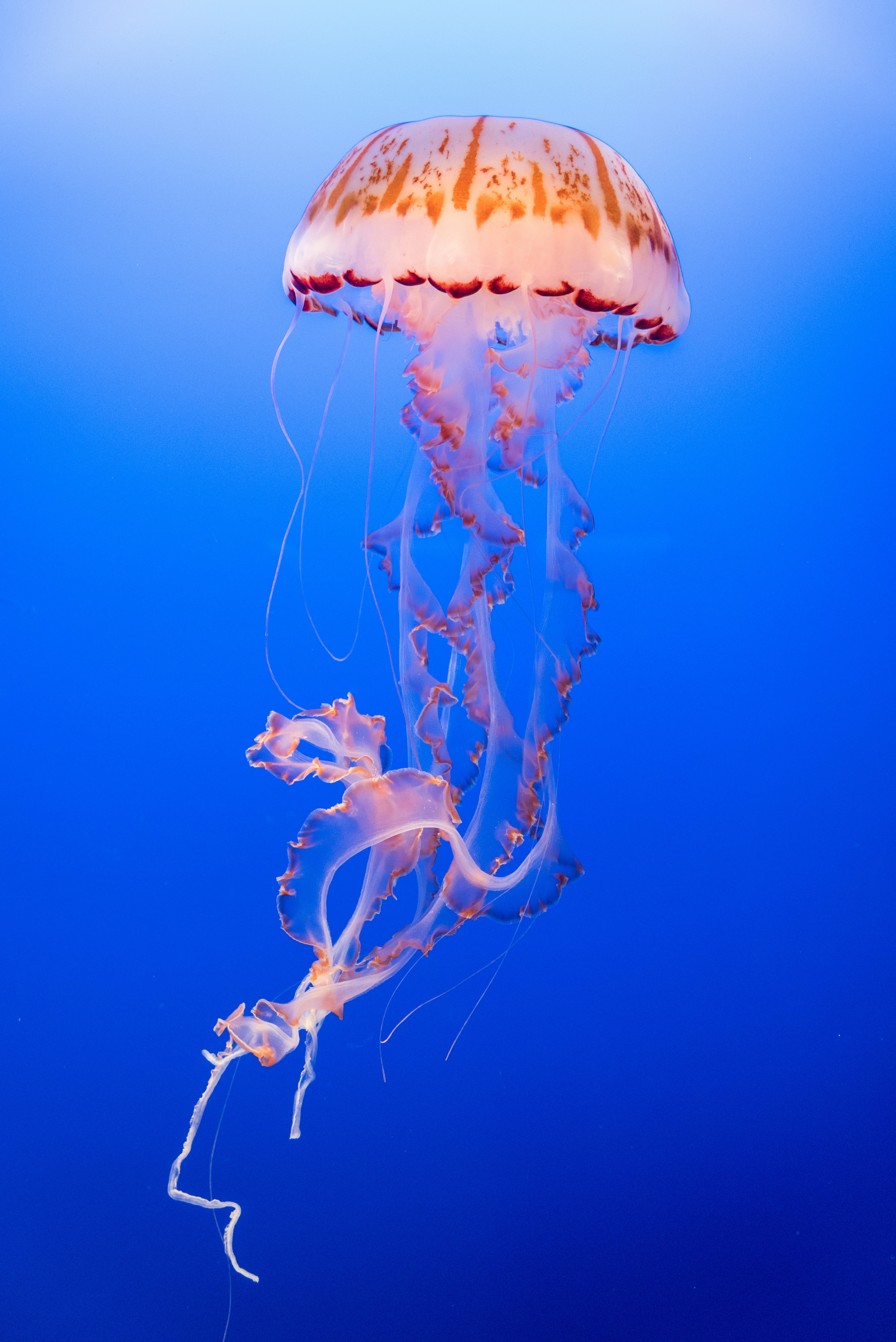
Photo: Kumar Ganapathy via Unsplash.
When I think of jellyfish, I remember a little marine scene I made in a shell when I was 13. As a see-through cover for the display, I used a dead jellyfish I’d found — the common kind of jellyfish that doesn’t sting.
It eventually evaporated.
James Bradley writes at the Guardian that scientists are only beginning to give jellyfish and other creatures that float on the surface the attention they deserve.
“In the summer months, north-easterly winds frequently herald the arrival of bluebottles on beaches along Australia’s east coast. But while bluebottles – or to give them their more formal name, the Pacific man-of-war – are a common sight on Australian shores, they are not native to coastal waters. Instead, they spend most of their lives on the open ocean, drifting with the winds and the currents.
“Bluebottles are just one of a collection of organisms that have made their home at the ocean’s surface. Some of these animals are hydrozoans like the bluebottle. There is the by-the-wind sailor, Velella velella, which has a stiff, transparent, oval sail about five centimeters [~two inches] attached to its bright blue float, and Porpita porpita, sometimes known as the blue button, which is shaped like a disc about three centimeters in diameter surrounded by stinging polyps. But there is also the strikingly beautiful sea dragon; crustaceans such as shrimp, buoy barnacles and tiny swimming copepods; and even mollusks such as the violet snail and Recluzia.
“Known collectively as the neuston, these creatures are not tied to any one place. Instead, they move with the wind and the water. Sometimes they gather into huge drifts, living islands of velella and bluebottles. … At other times they clump together around drifting debris or spread out sparsely over hundreds or even thousands of square kilometers.
“Despite its ubiquity, the neuston remains comparatively poorly understood and critically understudied. … Marine ecologist Associate Prof Kerrie Swadling, from the University of Tasmania, puts it bluntly. ‘“’We know more about deep sea vents than we know about the neuston.’
“The reasons for this ignorance are partly historical. Although several important studies of the neuston were published during the 20th century, they were written in Russian by scientists from the Soviet Union and were largely ignored outside the Eastern Bloc. But for the most part, the lack of research into the neuston is a consequence of the practical challenges involved in observing organisms that are scattered unevenly across the immensity of the open ocean. …
“In recent years, however, there has been an uptick in interest in the neuston. New research is revealing not just its importance to the health of ocean ecosystems as disparate as coral reefs and the deep ocean, but also important gaps in our understanding of how it will be affected by changes in the ocean environment.
‘The person most responsible for the increased visibility of the neuston is Dr Rebecca Helm. Now an assistant professor at Georgetown University in the United States, Helm was scrolling Twitter in 2018 when she came across a tweet about The Ocean Cleanup’s plans to remove plastic from the oceans by sweeping a floating net across the surface.
“Helm says she immediately wondered about the potential impact of this technology on the neuston, and so began to investigate. …
“[During the pandemic] she was locked out of her lab for several months. ‘I suddenly had all of this nebulous time to start looking into this more deeply, and became really fascinated. …
“Survival in the neuston [requires] animals to find some way to remain at the surface. For free-swimming species such as copepods and zooplankton, this is easy. But for other organisms it requires special adaptations.
“Hydrozoans like the bluebottle and velella employ gas-filled floats, while the buoy barnacle extrudes air into the cement that it would otherwise use to attach itself to ships and rocks, creating a substance a bit like pumice that it uses as a float. Similarly, violet snails suspend themselves beneath rafts constructed out of hardened bubbles of mucus. There is even a form of free-floating sea anemone that hangs upside down from the surface with the aid of a float in their pedal disc.
“Fascinatingly, this need for a float helps explain one of the more surprising discoveries to have come out of Helm’s research, which is that many of the animals that inhabit the neuston are not particularly closely related to other free-swimming species. Instead, they are descended from species that usually exist attached to the bottom of the sea that have migrated upwards, meaning that the neuston is, in a very real sense, what Helm dubs ‘an inverted sea floor’ clinging to the ocean’s surface.”
More at the Guardian, here. No firewall. Donations encouraged.

 Suzanne's Mom's Blog