Feeds:
Posts
Comments

Posts Tagged ‘Jim Crow’

Photo: Michael Claxton Collection.
Ellen Armstrong as a teenager in a costume she would typically wear while performing as a magician.

Among the many accomplished black Americans almost lost to history is a young female magician called Ellen Armstrong. Today we find out what Vanessa Armstrong at the New York Times (no relation) learned about this intriguing performer when she was assigned to write a belated obit.

“In December 1949, an article in Ebony magazine showcased a dozen Black magicians as ‘among America’s oldest entertainers although few in number.’ The sole woman among them was Ellen Armstrong,. …

“Armstrong began by practicing magic onstage with her father but later performed a solo act full of illusion and humor. One trick involved a blank pane of glass in a picture frame, where a cascade of sand fell from top to bottom when she turned it upside down. When the sand cleared, the frame held an image of someone famous, like the boxer Joe Louis. In another routine, called ‘Miser’s Dream,’ she made coins appear out of thin air and land with a miraculous clunk into a metal bucket. …

“Ellen Emma Armstrong was born on Dec. 27, 1905, in South Carolina to Ida [and] John Hartford Armstrong. The Armstrongs were a magic-performing dynasty, believed to be the first to come from and focus on the Black community. Her father started performing with his brother when he was a teenager. Later, he performed with Ellen’s mother, who died soon after giving birth to Ellen, and then with his second wife, Lillie Belle.

“Ellen was only 6 when she started performing with her father and stepmother, going by the name ‘Little Zelle,’ as they traveled to Black schools and churches along the East Coast, from Key West, Fla., to Philadelphia. … They performed during a time of legal segregation, sundown towns and lynchings. …

“J. Hartford Armstrong, as Ellen’s father was billed, and Lillie Belle had what they called a ‘Second Sight’ act: One of them, blindfolded, identified people and objects while fed information by the other via an elaborate verbal code system. Ellen did some mind-reading of her own in the show, and as she grew older she developed a ‘Chalk Talk’ routine in which cartoons she drew morphed into different images as she told a story.

“ ‘There were times when she would draw hats and then a rabbit coming out of it, and then she would elaborate on the rabbit, turn it upside down, and it’d be a picture of Abraham Lincoln,’ said Michael Claxton, a historian of magic and a professor of English at Harding University in Arkansas.

“Ellen Armstrong studied at the Haines Institute, in Augusta, Ga., and Barber-Scotia College, in Concord, N.C. After she graduated, she continued in the family business. When her father died of heart failure in 1939, she worked the circuit with her stepmother for three years or so. When her stepmother retired, Armstrong continued on her own, using dozens of props she had inherited from her father. But she continued to invoke her father’s name. …

“ ‘She did everything in honor of her father,’ said Nicole Cardoza, a magician who is making a documentary highlighting Armstrong and other Black female entertainers. …

“The places where she brought her act — churches and schools, mostly — were a refuge for African Americans and integral to Black culture, serving as public squares ‘that allow for joy, that allow for pleasure, that allow for restoration amidst the climate of injustice,’ said [Treva Lindsey, a professor at Ohio State University specializing in Black popular culture and African American women’s history]. …

” ‘Armstrong was fully aware of the inequities Black people faced, and as a Black woman she faced discrimination on two fronts. ‘We talk about Jim Crow often, but we don’t often talk about Jane Crow,’ Lindsey said, referencing the term coined by the activist and legal scholar Pauli Murray.

“The magician Kenrick Ice McDonald, in an interview, touched on the same point. ‘White women had to put up with chauvinism, yes, but they could still go in the front door of a theater,’ he said. He added, ‘To travel while Black can get you killed.’

“[Armstrong] continued to practice magic until about the 1970s. ‘She performed until she couldn’t perform anymore,’ Cardoza said. …

“Armstrong died on March 21, 1994, in a nursing home in Columbia, S.C. She was 88. … In January 2024, she was posthumously inducted into the Society of American Magician’s Hall of Fame. Today, a second documentary in which she figures prominently is also in the works, titled Going Fine Since 1889: The Magical Armstrongs, by the filmmaker Jennifer Stoy.”

More at the Times, here.
Read Full Post »

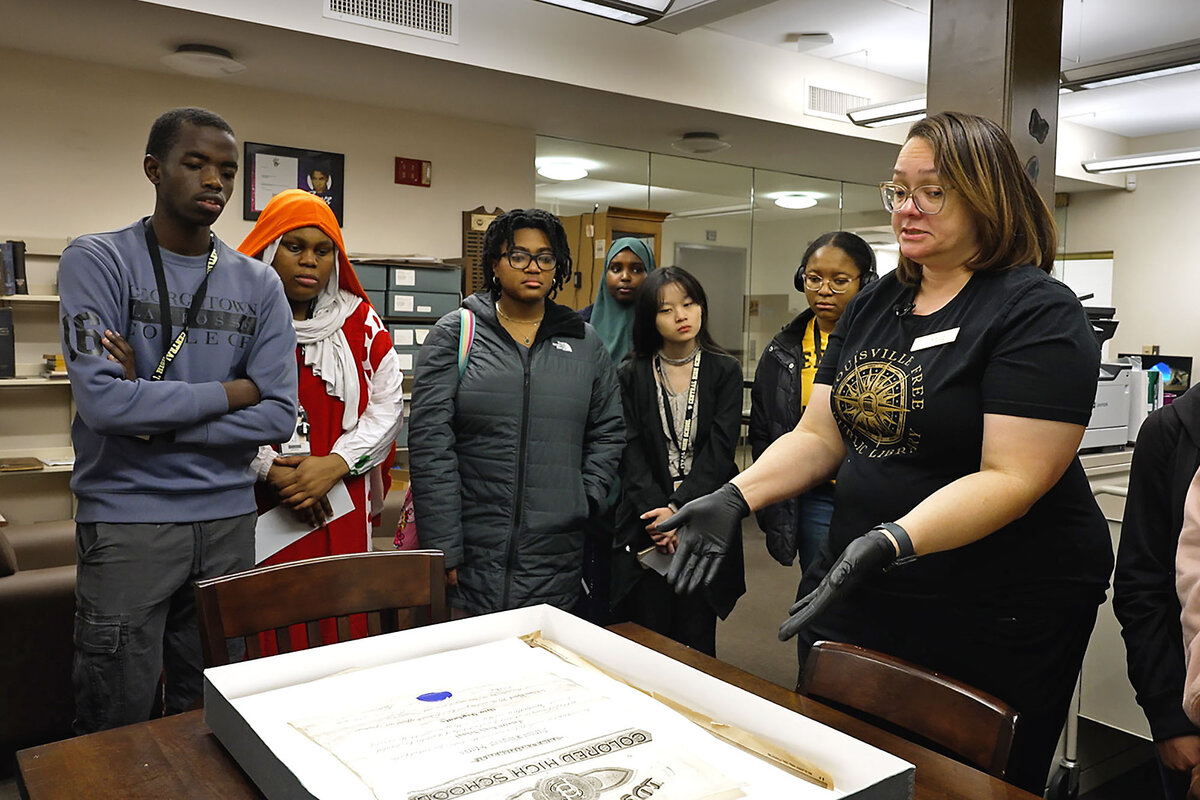
Photo: Jingnan Peng/Christian Science Monitor.
On a tour of Louisville’s Western Library, librarian Natalie Woods (right) shows a 1911 diploma of Louisville’s Central High School. Its former principal, Albert Meyzeek, helped create the oldest Black public library in the U.S. still independently run today.

It is often the case that people in a marginalized group excel in delivering badly needed services that others take for granted. Consider America’s oldest Black library and the man who started it.

Jingnan Peng writes at the Christian Science Monitor, “Thirty minutes into the library tour, Louisa Sarpee wants to work there. History is so close to her. One block away from her high school, the small library she had never set foot in laid the foundation of African American librarianship. What is more, the library was created by a former principal of her own school. Its archives even house a diploma of her school from the time the word ‘colored’ was still in the school’s name.

“ ‘Is there any way to volunteer at the library?’ the ninth grader asks Natalie Woods, the librarian giving the tour. …

“ ‘Say no more, girlfriend,’ Ms. Woods replies, beaming. ‘We’re gonna talk.’

“For Ms. Woods, the manager of Louisville’s Western Library, the gasps coming from the group of 18 students learning about its history is no surprise. She meets Louisvillians every day who know nothing about Western. The library under her care is the oldest public library in the United States independently run by and for African Americans. It was also the earliest training ground of Black librarians from around the South. It is a legacy that has changed Ms. Woods’ life, and preserving it has become her vocation. …

“The ‘Western Colored Branch’ of the Louisville Free Public Library system opened in 1905, in an era when Black communities across the South were building institutions in the wake of emancipation, says historian Tracy K’Meyer at the University of Louisville. …

“The segregated library was considered an experiment, says Ms. Woods. Its first manager, the Rev. Thomas Fountain Blue, had no formal schooling in library science – because there were no library schools open to Black people.  

“Blue not only ran a successful library … he also started the first training program for Black library workers. The course became the prototype for the first degree program in library science for African Americans, which opened in 1925 at Hampton Institute in Virginia. …

“Ms. Woods remembers Blue’s cursive handwriting. The first time she held his papers, they changed her life. She never learned about Western’s history when she grew up in Louisville. The child of a Black father and a white mother, she became a page at Louisville’s Shawnee Library. There, she would hear mentions of Western’s history.

“In 2008, while working as a library clerk and attending college at night, Ms. Woods lost the vision in her left eye due to complications from surgery. She couldn’t perceive distance properly and had to relearn basic activities, such as picking up a pencil, by repetition. It was a struggle to finish college, she says, and she gave up the idea of pursuing a master’s degree in library science.

“Then, one day, a supervisor brought Ms. Woods a folder of documents to transcribe. They were the papers of Thomas Fountain Blue. 

“On lined sheets, the cursive hand discussed circulation methods, library cards, and a library’s role in educating the public. 

“ ‘I knew of him, but I didn’t know how deep and intentional he was in everything he did,’ Ms. Woods says. ‘And it just gave me a new love and desire to go to library school.’ She obtained her library degree at Florida State University. She became Western’s manager on March 6, 2016: Blue’s 150th birthday.

“When Ms. Woods started at Western, she found that many people living near Western did not even know the library exists.

“The library’s archive, which includes Blue’s papers and a wealth of material on Black Louisville history, was disorganized. There was no indexing, and the room was not even locked down, Ms. Woods says.

“So she started giving tours of the library, which she still offers about once a week. In 2018, she obtained a $70,000 grant to index and digitize Western’s archive. 

“It is an important archive that sheds light on ‘how Black librarians, in real time, were trying to imagine what a library to serve a Black community should look like,’ says David Anderson, a professor of English at University of Louisville. …

“A child of formerly enslaved parents, Blue attended college and seminary in Virginia and ran a Louisville YMCA before starting at Western. He died in 1935, after being denied medical care for a treatable infection, says Annette Blue, his granddaughter. ‘He died from Jim Crow laws,’ she says in a Zoom interview from her home in California. …

“Ms. Woods says she does her work in honor of Blue and her parents. She tries to embody Blue’s commitment to ‘the betterment of his people.’ Her parents, who faced much opposition to their relationship as an interracial couple, taught her to ‘treat people the way you want to be treated.’ “

More at the Monitor, here. No firewall. Subscriptions are reasonable.

Read Full Post »