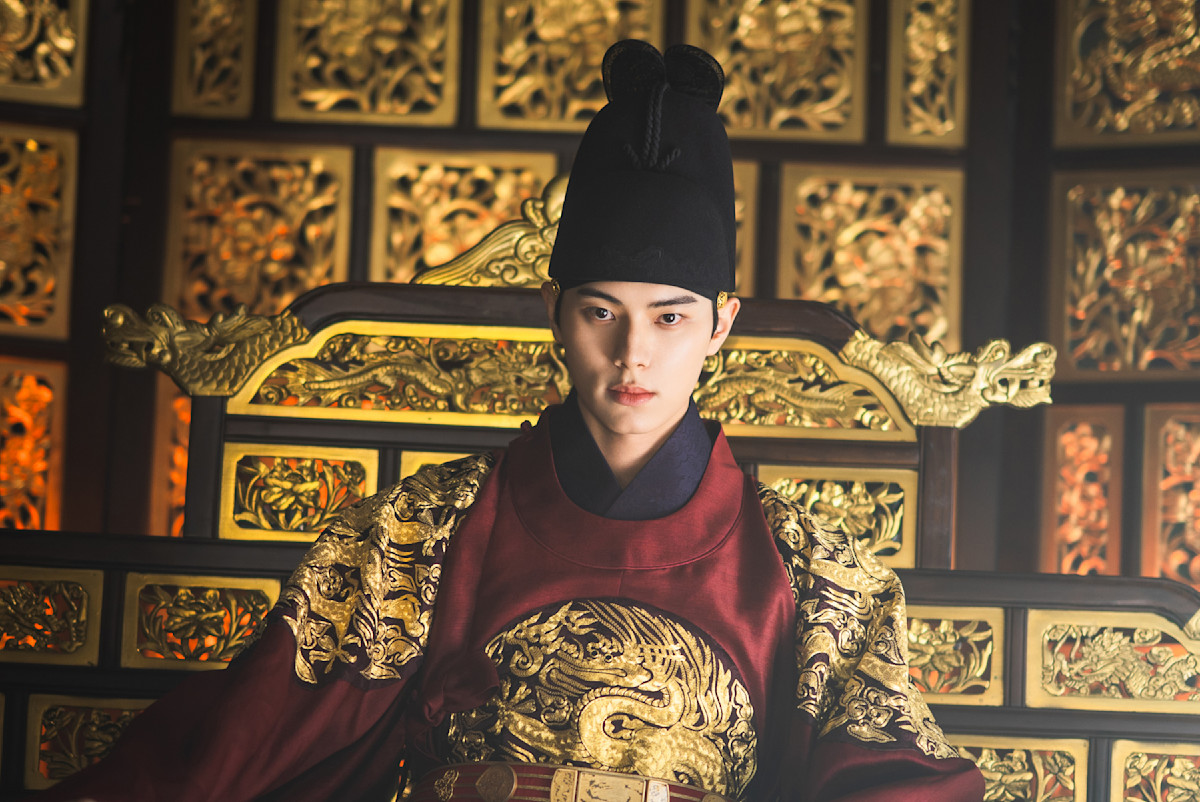
Photo: Netflix.
Lee Chae-min as the Joseon-era tyrant foodie king in Bon Appetit, Your Majesty.
If the novel Crying in H Mart didn’t get you hungering for Korean food, an unusual new series probably will.
Hanh Nguyen, executive editor at Salon, starts a review with a line from a 14th century palace cook.
” ‘How could a woman know how to prepare a royal meal?’ asks a palace cook in the Netflix series Bon Appetit, Your Majesty.
“Set five hundred years ago during Korea’s Joseon era, the hit period k-drama reveals how courtiers back then only deemed men skilled enough to craft meals worthy of royal consumption. The woman in question, Chef Yeon Ji-yeong (Im Yoon-ah), not only delivers on those high standards but exceeds them, wowing the King (Lee Chae-min) with dishes, ingredients and techniques that haven’t been seen before – literally. It turns out that Chef Yeon is a time-traveling French cuisine chef from the future.
“Bon Appetit, Your Majesty delights in trotting out Yeon’s modern, European know-how, ranging from whipping up vibrant-hued macarons to maintaining meat’s juiciness through sous vide cooking. However, the limited series similarly introduces viewers – accustomed to kimbap, ramyeon or bulgogi – to unfamiliar historical dishes: Korean palace cuisine.
“Junwon Park, who’s training to become a Korean craftsman-level cook, [says] ‘I think it’s a culture. And the reason I say that is because, just like in the Bon Appetit, Your Majesty show, they used food, not just to eat, but often as a ritualistic event. They were trying to send a message.’
“Throughout the series, the palace tasks Chef Yeon with crafting dishes to convey various intangible themes – often with her own life or the country’s future on the line. When instructed to cook a meal ‘fit for a king,’ Yeon turns to venison because deer had symbolized kings, and the tongue is seen as a rare delicacy only he has the privilege to enjoy. Therefore, the thought that goes into the care and feeding of monarchs reaches beyond mere culinary execution but also encompasses ingenuity, knowledge and a sense of diplomacy (not to mention flattery).
“ ‘That is just like how it happened in the actual Korean palace,’ Park confirmed. ‘One king, King Yeongjo, actually made a dish called tangpyeong-chae. He made this dish as a cold salad that mixes ingredients of different colors, each color representing a political faction that the palace was divided into. So by serving this dish and announcing the policy of having a quota that his palace is going to hire from all the factions, he was announcing that he wants the palace to be run like that salad – that people from different factions are coming together to create one flavor. So it was not just a dish.’
“Despite her expertise in French cuisine, Chef Yeon also demonstrates a deep understanding of Korean royal cookery and wields her modern knowledge to innovate while still maintaining the integrity of the royal dish. To embody the idea of filial piety to appeal to the Grand Queen Dowager, Yeon creates doenjang-guk, a traditional soybean paste stew, but adds two special ingredients: spinach and clams. She reveals that the spinach – an ingredient not regularly used in cooking during that time period – is full of iron and therefore can help Her Highness, who has been feeling weaker lately.
” ‘Food and medicine share the same roots,’ she says, citing the yaksikdongwon philosophy. …
“The clams, however, are the stew’s secret weapon. Knowing the Queen Dowager has long sought a doenjang-guk that tastes like her late mother’s, Yeon realizes that clams would add that mystery umami that only people who were raised near the Seomjin River or Nakdong River would have accessed. Once the Queen Dowager tastes the soup, she’s transported back to childhood and tearfully declares, ‘The soup contains family. She has given me my family through this dish.’
“Later in the series, while prepping the Grand Queen Dowager’s 70th birthday banquet, Chef Yeon must deal with a major menu-planning curveball: the birthday girl has been advised to cut out meat from her diet. Yeon certainly doesn’t want to cook dishes that would threaten the Queen Dowager’s health, especially for an occasion honoring her longevity. But dishes comprising the Korean royal banquet, such as gujeolpan, often include meat. The name gujeolpan refers to nine ingredients on a plate, with eight colorful vegetables or proteins sliced thinly and arrayed around the edge of plate, much like a mouth-watering sundial. Small crepes sit in the dish’s center and provide a wrapper for the ingredients.
” ‘One of the most grand dishes in Korean Palace cuisine is actually what she prepares for the Grand Queen Dowager, which is gujeolpan,’ said Park. ‘Today it’s often used for weddings . . . it’s to show that “I am putting in so much effort” that I’m preparing each ingredient separately, laying it out separately in a beautiful presentation, and then we are putting it together to create one ssam, just like a bossam, or the way that we eat KBBQ in lettuce today. So it has a ritualistic meaning.
“ ‘But when [Chef Yeon] prepares it, she prepares a special version of the dish that uses something like Impossible meat, so like a soy-based meat, rather than a regular meat,’ he added. The faux meat impresses the courtiers, who note the effort required for the dish.
“ ‘Seeing all of you enjoy it so much, I couldn’t ask for more,’ says Yeon, before addressing the Grand Queen Dowager, ‘May you always be safe in good health.’ ”
More at Salon, here.

 Suzanne's Mom's Blog