Feeds:
Posts
Comments

Posts Tagged ‘kenya’

In February, Treehugger posted an article on sustainable husbandry in Africa by Charlotte Kaiser, of the Nature Conservancy’s NatureVest arm.

“For thousands of years,” she writes, “the pastoralist communities of northern Kenya have herded their cattle alongside elephants and zebras, the grass of the rangelands shared between livestock and wildlife in relative balance. In recent decades, climate change, habitat loss, and human population growth have combined to erode that balance, leading to overgrazing and the degradation of the grasslands that both humans and wildlife need to survive.

“For over a decade, the Northern Rangelands Trust (NRT) has worked with the communities of Northern Kenya to develop community conservancies that support better management of cattle and grass. …

“A key tool in driving the better management of the rangelands is access to markets. … In 2008, NRT created the Livestock to Markets program (LTM), which brought the market to the Conservancies. In exchange for conservancies achieving specific targets in conservation, LTM buys cattle directly from the conservancies, purchasing several hundred head at a time from dozens of households. Providing access to markets allows pastoralists to better manage their herd sizes, since they know they can sell animals when they need to at a fair price. And LTM also encourages the herders to bank their cash, bringing mobile banking representatives to market days so herders can open bank accounts with the proceeds from the sale.

“Once the cattle are purchased, NRT treks the animals to Lewa Conservancy, a partner NGO. After six weeks of quarantine, the animals move to Ol Pejeta Conservancy, another partner, where they are fattened on grass for 15 months, improving the size and quality of the animals. Finally, the animals are [sold] into the Nairobi meat market. By capturing much of the full value of the supply chain, NRT can pay a levy on every animal they buy to the conservancies themselves. This levy funds conservancy investments in wildlife guards, ecotourism lodges, and community facilities like clinics and schools.” Check out the full article here, and the lovely pictures.

Photo: Ron Geatz
Livestock is the primary measure of wealth among herding communities of northern Kenya.

Read Full Post »

ajiri-tea

The secret to neighborhood parties is to leave while it is still fun. We have three this week. I feel lucky to live where people do this.

This year my house gift is A Jiri Tea from Kenya: “100% of profits support Orphan Education in Western Kenya.”

At the first neighborhood party, I stayed about 45 minutes. I had nice chats with four women, but you know, sometimes I get in a rut and bring up the same topics I have brought up for years.

The first woman and I talked about the parking situation on the street and how train commuters park all day although they are not supposed to.

The second woman and I talked about the parking situation on the street and how the town did a study and never pursued any recommendations.

The third woman and I talked about how great the new minister is but how the old assistant minister was given a bum deal.

The fourth woman and I talked about her daughter-in-law’s work helping Chinese nationals invest in the U.S. economy for an EB-5 visa. I definitely didn’t talk about EB-5 visas at a party in the past. I just learned about them at a September conference.

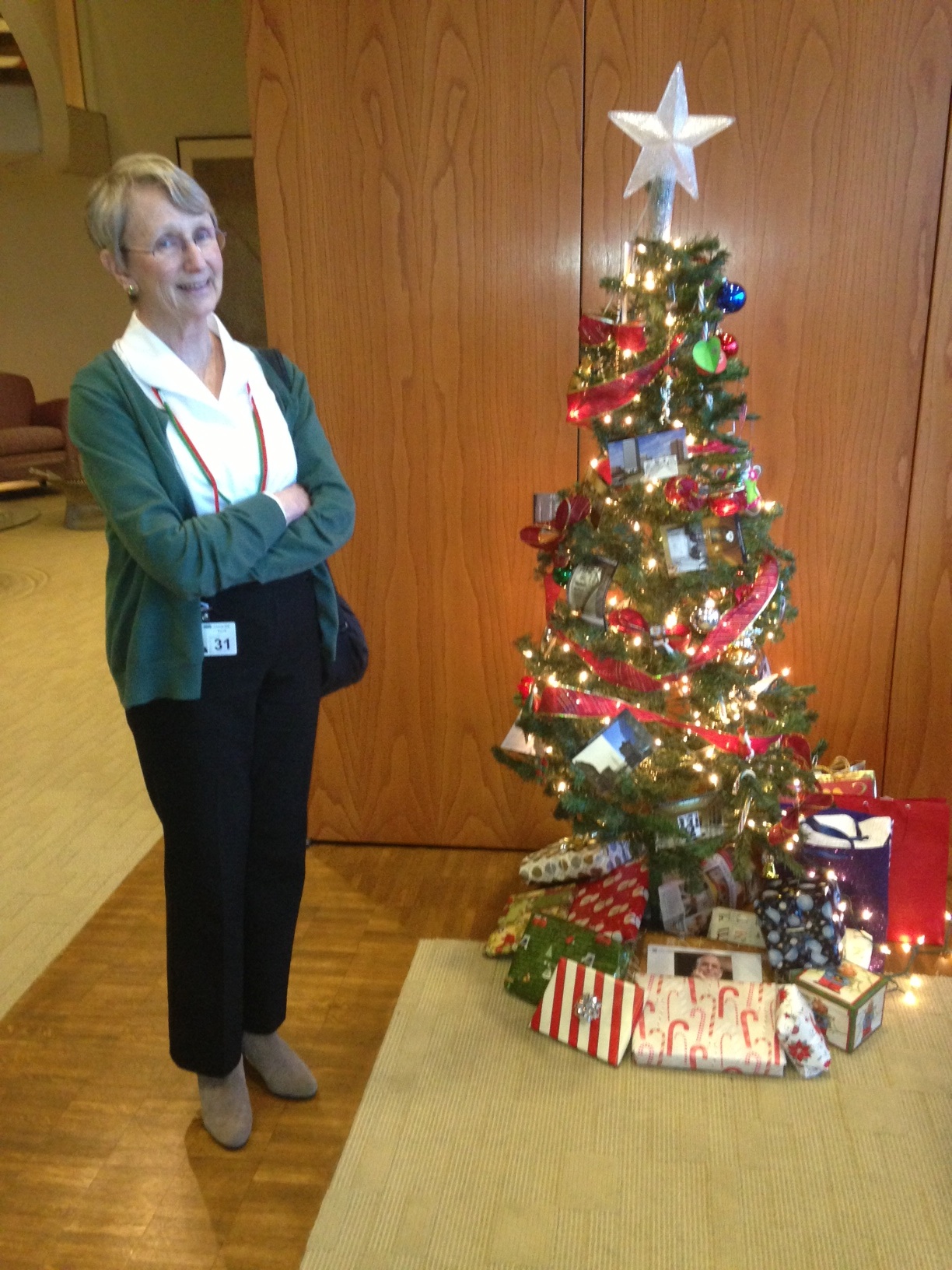
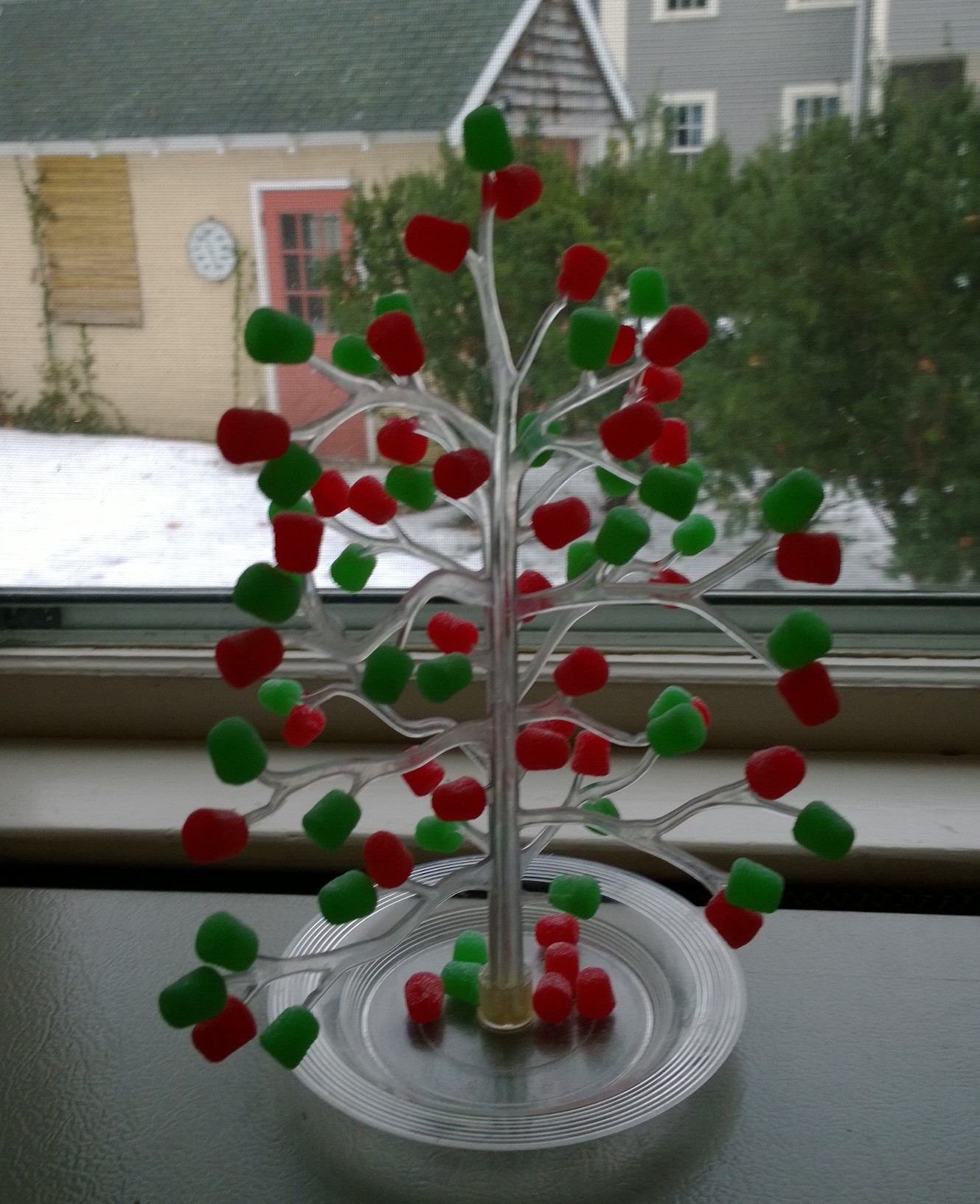
Here I am at the office holiday party, where I contributed a gumdrop tree (below) for the Yankee Swap, and the person who got it decided it would become her Christmas tree this year. I left this party early, too.

2013-office-holiday

gumdrop-tree

Read Full Post »

The Globe‘s Callum Borchers wrote recently about an organization called Seeding Labs, which presented at the IDEAS conference in Boston.

Founder Nina Dudnick, he says, “collects and ships used lab equipment to developing countries.

“Last year, Seeding Labs hosted six scientists and researchers from Kenya, one of whom was a chemist, Mildred Nawiri, who is studying how certain vegetables that are indigenous to West Africa might help prevent cancer.

“On Wednesday, Dudnick pointed to Nawiri’s research as an example of work that is unlikely to be done in the United States, because the vegetables she is studying do not grow here.

“And whatever benefits she might discover could go unrealized without modern equipment. Before Seeding Labs, Nawiri was using techniques Western scientists employed in the 1800s, Dudnick said.”

Dudnick points out that “this talent really is everywhere. The problems that face us, like cancer, don’t respect boundaries drawn on a map, so why should our scientific community?”

More at the Globe.

Read Full Post »

Pius Sawa at AlertNet (and the Christian Science Monitor) writes, “Residents of Rusinga Island in Kenya [are experimenting] with renewable energy innovations, environmentally friendly farming, tree planting, and other efforts aimed at improving the island’s environment, creating jobs, and overcoming shortages of food and water.

“For the past 16 years, Ester Evelyn Odhiambo has dedicated herself to improving life on one small island. It’s no small task.

“Rusinga Island, in the northeast corner of Lake Victoria in Kenya, is about 16 km (10 miles) long and 5 km (3 miles) wide. About 30,000 people call it home. But the island over the years has become an increasingly inhospitable environment for them.

“ ‘If you plant something, it just dries out,’ says Ms. Odhiabmo, who runs an organization to help people widowed or orphaned by AIDS [Kisibom, or “come and learn”]. ‘You try to irrigate, and the water is too little because the sun comes and dries everything.’

“The changes have come because of poor management of resources – including forests and fishing grounds – and because of increasing climate impacts.

“But now residents are experimenting with renewable energy innovations, environmentally friendly farming, tree planting, and other efforts aimed at improving the island’s environment, building resilience, creating livelihoods, and overcoming shortages of food and water.”

More.

Photograph: Pius Sawa/AlertNet
Ester Evelyn Odhiambo opens a charcoal refrigerator on Rusinga Island, Kenya. It is lined with charcoal, into which water seeps through a hosepipe fed by a bucket. The wet charcoal absorbs heat and keeps the items inside the fridge cool without needing electricity.


Read Full Post »

Lately, it seems that lot of young people want to make the world a better place and are starting nonprofits to do so.

Marian Daniells writes in the Boston Globe about one young activist, who attends Northeastern University.

“Mike Behan spends six months out of the year in Njabini, Kenya. But it’s no safari vacation. Behan, 21, is the cofounder and CEO of Njabini Apparel, a nonprofit company selling handcrafted accessories made by landless and handicapped mothers in the Kenyan settlement.

“A rising senior at Northeastern University, Behan first visited Njabini in June 2010 as a volunteer with Flying Kites, a nonprofit group that supports orphaned children in Kenya. With Flying Kites’ help, Behan then started Njabini Apparel with Tom Mwangi and marketing director Erin O’Malley (both volunteers with Flying Kites) in August of that year. By October, they were selling hats and scarves. Most of Njabini Apparel’s sales are done online, or by volunteers for Njabini Apparel and Flying Kites. …

“Participating mothers are able to immediately earn four times the average national income (equivalent to $780), which is then driven back into the local economy.” Read more. It will make you feel good.

Lucy Wanjiku at Njabini Apparel, a nonprofit cofounded by Mike Behan that sells handcrafted goods made by landless and handicapped mothers in the Kenyan settlement. Photograph: John Deputy

Read Full Post »

A new exhibit organized by the Cooper-Hewitt National Design Museum in New York demonstrates the power of design to make life better for disadvantaged people.

“This is a design show about remaking the world … And that’s thrilling,” writes Michael Kimmelman, “whether it’s happening in Cupertino, Calif., or Uganda, where H.I.V. infects hundreds of people a day, and the latest news cellphone-wise has been the design and distribution of a text-messaging system that spreads health care information.

“In Kibera, an area of Nairobi, Kenya, and one of the densest slums in Africa, the challenge was different. Traditional wood and charcoal fires cause rampant respiratory disease there. Refuse fills the streets. So a Nairobian architect designed a community cooker, fueled by refuse residents collect in return for time using the ovens.

“From cellphones and cookers to cities: in Thailand, a public program called Baan Mankong Community Upgrading has, for the last eight years, been improving conditions in hundreds of that country’s 5,500 slums, bringing residents together with government and nongovernment agencies to design safer, cleaner places to live.”

Read more in the NY Times.

You will also enjoy reading about slum (favela) painting in Brazil and what a new coat of paint can do for building residents’ skills while lifting their spirits.

Read Full Post »

Nicholas Kristof writes in the NY Times about a Kenyan called Jane, who was pushed out when her husband took a second wife and who found herself supporting her children through prostitution. That is, until she joined a remarkable nonprofit and made a better life for herself through sewing. She takes used wedding gowns and bridesmaid gowns and cuts them up to create several smaller dresses that she can sell.

Kristof writes that in 1999, Jane was fortunate to find “an antipoverty organization called Jamii Bora, which means ‘good families’ in Swahili. The group, founded by 50 street beggars with the help of a Swedish woman, Ingrid Munro, who still lives in Nairobi, became Kenya’s largest microfinance organization, with more than 300,000 members. But it also runs entrepreneurship training, a sobriety campaign to reduce alcoholism, and a housing program to help slum-dwellers move to the suburbs.” Jane became an entrepreneur, was able to get her children into good schools, and rejoiced to see them thriving.

But as Kristof explains, the lives of the working poor tend to remain one accident or illness away from upheaval. Jane’s daughter was hurt in a traffic accident and treatment for the injury sucked up all Jane’s savings, affecting her ability to pay for school.

Kristof likes to go beyond traditional reporting in his columns and give readers a way to help, so you might want to check his blog.

More on Jamii Bora:


Read Full Post »

« Newer Posts