Feeds:
Posts
Comments

Posts Tagged ‘korea’

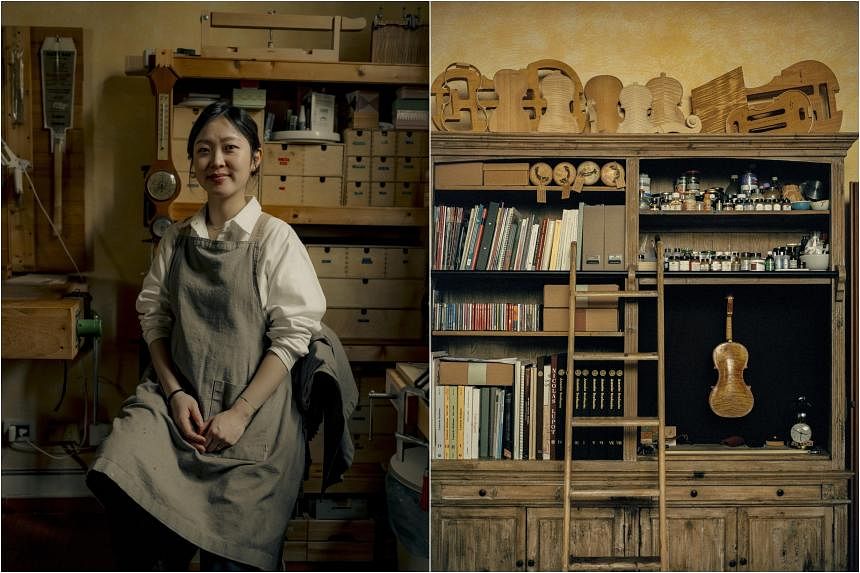
Photo:Sasha Arutyunova/New York Times.
South Korean violin maker Ayoung An at her studio in Cremona, Italy. 

It’s a mystery how some children get a passion for an activity at a very young age and never let it go. You can probably think of someone you know who was like that.

At the New York Times, Valeriya Safronova writes about a little girl in Korea who slept with her violin and who later learned to make violins in the Italian tradition.

When Ayoung An was 8,” Safronova writes, “her parents bought her a violin. She slept with the instrument on the pillow next to her every night. Two years later, a shop selling musical instruments opened in Pyeongtaek, South Korea, her hometown, and An became a fixture there, pelting the owner with questions. ‘I think I bothered him a lot,’ An, now 32, said.

“As a teenager, she decided she would become a violin maker. Eventually, a journey with twists and turns took her to Cremona in northern Italy — a famed hub for violin makers, including masters like Antonio Stradivari, since the 16th century. There, An, a rising star in the violin-making world with international awards under her belt, runs her own workshop. …

“On a recent Monday, An was hunched over a thick 20-inch piece of wood held in place by two metal clamps. Pressing her body down for leverage, she scraped the wood with a gouge, removing layers, her hands steady and firm. She was forming a curving neck called a ‘scroll,’ one of the later steps of making a violin or cello. On this day, the violin maker was immersed on a commission for a cello, which shares a similar crafting process.

“Violins like An’s, made in the tradition of Stradivari and Giuseppe Guarneri, require about two months of work and sell for about 16,000 to 17,000 euros, or $17,500 to $18,500. …

“An was 17 when she hatched her plan to learn the craft: She would move in with an American family in a Chicago suburb so that she could attend a local high school, master English and eventually study at the Chicago School of Violin Making. There were no such schools in Korea at the time. Her parents, distraught about her moving so far away to pursue an uncertain career path, tried to stop her. …

“ ‘When I said goodbye to my parents at the airport, they were crying,’ she said. ‘I wasn’t. I was too excited.’

“Two years after moving to Illinois, she discovered that one of the best known schools for violin makers, the International School of Violin Making, was actually in Cremona. So in 2011, at age 20, she moved to a new country again.

“Cremona was home to some of history’s most famous luthiers, makers of stringed instruments: Stradivari; Andrea Amati, considered ‘the father of the violin’; and the Guarneri family. For the 160 to 200 violin makers in Cremona today, the sound quality of the masters remains the ultimate goal. …

“Around the studio, small pots of pigment, for varnishing, sat on shelves and tables alongside jars of powders — ground glass and minerals — for polishing. On a wall were dozens of knives, chisels and saws. Also present: dentist’s tools to scratch the instrument for a more antique look.

“An is the youngest member of a consortium in Cremona dedicated to upholding violin-making traditions. She is so immersed in the Cremonese method of violin making that, at the suggestion of a mentor, she created an artist’s name, Anna Arietti, to better fit in with Italian culture.

“An important moment is when luthiers place their label inside the instrument, called a ‘baptism.’ To make her label, An stamps her ink signature onto a small piece of paper — a browned page from a secondhand book, giving the impression of age. Then, using a traditional homemade mixture of melted bovine skin and rabbit skin as a long-lasting adhesive, she glues the label inside one half of the instrument. She also burns the signature of her Korean name into the instrument with a tiny heated brand.

“Afterward, the two halves are sealed together, completing the main body of the instrument. Her Italian artist’s name remains inside, intact as long as the violin is.”

More at the Times, here.

Read Full Post »

Photo: Chris Crowe/Smithsonian National Zoo & Conservation Biology Institute.
The endangered white-naped crane is difficult to breed in captivity. But then a zoo keeper in Virginia bonded with one.

This year marked the death of a white-naped crane called Walnut, a bird unusual not only for her rarity but for her predilections. Let’s go back a few years and learn why she was unusual.

At the Washington Post in 2018, Sadie Dingfelder wrote about the crane that fell for a human.

“Early one summer morning, as rain is misting the foothills of the Blue Ridge Mountains, a middle-aged man is courting a crane. Chris Crowe, 42, bends forward in a slight bow and then flaps his arms slowly, like wings. ‘Hey, girl, whatcha think,’ he coos.

“Walnut has heard that line before. The stately bird ignores Crowe, reshuffles her storm-cloud-gray wings, and snakes her head gracefully to the ground, looking for something tasty to eat.

“ ‘Come on, now,’ Crowe says. The zookeeper grabs a fistful of grass and tosses it into the air. This is Crowe’s sexiest move — a sly reference to building a nest together. Walnut looks up, curiosity glinting in her marigold eyes, but then she returns to probing the soft, wet ground with her bark-colored bill. She’s simply not feeling romantic. …

” ‘Try getting in the van,’ Crowe calls to me. I follow his suggestion, and, almost immediately, Walnut starts responding to Crowe’s overtures. She returns his bows and then turns away from him and holds her wings loosely away from her body. Kneeling behind the bird, Crowe rests a hand gently on her back. …

“This strange cross-species seduction has helped ensure that white-naped cranes continue to exist, at least in captivity, says Warren Lynch, a fellow zookeeper at the Smithsonian Conservation Biology Institute.

‘It’s amazing, what Chris has accomplished with Walnut,’ Lynch says. ‘This isn’t something just anyone can do.’

“When Walnut arrived at the Front Royal, Va., endangered species breeding center, back in 2004, she was the most genetically valuable white-naped crane in captivity. At 23, she had yet to produce a single chick. … Walnut hatched on July 2, 1981, in an old horse barn in Baraboo, Wis. … Volunteers named her, somewhat randomly, after their favorite dessert at a nearby diner, a walnut cream pie.

“The foundation was in full-tilt crane-making mode, trying to churn out as many of the rare animals as possible, recalls former ICF ornithologist Michael Putnam. When a pair of cranes produced eggs, staff would put the eggs in an incubator, which would prompt the pair to make more.

“Walnut’s parents [were] captured illegally in China and smuggled to Hong Kong. … They were intercepted by local authorities and eventually shipped to the [International Crane Foundation].

“Though it would have been better to return the birds to the wild, international tensions in 1978 made that impossible, Putnam recalls. Plus, no one knew exactly where in China they had been captured, or what the birds might have been exposed to during transit. ‘We didn’t want to release birds that might carry diseases and put them back into the wild flock,’ Putnam says.

“This kind of poaching is less common today, but the white-naped crane population is falling fast because of a more relentless foe: booming human populations, which are overtaking, polluting or draining the wetlands that the birds need to survive. ‘One pair of cranes, to breed, usually requires huge wetland areas,’ Archibald says. ‘It may be several acres, it may be several hundred acres.’

“In addition to demanding vast areas of untrammeled wilderness, these difficult birds seem almost drawn to marginal places. For instance, one of the white-naped cranes’ most important wintering grounds is the 2.5-mile-wide demilitarized zone that separates North and South Korea. There, in a strange, de facto nature preserve, white-naped cranes and their even-more endangered cousins, red-crowned cranes, root for tubers among the land mines they are too light to trigger. If tensions between the Koreas subside, however, the cranes will be in trouble. Farmers are already clamoring for access to the nutrient-rich land, and developers are planning for a reunification city and deepwater port.”

The long and fascinating article at the Post is here, but paywalled. So check out Walnut’s history at the Guardian obit, here.

It reads in part, “Walnut, a white-naped crane and internet celebrity, has died at the age of 42. She is survived by eight chicks, the loving staff at the Smithsonian’s National Zoo and Conservation Biology Institute, and by Chris Crowe – a human zookeeper whom Walnut regarded as her proxy mate for nearly 20 years. …

“Walnut was hand-raised by people and bonded with her human caretakers. That preference continued when she came to the institute – she showed no interest in breeding and even attacked male crane suitors. … As the offspring of two wild-caught cranes, Walnut’s genes were not represented in US zoos. So convincing Walnut to breed was regarded as a priority.

“Crowe, according to a zoo statement, won her over by ‘observing and mimicking’ the institute’s male white-naped cranes’ actions during breeding season. … Once Crowe had gained her trust, he was able to artificially inseminate her using sperm from a male crane.

“The unique arrangement was very successful and Walnut laid fertilized eggs that eventually hatched eight chicks. The fertilized eggs were given to other white-napped crane pairs who tended to them as their own. …

“Earlier this month, keepers noticed that Walnut wasn’t eating or drinking, even her favorite treats, frozen-thawed mice, peanuts and mealworms, couldn’t spark her appetite. The bird declined and, surrounded by an animal care team, died peacefully, an autopsy revealing the cause of death to be renal failure. …

“Crowe said, ‘Walnut’s extraordinary story has helped bring attention to her vulnerable species’ plight. I hope everyone who was touched by her story understands that her species’ survival depends on our ability and desire to protect wetland habitats.’ ”

Makes me think of the book Birdy — only the guy really thought he was a bird. Remember that?

Read Full Post »

Photo: David Brichford
This eight-panel folding screen, a late 1800s example of Korean “Chaekgeori,” makes one observer think of a kind of instagram photo popular today. The screen was displayed in a recent Cleveland Museum of Art exhibition.

Some people call instagram pictures of their beautifully appointed bookshelves “shelfies.” They might think the fad is a 21st C. idea, but in 18th C. Korea, something similar was going on.

Claire Voon writes about the Cleveland Museum of Art’s recent chaekgeori exhibit at the website Hyperallergic.

“You could call it a very early precursor to the ‘shelfie.’ Long before we were snapping pictures of our bookshelves to show off our literary troves on the ‘gram, there was chaekgeori, a style of Korean still-life painting that emerged in the late 18th century. Spread across the panels of folded screens, these images of near-life-size bookshelves were also meant to express an individual’s intellect, and often stood in a scholar’s room as a beautiful, dignifying backdrop.

“More broadly, they were markers of one’s social status, putting on full view the objects of refined taste and affluence. Chaekgeori (pronounced check-oh-ree) literally means ‘books and things.’ Aside from tomes stacked on tomes on tomes, these massive paintings also featured writing tools, luxury goods from abroad, and gourmet delicacies, all neatly arranged. …

“The interest in depicting bookshelves grew under the reign of King Jeongjo of the Joseon Dynasty, between 1776 and 1800, and flourished through the early 20th century. As Sooa McCormick, the museum’s assistant curator of Korean art explained, Jeongjo [began] commissioning chaekgeori as a royal emblem to display around his royal throne. …

“ ‘Books became a symbol of high social status and power,’ McCormick told Hyperallergic. … ‘Learned individuals made up a very, very small percent of the population.’ …

“In a few instances, screens also included Western objects: one of the paintings on view [in Cleveland] boasts a rare depiction of European mechanical clocks — a subtle yet significant record of the kinds of cultural exchanges that occurred during this period.

” ‘When historians look at ancient, premodern Korea, they often describe Korea as “a hermit kingdom” — as if Korea never really interacted with the bigger world,’ McCormick said. ‘But when you look at these works, you see that Koreans traveled to Beijing, and that European materials were also introduced to Korean audiences at the time.”

More at Hyperallergic, here. (This lead came from twitter.)

Read Full Post »

It should be obvious that being out in nature is good for us, but today it often seems like a foreign concept.

“Take Two Hours of Pine Forest and Call Me in the Morning” is a lovely article, coming to you from Outside magazine. (I got the link from Andrew Sullivan’s blog.)

“These days, screen-addicted Americans are more stressed out and distracted than ever. And nope, there’s no app for that. But there is a radically simple remedy: get outside. [Outside magazine’s] Florence Williams travels to the deep woods of Japan, where researchers are backing up the surprising theory that nature can lower your blood pressure, fight off depression, beat back stress —  and even prevent cancer. …

“If the Japanese embrace of forest therapy can be attributed to one man, it’s [Yoshifumi] Miyazaki, a physiological anthropologist and vice director of Chiba University’s Center for Environment, Health, and Field Sciences, located just outside Tokyo.

“Miyazaki believes that because humans evolved in nature, it’s where we feel most comfortable, even if we don’t always know it. …

“Miyazaki has taken more than 600 research subjects into the woods since 2004. He and his colleague Juyoung Lee, also of Chiba University, have found that leisurely forest walks, compared with urban walks, yield a 12.4 percent decrease in the stress hormone cortisol, a seven percent decrease in sympathetic nerve activity, a 1.4 percent decrease in blood pressure, and a 5.8 percent decrease in heart rate. On subjective tests, study participants also report better moods and lower anxiety. …

“The science is so convincing that other countries are following Japan’s lead in studying and promoting nature as a cure. Lee just got hired away by the South Korean government, which is pouring more than $140 million into a new National Forest Therapy Center, expected to be completed in 2014. Finland, an empire of boreal spruce and pine, is also funding numerous studies. ‘Japan showed us that there could be cooperation between forestry and medical fields,’ says Liisa Tyrvainen of the Finnish Forest Research Institute” More.

Apart from just feeling better when I step outside for my walk and breathe the outdoors air, I note that a couple of my hero writers (Dickens and Asakiyume) are known for ruminating on long walks. Nature nourishes creative thought. P.S. Asakiyume also takes great pictures on her walks and posts them on her blog.

May 27, 2013, update from John: Mononoke creator Hayao Miyazaki on how he thinks about his art, here.

Photograph: Casey Yee
Mononoke forest, Yakushima Island, a
long the Kusugawa Trail. This is the forest that inspired Ghibli studio’s “Princess Mononoke.”

[University of Chiba‘s Yoshifumi Miyazaki] believes that because humans evolved in nature, it’s where we feel most comfortable, even if we don’t always know it. “Throughout our evolution, we’ve spent 99.9 percent of our time in natural environments,” he says. “Our physiological functions are still adapted to it. During everyday life, a feeling of comfort can be achieved if our rhythms are synchronized with those of the environment.”

To prove it, Miyazaki has taken more than 600 research subjects into the woods since 2004. He and his colleague Juyoung Lee, also of Chiba University, have found that leisurely forest walks, compared with urban walks, yield a 12.4 percent decrease in the stress hormone cortisol, a seven percent decrease in sympathetic nerve activity, a 1.4 percent decrease in blood pressure, and a 5.8 percent decrease in heart rate. On subjective tests, study participants also report better moods and lower anxiety.

Read Full Post »

I like to think I know something about the nonwork interests of my colleagues, interests that may be — in spite of their workday professionalism — at least as much a part of who they are as their jobs. There’s the woman employed as a customer service rep who gets her kicks out of Tough Mudder competitions (extreme sports in mud). Or the editor who bakes bread every day. Or the economist who composes choral music and creates arrangements for flute choir.

Everyone has at least one other life.

But I guess if you’re not physically in the same office, if don’t have lunch together or chat in the ladies room or on the subway, you never find out about people’s other lives.

That’s why I was utterly floored this week when a hard-driving, business-oriented colleague in the Washington office sent around an e-mail saying she would be away from her desk for a month at an artist retreat in Korea. Huh?

Says I, “Oh! Are you an artist?”

Says she: “Yes” and sends me her website.

Oh, my gosh. This is who she really is: a sculptor and installation artist with a record of shows and a gorgeous portfolio. How does she even find time to be hard-driving and business-oriented in the day job?

It makes me wonder what else I’m missing, whose real life is right in front of me and I’m not noticing.

Read Full Post »