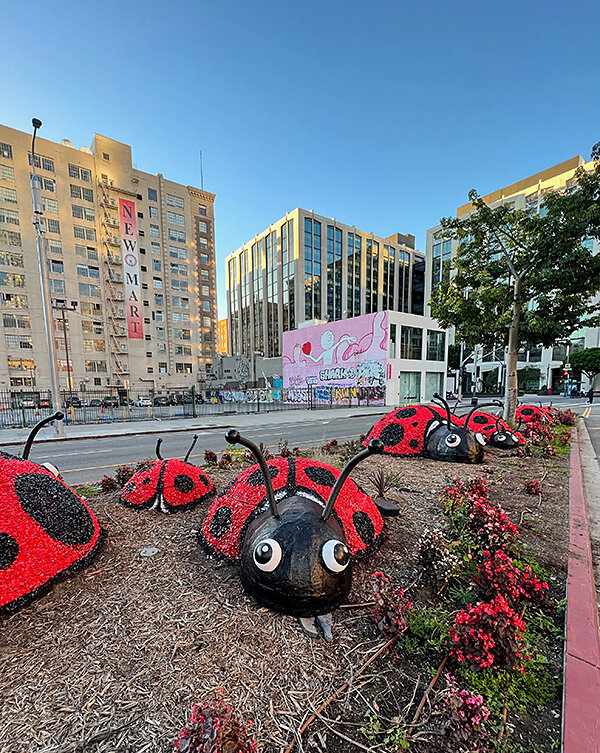
Photo: S.C. Mero.
Ladybugs nestle into the intersection of 9th, Main, and Spring Streets in Los Angeles, spring 2023. LA’s Fashion District commissioned S.C. Mero to create a series of installations to decorate the median, which had fallen into disrepair.
Art can lift up a community. It can be an outlet for feelings of all kinds. Whether it’s the art of graffiti (see Manny’s documentary Stations of the Elevated), the art of whimsy, or any other kind.
In today’s post, Ali Martin interviews a whimsical street artist, S.C. Mero, for the MonitorDaily.
“In downtown Los Angeles, absurdity interrupts urban blight: A fire hydrant sprouts stockinged legs; a winged telephone leaps from a phone booth; a mailbox towers, inaccessible, over passersby.
“The city’s historic business district and surrounding neighborhoods are the backdrop for contemporary street artist S.C. Mero, who sees opportunity in a landscape dogged by disappointment and deferred dreams.
“The Minnesota native embraced the area, known as DTLA, after graduating from the University of Southern California (USC) a decade ago. Today, her rogue installations are part of downtown’s creative fabric – and local authorities are in on it. She’s been honored by the city for her contributions to the Skid Row neighborhood and commissioned by the nearby Fashion District to decorate a median at an intersection.
“Transformation governs her art. Ms. Mero’s first pieces were mosaics made of pennies which she altered with heat, dye, and tools. Other projects reshape abandoned spaces into commentaries on politics and humanity.
“Her work insists on hope, which she describes as rebellious. ‘To put something like cute little turtles on a median with downtown the way it is, it’s resisting something, right? It’s resisting the default, which is to be negative,’ says Ms. Mero.
“The Monitor spoke with Ms. Mero at Something Poetic, her venue for performance art. The space, offered to her during the pandemic by the Historic Core Business Improvement District, has become a hub for local artists. The conversation has been edited for clarity and length.
“Monitor: Why downtown? You joined an artist collective on Skid Row after graduating from USC. I’m guessing there were other options.
“S.C. Mero: I think my mom asked me the same question all the time. I just feel like it’s a good fit for what I’m doing. It’s really a creative vortex. … You have the Arts District, the Flower District, the Fashion District, Little Tokyo, you have the Industrial District, the Financial District. And maybe that’s typical of most cities, but I feel like there’s a lot happening here and it’s good for cultivating ideas. I’ve just felt like I want to see it through, too. Look at these [historic, vacant] buildings. I think this could come back to life and they’re not there yet. So I want to be part of that transition. …
“You look at a pothole, you look at something breaking down around you, and you see whimsy and light. How does that happen?
“Because nobody cares about it anymore. It’s free game, right? Nobody’s going to stop you from really, truly doing anything on a pay phone right now, or a newspaper stand, or – in certain areas – a pothole. … To do anything to it, people are like, ‘Oh, you know, it’s better than what was there.’
“What do you want people to take away from your art?
“I feel like wanting people to take away something is in a way thinking that I want something from them. … I’m thankful that they are even allowing me to do it. So the fact that their reaction is positive, I’m just even more grateful for that – it makes it a little easier to be able to keep doing it. So I don’t know if I want a certain reaction from people. I just hope that they can find something that they do that they love as much as what I’m doing.
“Is there a theme or an idea that pulses through your work?
“Yes. At first I didn’t really see it. … The age-old idea of spiritual growth and transformation. And I think that that’s evident in a lot of my work – the whole idea that something can lose its identity or lose its value, but then come back even stronger.
“A lot of my work is critical of our government, but I still maintain hope that there is a better way. It speaks to the truth because it’s not really about a payphone or a penny. We’re no different than that, right? Something is that way, but it can be better. What does it take for that to happen? It takes a belief, for one. It’s not going to get better by not thinking or imagining or seeing it that way.
“What is the relationship between your work and the downtown community?
“They’re as much of a part of [the art] as I am. It’s that we’re-in-this-together kind of vibe. Whether they like the piece or not, they get it because they’ve seen that pothole. They’ve seen a payphone like that. … It has that sense of camaraderie, I think.”
More at the Monitor, here. Note the funny mailbox, among other things.

 Suzanne's Mom's Blog