Feeds:
Posts
Comments

Posts Tagged ‘leather’

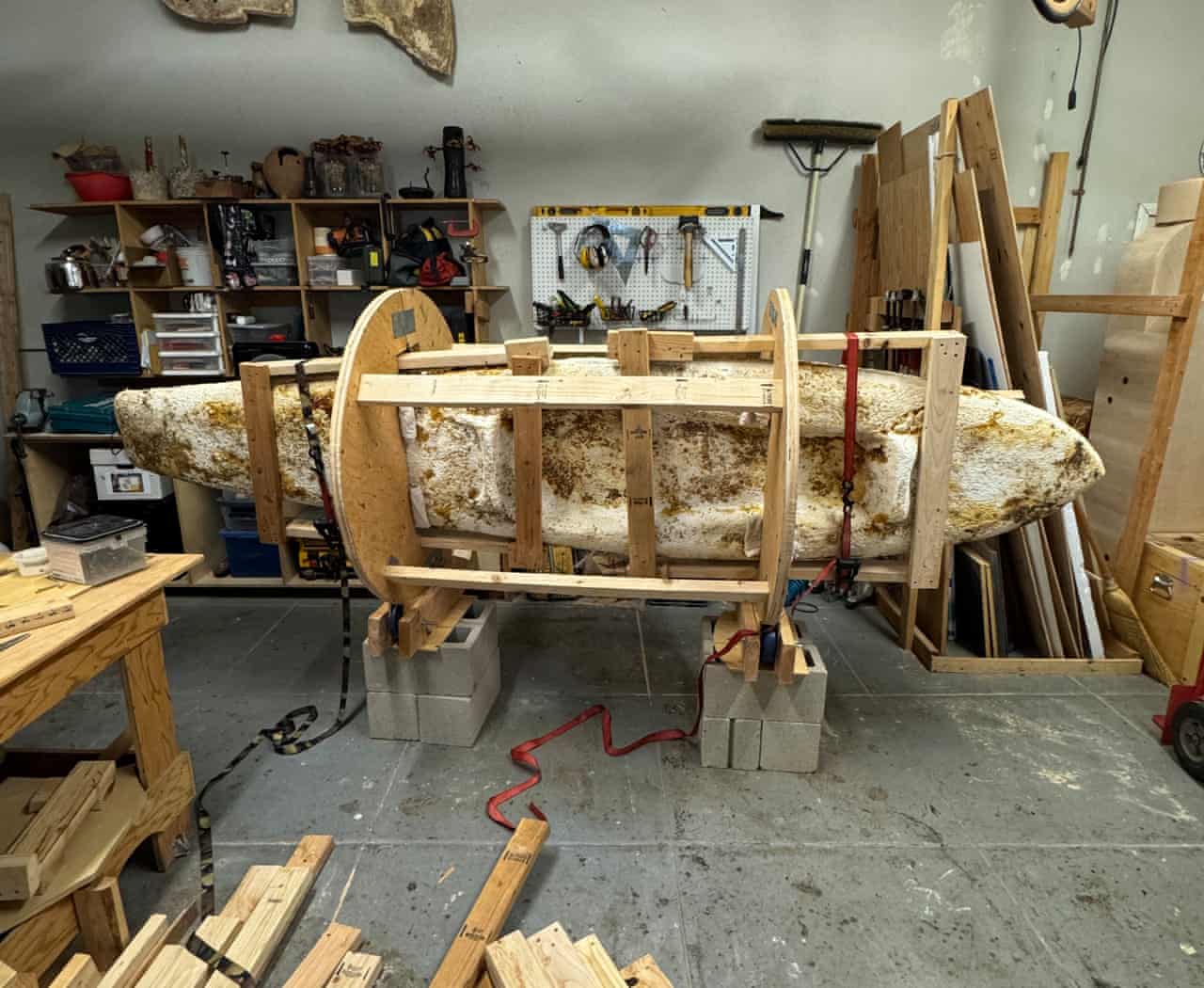
Photo: Jordan Freeman/Sam Shoemaker.
Sam Shoemaker made a kayak entirely from mushrooms.

Mushrooms! What next?

This week I chatted with Ann about a class where she learned to use mushrooms for natural dyes. And you may remember a post, here, about human caskets made from mushrooms.

But, wait! There’s more, says Open Fung, a nonprofit advancing the future of fungi-based technologies, materials, and the arts. Their latest endeavor: making a kayak from mushrooms.

Lisa Kwon reports at the Guardian, “On a clear, still morning in early August, Sam Shoemaker launched his kayak into the waters off Catalina Island and began paddling. His goal: to traverse the open ocean to San Pedro, just south of Los Angeles, some 26.4 miles away.

“But upon a closer look, Shoemaker’s kayak was no ordinary kayak. Brown-ish yellow and bumpy in texture, it had been made – or rather, grown – entirely from mushrooms. His journey, if successful, would mark the world’s longest open-water journey in a kayak built from this unique material.

“With his phone, GoPro camera, walkie talkie, and a compass affixed to his life vest, Shoemaker left shortly before 6am in order to avoid the worst of the swells in the forecast. But three hours in and powering through his ninth mile, the coastline still out of sight, Shoemaker began feeling seasick.

“Suddenly, he heard the sound of a large animal breaching the waters. To his left, a fin whale flashed its glistening tail, then trailed slowly behind him. As the 50-ft creature followed him for three more miles, Shoemaker found the strength to finish out the maiden voyage … which took him 12 hours.

“As he stumbled onto shore with his mushroom kayak still intact, the artist and mycologist embraced his friends and family. …

“Shoemaker began his career as an artist creating sculptures with propagated mushrooms. Upon returning to Los Angeles after graduating from Yale with an MFA in 2020, he began exhibiting artwork that captured the unique behavior of mushrooms as they grew out of hand-built ceramic vessels and blown glass. … Shoemaker now belongs to a small community of scientists and artists exploring the potentiality of fungal innovation as an alternative material that could be used in everything from kayaks and buoys to surfboards.

“Their focus is on mycelium … a pivotal connective tissue in the animal kingdom. Mycelium-based materials in an aquatic context are known as AquaFung, a term coined by Shoemaker’s mentor Phil Ross, an artist and the co-founder of a biotechnology company called MycoWorks that engineers mycelium-based materials including a mushroom ‘leather‘ that can be used in furniture, handbags and biomedical equipment. After cofounding MycoWorks, Ross cofounded Open Fung. …

“Ross argues that AquaFung has many of the appealing properties as plastic – such as being lightweight and buoyant – but without the harmful footprint. …

“Shoemaker began working on his first mycelium boat in 2024. …

He modified a used fishing kayak to serve as his fiberglass mold, then grew the mycelium network inside the mold …

“Shoemaker meticulously dried the resulting kayak composite structure using fans over the course of several months. …

“Confident in his prototype, Shoemaker began searching for appropriate support. Shoemaker met Patrick Reed, the lead curator of the Pasadena-based arts organization Fulcrum Arts, in December 2023 through mutual friends. After a studio visit, Reed was blown away by everything that the artist had to show him. … Shoemaker completed his second mushroom boat in June; grown from the same wild Ganoderma polychromum mycelium. …

“The completion of Shoemaker’s boat marks the second ever water-tested mushroom boat to be made after Katy Ayers, who holds the Guinness World Record for growing, then testing, what was then the world’s longest fungal mycelium boat on a Nebraska lake in 2019.

“ ‘A lot of people really didn’t think it was possible,’ says Ayers, who grew her boat after being inspired by a documentary called Super Fungi. …

“Ayers and Shoemaker credits mycology pioneers like Ross for making the technology more accessible. And mushroom-based materials are slowly beginning to pop up in the mainstream: In 2021, Stella McCartney made headlines with its launch of the world’s first-ever garments made from lab-grown mushroom leather, in consultation with Ross.”

More on the future of fungal materials at the Guardian, here. No paywall: Please consider offering some financial support to the Guardian.

Read Full Post »

mammals-3218028_1280

Why do foxes steal so many shoes?

A recent article by Daniel Hurst, reporting from Tokyo for the Guardian, prompted a web search but no definitive answers. Apparently foxes steal shoes. OK, but why and why so many?

“It began at midnight,” Hurst wrote. “A six-hour police stakeout to catch the shoe-loving thieves who had pilfered 40 pairs of sandals from a neighbourhood in Japan. Finally, the officers found the main suspects: a pair of sly foxes.

“ ‘I can’t believe that foxes stole my sandals,’ a resident, 36, told the Mainichi newspaper. …

“Five police officers were involved in the stakeout in the early hours of 20 May. This culminated in the discovery of two foxes in the garden of an empty house, with 40 pairs of shoes scattered around a burrow, the Mainichi reported.

“Kyoto city zoo’s chief, Naoki Yamashita, speculated that the foxes ‘could have been building a burrow to breed and collected the sandals out of their instinct to stock up on food and other items.’

“Police have reportedly issued a warning to local residents to keep their shoes inside their homes to prevent any further disappearances.

“The Nagaokakyo animals are not the first shoe-stealing foxes. … The journalist Peter Beaumont wrote an article for the Observer in 2013 on his battle with foxes near his home in north London.

“ ‘One morning I came down to find seven shoes ranging in size from that of a toddler to an adult trainer sitting in the middle of the lawn, none of them a pair,’ he wrote.

“In 2014, a resident in Farlington, Portsmouth, reported finding more than 50 shoes along a path near a fox den. Those responsible seemed to prefer trainers and work boots, the resident said at the time.” More at the Guardian, here.

In a 2009 Reuters article from the small western German town of Foehren, an officer provided speculation about the needs of baby foxes, ” ‘There was everything from ladies’ shoes to trainers,’ said a local police spokesman. ‘We’ve found between 110 and 120 so far. It seems a vixen stole them for her cubs to play with.’ ”

And here’s a 2014 BBC report in which kept delivering shoes to the yard of a Horsforth woman.

But for an answer of why, check the Yahoo questions site, here. One answer: “Same as dogs: to chew on. They like the smell, they like the leather.” Another theory, my favorite: “Foxes steal shoes because most shoe stores and malls discriminate against foxes.”

Read Full Post »

Sometimes I get blog ideas from Facebook, which is one reason I can’t see myself pulling out despite all the irrelevant, unwanted clutter there.

Former colleague Scott G. recently posted a curious item on Facebook about turning pineapple waste into leather — real leather, not “fruit leather.” It’s much better for the environment than animal-based leathers and more appealing to sustainability-conscious consumers than petroleum-based ones.

Adele Peters at FastCoexist says that Carmen Hijosa got the idea for a new, sustainable industry on a visit to the Philippines years ago. But first she needed a PhD.

“When leather expert Carmen Hijosa visited the Philippines to consult with the leather industry there, she discovered two big problems: The leather was poor quality, and producing it was bad both for the local environment and the people involved.

“But as she traveled around the country, she had an epiphany. The Philippines grows a lot of pineapples — and ends up with a lot of wasted pineapple leaves. The leaves, she realized, had certain features that might make it possible to turn them into a plant-based leather alternative. …

“She also looked at other local plants, such as banana fibers and sisal. But only pineapple fibers were strong and flexible enough to handle the manufacturing process she had in mind.

“Hijosa left her work in the traditional leather industry and spent the next seven years at the Royal College of Art in London, developing the material into a patented product while she earned a PhD. Now running a startup — at age 63 — she’s ramping up manufacturing of her pineapple-based leather, called Piñatex. …

“Her startup, Ananas Anam, has built its production from 500 meters to 2,000 meters, and [by August], she expects the next batch to be around 8,000 meters. But as the company’s capacity grows, demand is already outpacing supply. Companies like Puma and Camper have made prototypes with the material, and others are already using it.”

What an impressive woman! More here.

Photo: FastCoexist
Because pineapple leaves would normally be wasted, turning them into leather, is an extra source of income for farmers.

Read Full Post »