Feeds:
Posts
Comments

Posts Tagged ‘light pollution’

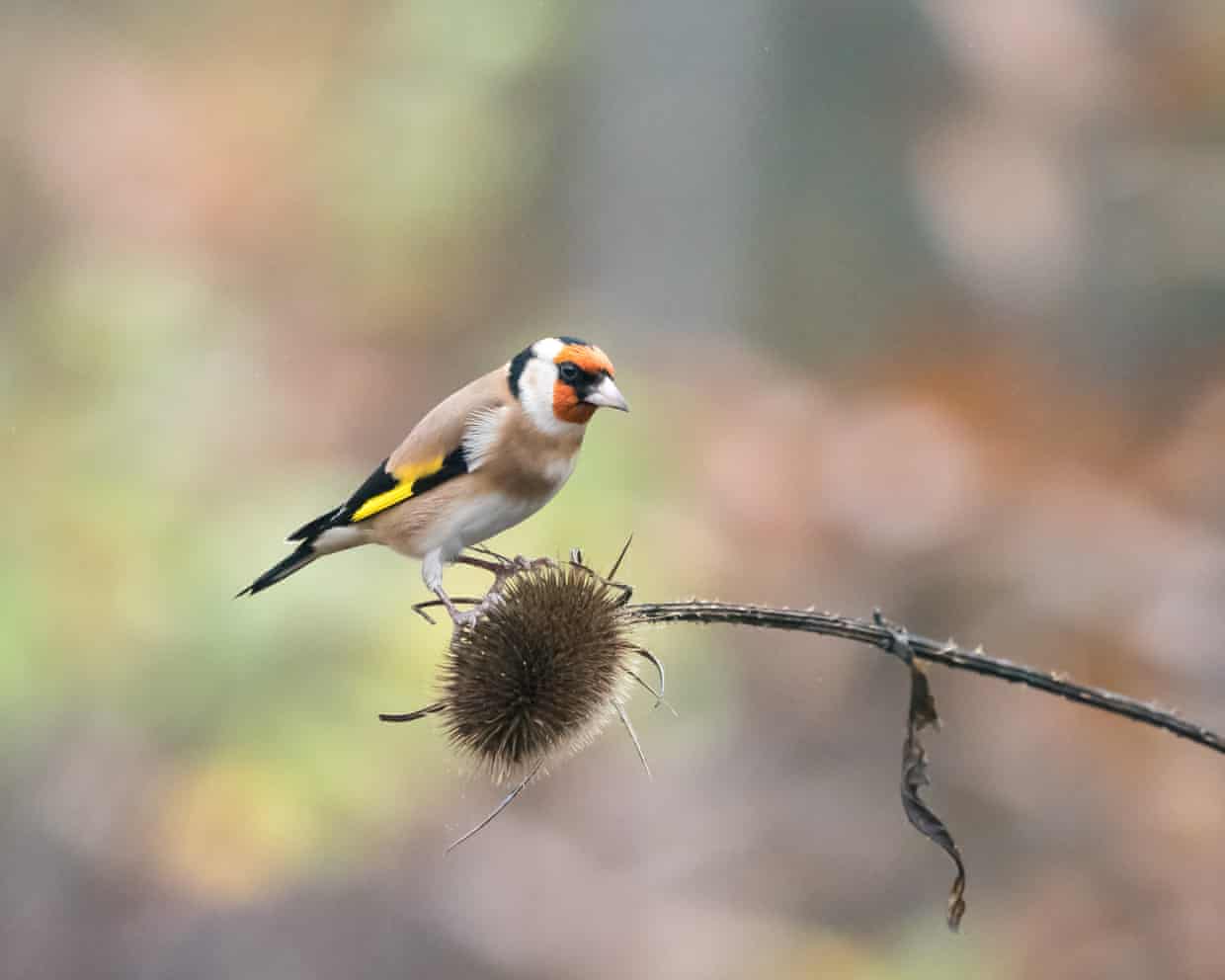
Photo: Suerob/Getty Images/iStockphoto.
The European goldfinch, above, was one of the species most affected by the growing amount of light-polluted areas. 

I am not a scientific kind of birdwatcher, but I love trying to identifying the birds around here, sometimes by their song. I’ve learned that one “song” of the red-bellied woodpecker, for instance, sounds a lot like a metal windup toy.

Citizen scientists the world over are contributing to what scientists know about birds. Consider how a recent study was able to use a bird lovers’ website to take our knowledge of avian behavior a step farther.

Hannah Devlin, science correspondent at the Guardian, reports that “urban birds stay up significantly later than their rural counterparts, according to research that highlights the impact of light pollution on wildlife.

“The study, based on recordings submitted by bird enthusiasts to a popular species identification and mapping website, showed that light pollution caused birds to sing for an average of 50 minutes longer each day, with some species waking up an hour earlier and settling down for the evening an hour later.

“ ‘We were shocked by our findings,’ said Dr Brent Pease, an assistant professor of biodiversity conservation at Southern Illinois University Carbondale. ‘Under the brightest night skies, a bird’s day is extended by nearly an hour.’

“Light pollution now affects 23% of Earth’s surface and is rapidly growing in extent and intensity, data suggests. There is already evidence for detrimental effects on human health and concerns that many species are affected, with negative consequences including die-offs of insects and the disruption of migration patterns in bats and sea turtles.

“The latest study used bird recordings submitted to BirdWeather, a citizen science project that allows users to submit recordings from birds in their local area to produce a global live library of birdsong and which uses AI to allow users to identify birds in their gardens. In total the scientists analyzed 2.6m observations of onset (morning) bird vocalization and 1.8m observations of cessation (evening) bird calls, for hundreds of species. This data was combined with global satellite imagery measurements of light pollution. …

“The analysis found that for birds in light-polluted areas, the waking day was extended by 50 minutes on average.

Species with large eyes, relative to their body size, had the strongest response to artificial light.

“ ‘The American robin, Northern mockingbird and European goldfinch all extended their day by more than average,’ said Pease. …

“The impact of a longer day for birds was not yet clear, the researchers said. ‘We know that sleep loss is not great for humans, but birds are different,’ said Pease. ‘They have developed interesting strategies to cope with loss of sleep during migratory periods.’

“A disturbance of natural behavior patterns was of concern, Pease added, although there is evidence, in some species, that artificial lighting may increase foraging and mating time and improve the survival rate of fledglings.

“The findings are published in the journal Science.”

Sounds like this is a case of “more research is needed.” More at the Guardian, here.
Read Full Post »

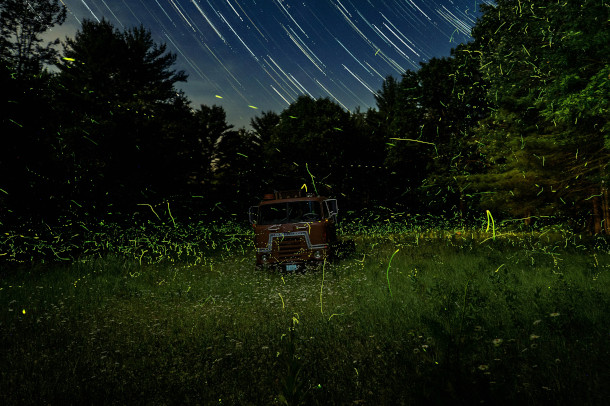
Photo: Robert Ritchie, Unsplash via Living on Earth.
The streaks of light in this 30-minute timelapse image show fireflies in a Wisconsin field.

Where are the fireflies of our childhood? Although the population perked up around here this past summer, possibly because of all the rain, firefly lovers have reason to be worried about the long term. Today’s story explains what’s going on — and how we can all help.

Eric Berger writes at the Guardian, “Max Vogel, a 29-year-old public defense attorney, was picnicking with friends in early August at Prospect Park in Brooklyn, New York, when he noticed flashes of light appear in the air around him.

“They were fireflies, bioluminescent insects that the Washington DC native had not seen while living in Oregon, where there are few, if any. For many Americans who live where fireflies do, their flashing lights at dusk are a tangible rite of summer – though one that may now be under threat. …

“Vogel said, ‘It’s like a shooting star that just is surprising and gives you the childlike wonder of how you felt when you first saw fireflies in your yard.’

“Even in areas of the US where there are typically fireflies, people are especially excited to see them this year because there appear to be more this summer after a steady decline in recent years, according to scientists.

“Despite that welcome news, researchers caution that it does not necessarily signal a reversal of the downward trend. They remain concerned about the long-term viability of the firefly family, which includes more than 2,000 species, some of which are at risk of extinction due to factors such as light pollution and climate change.

“ ‘It’s been really uplifting to hear all of the reports of huge increases in fireflies,’ said Candace Fallon, senior endangered species conservation biologist for the Xerces Society for Invertebrate Conservation. ‘But they are also insects, and insects are notorious for having populations that bounce up and down each year, and so it’s hard to say that their populations are increasing from a single year of data.’

“Fireflies, also known as lightning bugs, are beetles that come out at night during summer and produce a bioluminescent gleam, primarily to attract a mate.

“Cultures around the world treasure the bugs, including in Japan, where they are symbols of love and fallen soldiers.

“ ‘Catching fireflies is a relatively harmless thing that you can do that really connects you to your natural world,’ said Matt Schlesinger, chief zoologist with the New York Natural Heritage Program, which is participating in a project to identify which firefly species occur in state parks.

“Scientists in the US and Canada do not have baseline data on firefly species, which makes it difficult to quantify how much the population has decreased, and they must instead rely on anecdotal reports and documented habitat loss, which point to a downward trajectory, Fallon said.

“She and other researchers conducted a study published in the journal PLOS One which found that 18 species in North America are threatened with extinction. But the scientists also did not have enough data on more than half of the assessed species to determine their extinction risks. …

“The primary factor behind fireflies’ decline is habitat loss and degradation, according to the Xerces Society. That includes land being disrupted by development, light pollution and pesticide use. Artificial lighting at night makes it hard for the bugs to communicate and mate, Fallon said.

“Climate change, including an increase in droughts and rising sea levels, also affect firefly populations, she said.

“Still, there are some firefly species that appear to be doing ‘just fine,’ Schlesinger said [adding that] the kinds that specialize in particular habitats are the ones struggling. …

“ ‘If they can still have a big year, at least those species are probably doing fine and have the potential to recover,’ Schlesinger said. That said, ‘any single year doesn’t tell you about the long-term trajectory of firefly populations. …

“Kids should continue the tradition of venturing out with jars in the summer but should then release the bugs rather than collecting them, Schlesinger said.

“Other ways to help fireflies survive include: not using pesticides, reducing artificial lighting at night, and allowing the grass to grow long and the leaves to pile up in your yard.

“ ‘A lot of fireflies pupate in leaves, and so when we rake those and put them in bags, we’re destroying their habitat at a very small scale,’ Schlesinger said.

“Despite the concerns about extinction, Fallon is encouraged by master gardeners in Arkansas who created a firefly sanctuary, and by lawmakers in Maryland who approved legislation earlier this year which introduces new regulations on what type of lighting can be bought with state funds. …

“ ‘I think we have enough time to make a difference.”

More at the Guardian, here. See also the radio show Living on Earth, here.

Read Full Post »

Photo: National Park Service.
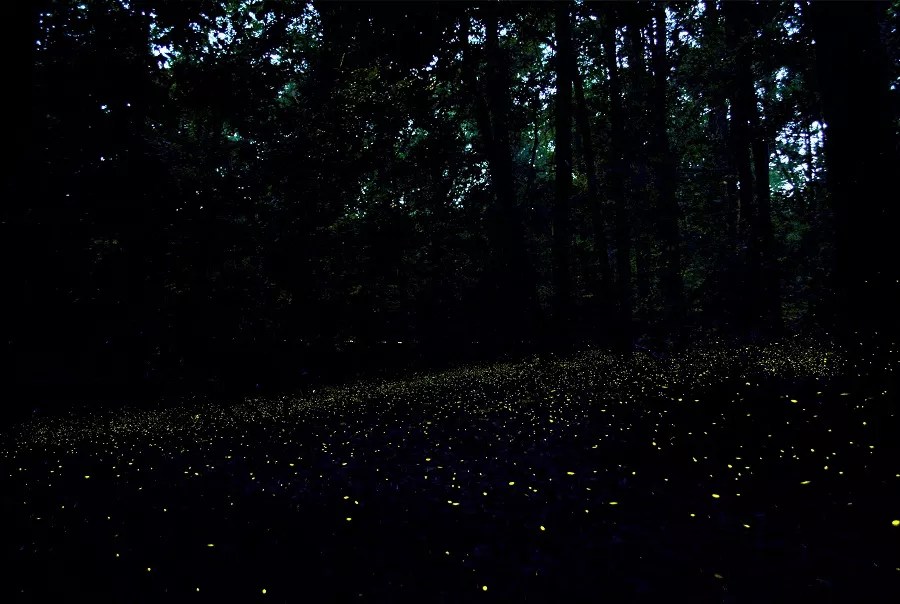
Mid-May to mid-June, synchronous fireflies light up the forest at dusk in Congaree National Park, South Carolina.

I used to love seeing fireflies as a kid, and now they are rare where I live. It makes me sad. What’s it all about? What is to be done?

Dino Grandoni at the Washington Post has this to say about the dangers to fireflies and possible ways to help bring them back.

“As a younger man, Joe Cicero saw ‘thousands and thousands of them.’ Swarms of fireflies put on a soundless fireworks show for him every summer in southern Arizona. The sight of the fireflies flashing in unison was so mysterious and mesmerizing that the entomologist made the study of the flickering insects his life’s work.

“Four decades later, Cicero, now retired, still goes back to those oak woodlands. Today, though, they’re mostly dark. The fireflies have been decimated, Cicero lamented. ‘Down to just a trivial few relative to the big population they had back then.’

“For many Americans, their otherworldly glow signals the start of summer. But across the country, many of these harbingers of summer may be blinking out of existence. What was once a series of tales from old-timers about the decline of fireflies from the days of their youth is coalescing into a disturbing scientific truth.

“Nearly 1 in 3 firefly species in the United States and Canada may be threatened with extinction, firefly experts estimate in a recent comprehensive assessment. … New research is shedding light on how these ethereal insects are struggling to thrive in the brightly lit world we have built around them.

“And the problem is bigger than a single type of bug. … In so many spots where scientists look, insects of all sorts are vanishing, … leading to fears of a potential-though-still hotly debated ‘bugpocalypse,’ which could unravel food webs for birds and other insect-eating animals and cause calamity for farmers who need pollinators to grow crops.

“ ‘I know a lot of people who hate insects. I’ve never met a single person who didn’t like fireflies,” said Sara Lewis, a Tufts University biologist and author of Silent Sparks: The Wondrous World of Fireflies.

“To understand the threats to fireflies, start underground. Fireflies in the United States spend the vast majority of their lives in their larval state, roaming the dirt to consume snails, worms and other soft-bodied grub several times their size. In contrast to their gentle summertime image, baby fireflies are vicious predators.

“But much of the swampy soil young fireflies need to thrive is increasingly being bulldozed for golf courses, suburban subdivisions and other types of development, making habitat loss a top threat. …

“ ‘These wetlands only occur right along the beach along the Mid-Atlantic,’ said Christopher Heckscher, an environmental scientist at Delaware State. … In Arizona, the Southwest synchronous firefly that Cicero studies is being trampled by different threats. Cattle and all-terrain vehicles in Coronado National Forest are stomping out its riverside habitat, he said. …

“When the time is right in the spring, juvenile fireflies seek a spot to pupate. Much like how a caterpillar transforms into a butterfly, a young firefly rearranges its body to turn into an adult. Then they take flight.

“The adults live for only a few weeks — with one thing on their minds. Fireflies flicker at each other to find their mates. …

“Males of certain species work together to woo mates by synchronizing their pulses. Other varieties are more ruthless, imitating the flashes of smaller fireflies to lure them in — and eat them. There are more than 2,000 species of fireflies globally, each doing a different dance.

“Even in the best conditions, males drifting in the air struggle to find females on the ground. ‘Mating success rate in darkness is not especially high,’ said Avalon Owens, a research fellow at Harvard. …

“Increasingly, we’re the ones making it harder. The artificial light we pour into the night is interrupting these bioluminescent courtships.

“To test the impact of light pollution, Owens set up a mating arena on her porch in her home outside Boston in 2020 during the height of the coronavirus pandemic. …

“In a study published last year, Owens and Lewis found exposing a semi-nocturnal firefly species called Photinus obscurellus to a bright light on the porch completely prevented it from mating. Out in the wild, the [researchers] found males of a related species, P. greeni, preferred LEDs meant to imitate females that were bathed in darkness.

“Brightening the night not only makes it harder for fireflies to see each other, it may also trick them into thinking it is daytime, Owens said. ‘It erases their habitat,’ she added. …

“Not every type of firefly is in peril. Some are actually thriving in our well-lit world.

“The big dipper firefly, named for the swooping arc it draws in the sky, evolved to come out at dusk and does not seem to mind modern streetlights. In their field experiments, Owens and Lewis found artificial lighting had little impact on the big dipper’s mating. Plenty can be found in well-lit corners of Central Park in New York.

“For many fireflies, there is a painful lack of data on even baseline populations. While some species remain abundant, overall, we risk the loss of firefly biodiversity. …

“While reversing climate change and other environmental threats is monumentally difficult, saving fireflies from light pollution is relatively easy. ‘You literally can just turn off the light, and the threat is gone,’ said Candace Fallon, a senior conservation biologist with the Xerces Society, a nonprofit conservation group pressing the federal government to extend endangered-species protections to fireflies. …

“For now, firefly aficionados are trying to inspire the next generation. Nearly 30,000 people flock to the Great Smoky Mountains each year to watch the park’s fireflies light up in sync. In Arizona, Cicero stages similar nightwatch parties for the few synchronous fireflies that remain there.”

More at the Post, here.

Read Full Post »

Love your universe. Here’s how.

First, as we discussed, there is forest bathing (note the comment on the June 15 post about regular forest-bathing excursions in Lowell, Mass.). Now we turn to star gazing. For both, you need to leave behind superfluous stuff like social media and bright lights.

Margaret Regan writes for the Guardian, “Take a nighttime drive into Arizona Sky Village, in a remote valley in south-east Arizona, and the only thing you can see clearly are the millions of stars twinkling overhead. Beyond the light show, the sky is a deep inky black, and the ground below is nothing but shadows. Dimmed car headlights might pick up spooked jackrabbits hopping through the desert brush, but the village’s unlit houses are all but invisible in the darkness.

“That’s the way the residents of this astronomy-loving community like it. The less light, the better their view of the universe.  …

“Arizona Sky Village is home to a quirky community of stargazers. Shielded by the nearby Chiricahua mountains from urban sky glow – scientists’ poetic name for light pollution – nearly every house in the rural 450-acre development has its own domed observatory, complete with an array of telescopes.

“Outdoor lights are strictly forbidden; blackout shades are required in every window of every house; and nighttime driving is discouraged. Most residents don’t want to be bothered with driving at night anyway: they’re too busy scanning the skies.

“ ‘This is what we do,’ villager Frank Gilliland says cheerfully one starry night as he peers through the community’s biggest telescope, a 24-incher belonging to neighbor Rick Beno. At the moment, the scope is aimed at the Milky Way through an open hatch in the dome of Beno’s personal observatory, giving Gilliland a crystal-clear view of the Orion nebula, a remarkable 1,344 light years away. …

“Most of the Sky Villagers had technical or scientific careers – Dr Fred Espenak, a bona fide astronomy pro, is a retired Nasa astrophysicist known as Mr Eclipse – but [Arizona Sky Village founder Jack] Newton spent his working life managing department stores in his native Canada. He always made time for the sky though, rambling miles into the countryside outside his hometown of Victoria. …

“When Jack retired, the Newtons wanted a break from rainy Victoria and its murky skies. After a first retirement stop at a sky village in Florida, Newton and development partner Gene Turner came out to Arizona to scout dark places.

“The isolated stretch of treeless desert they found outside Portal was perfect: it was sparsely populated, 150 miles distant from Tucson, the nearest city, and velvety black at night. Now some 21 households live there peaceably under Newton’s Law: they cover up their windows and they turn off the ‘goddam’ lights. …

“Even Arizona’s state government – not known for progressive policies – has restricted electronic billboards. The flashy placards are allowed only in several designated sites at least 75 miles from the venerated Grand Canyon and from the Kitt Peak and Mt Lemmon observatories. In 2012, the then governor Jan Brewer vetoed a 2012 attempt to light up more of the state’s highways with dancing electronic videos, declaring that she refused to put astronomy in jeopardy. As she noted, the industry contributes $250m annually to Arizona’s economy and employs more than 3,300 people.” More here.

Seems a shame to have to make economic arguments to do good, but whatever works. We do need to keep seeking common ground when addressing challenges.

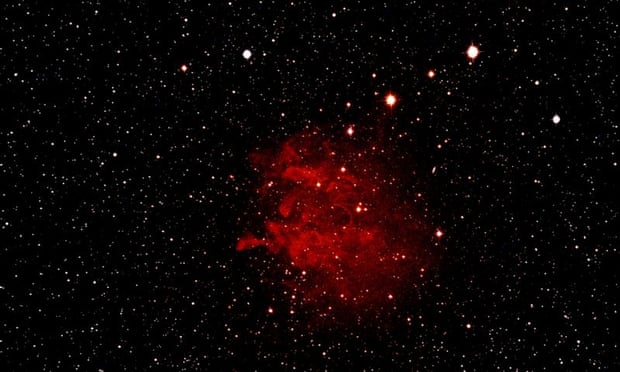
Photograph: Rick Beno
Emission Nebula in Aries. Arizona Sky Village is one of the best places in America to see the stars.

Read Full Post »

Every once in a while reporter Ted Nesi adds a tidbit to his valuable “Saturday Morning Post” that doesn’t seem to fit with the news from Rhode Island and yet fits everywhere. This link from the Virginia Quarterly Review (VQR), a “national journal of literature and discussion,” is one such example.

Amanda Petrusich writes in part, “Darkness is a complicated thing to quantify, defined as it is by deficiency. … Unihedron’s Sky Quality Meter is the most popular instrument for this kind of measurement, in part because of its portability (about the size of a garage-door opener) and also because it connects to an online global database of user-submitted data.

“According to that database, Cherry Springs State Park — an eighty-two-acre park in a remote swath of rural, north-central Pennsylvania, built by the Civilian Conversation Corps during the Great Depression—presently has the second darkest score listed …

“The International Dark-Sky Association (IDA), a nonprofit organization that recognizes, supports, and protects dark-sky preserves around the world, designated it a Gold-tier International Dark Sky Park in 2008, only the second in the United States at the time, following Natural Bridges National Monument in San Juan County, Utah.

“Earlier this year, I drove the six hours to Cherry Springs from New York City to meet Chip Harrison, the park’s manager, his wife, Maxine, and a park volunteer named Pam for a 4:30 p.m. dinner of baked fish. Afterward, Chip had promised, we’d go see stars.  …

“On a clear night, from the proper vantage, watching constellations emerge over Cherry Springs is like watching a freshly exposed photograph sink into a bath of developer, slowly becoming known to the eye: a single crumb of light, then another, until the entire tableau is realized. Pam pointed the telescope toward Jupiter, which had risen over the east end of the field. The four Gallilean moons—Io, Europa, Ganymede, and Callisto—were clearly visible through the lens. …

“When I got back to New York, I visited with Matt Stanley, a beloved colleague at the university where I teach. Stanley … has a particular interest in how science has changed from a theistic practice to a naturalistic one. He leads a seminar called ‘Achilles’ Shield: Mapping the Ancient Cosmos,’ and another called ‘Understanding the Universe.’

“ ‘I’ve found that probably 95 percent of my students come from either an urban or suburban environment, which means they can only see a dozen stars at night, and no planets,’ Stanley said. ‘When you say the Milky Way to them, they imagine a spiral galaxy, which is fine, but that’s not what the Milky Way looks like — it’s a big, whitish smear across the sky. I have to do a lot of work to orient them to what human beings actually saw when they looked at the sky. They don’t know that stars rise and set. Their minds explode.’ ” More here.

In Rhode Island, New Shoreham offers a pretty good look at the night sky. There are shooting stars in August. I feel lucky about that and hope that the five nearby offshore wind turbines don’t change anything.

Photo: Gary Honis

Read Full Post »