Feeds:
Posts
Comments

Posts Tagged ‘linguistic’

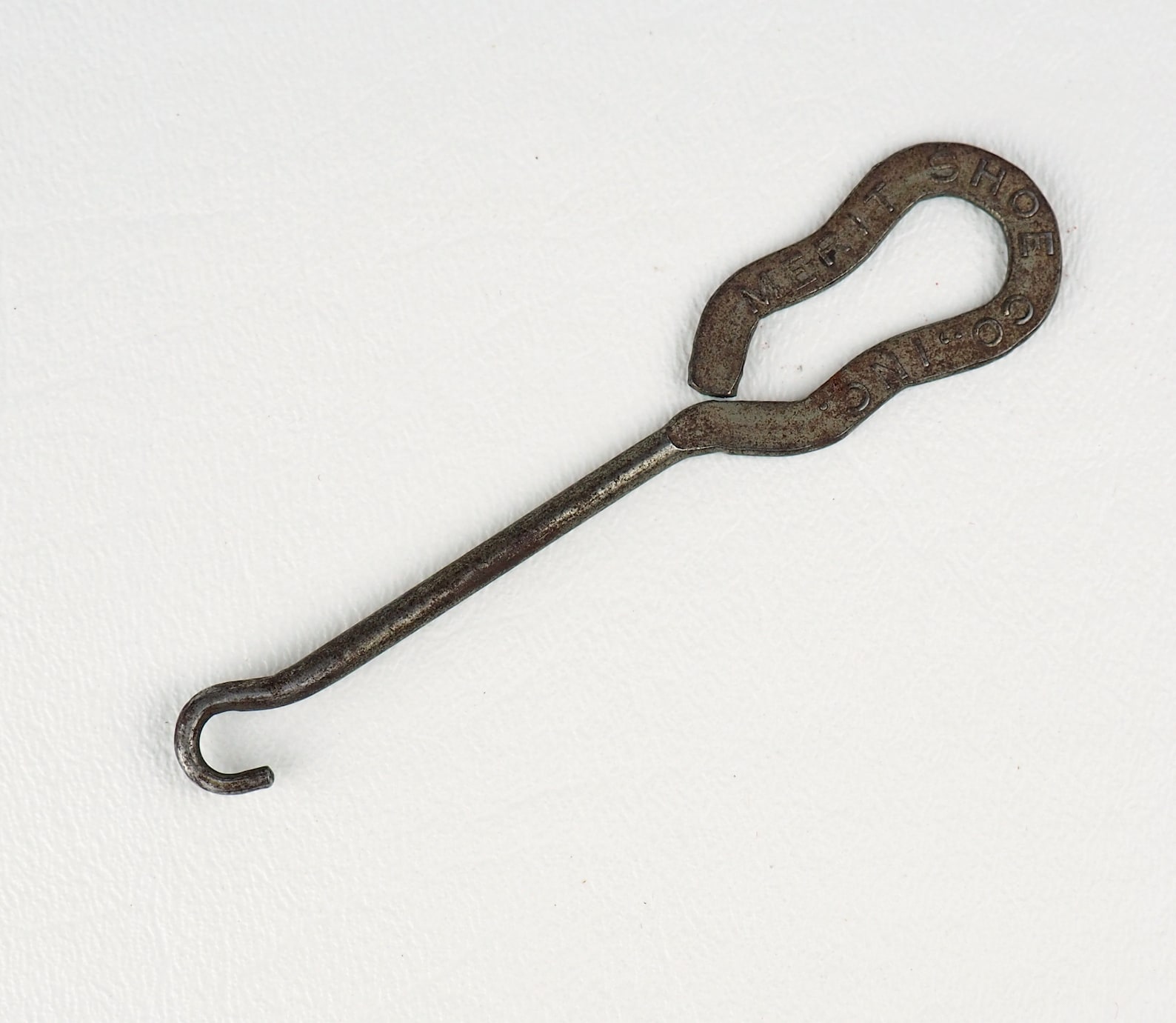
Photo: Etsy.
Antique button hook for shoes.

Recently, Suzanne’s friend Jackie Delamatre has been researching and writing about unfamiliar utensils like grapefruit spoons. There sure are an array of antique gizmos for her to choose from, and lots of new ones.

Don’t you love the word “gizmo”? It was so handy when Suzanne was a toddler and was asking too many times in 10 minutes “what’s this called, what’s that called?”

Today’s story explains why and how we use words like gizmo, whatchamacallit, thingamajig …

Ursula Kania, a senior lecturer in English Language and Linguistics, at the UK’s University of Liverpool, writes at the Conversation.

Years ago, humans started speaking and we’ve not shut up since. Sometimes, though, we struggle to remember the name of an object, a place, or a person we want to talk about. The technical term for this phenomenon is ‘lethologica.’ … Drawing the occasional, temporary blank is very common. Unsurprisingly, stress doesn’t help, and it gets worse as we age.

“But what can we do if we’re coming up empty yet still want to keep the conversation going? …

“We can hesitate, using so-called fillers like ‘ehm’ and ‘uh’ to buy us some time, in the hope that the right word will make a delayed but triumphant appearance. We can describe what we mean, hoping to still get the message across. … We may even be able to recall certain formal characteristics of the word, like the first letter or sound, or how many syllables it has and generously offer these clues to the puzzled listener: ‘You know – this guy we met last week, I think his name starts with a G.’

“This is why we also call this the tip-of-the-tongue phenomenon. We’ve almost got it, and our brain is doing its best to use all stored bits of information (for example, on the word’s pronunciation and meaning) to come up with something useful to say, even if it isn’t the correct word itself.

“Sometimes, this results in us making up words on the spot (referred to within linguistics as ‘spontaneous’ or ‘ad-hoc coinages’). You may not find them in the dictionary, but they usually still make sense in context.

“Even young children already come up with them in an attempt to put into useful practice what they’ve already learned about language. …

“My favorite example in this category, though, is a Tweet about a German customer in a Welsh pub who couldn’t recall the word ‘cutlery’ and politely asked for ‘food weapons.’

“Last but certainly not least, we may use ready-made placeholders like ‘thingamajig,’ ‘whatchamacallit’ (for an object) or ‘what’s-his-name’ (for a person).

“Apparently, the struggle to find the right word is real and has been for some time, because the Oxford English Dictionary has its own category for these terms, labelled ‘thing or person whose name is forgotten or unknown.’ It includes 64 entries and some records go back as far as the early middle English period (1100–1300).

“Not all of them are still used today. The last attested use for the strangely evocative whiblin’ was in 1652, for example, and ‘jiggumbob’ is marked as obsolete.

Others, like ‘gizmo’ or ‘doodah’ are still going strong, though, and you can even buy ‘Whatchamacallits’ and ‘Whozeewhatzits’ – they are chocolate bars made by Hershey’s.

“There are threads on Reddit dedicated to collecting placeholder words in English and from around the world. They are worth exploring, with gems like ‘doomaflitchie,’ the Dutch ‘huppeldepup’ and the German ‘dingsdabumsda.’ “

If you know any others, especially whatchamallits in non-English languages, do let us know. We old folks need lots of these substitutes. More at the Conversation, here. No paywall.
Read Full Post »

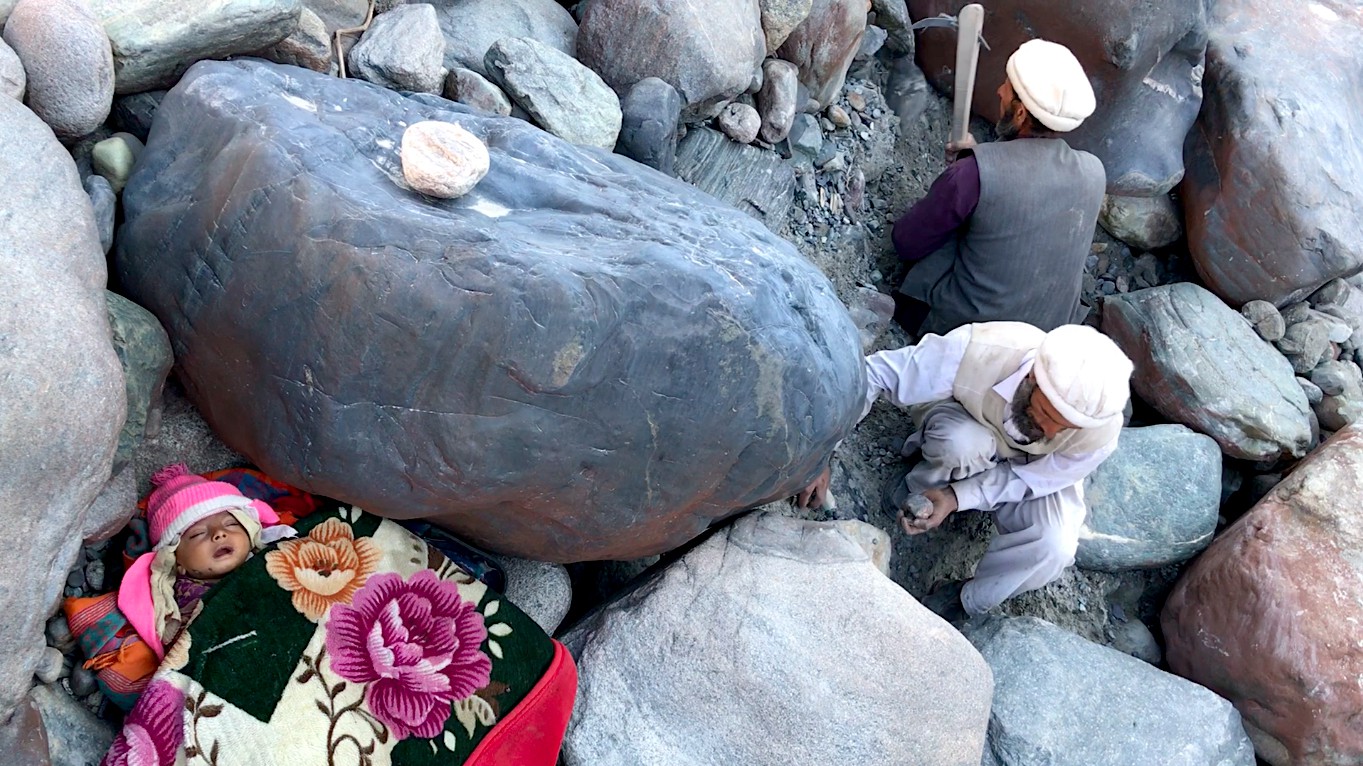
Photo: Paul Salopek/ National Geographic.
A baby sleeps near a gold prospector’s diggings in northern Pakistan.

I’m not sure how many readers will be interested in today’s rather academic treatment of an exotic part of the world and its many languages. Although I am not fluent in anything but English, I myself like learning about languages, especially those that are spoken by a small number of people and don’t even have a written form.

Language activist Zubair Torwali writes at Aeon about the many languages of ‘Dardistan,’ which includes northern Pakistan, parts of Eastern Tibet in China, eastern Afghanistan and the Kashmir valley on both sides of the Pakistan-India border.

“Dardistan is one of the most diverse linguistic regions in the world. … The region has the large Dardic languages such as Kashmiri, Shina and Khowar on the one hand and, on the other, it is home to the Burushaski language, which could not be placed within any language family because of its unique features. The Nuristani, formerly Kafiri, languages are spoken here, too. There are minor languages such as Kalasha, spoken by the Kalash community of hardly 4,000 people who still follow the ancient animistic religion that was once practiced across Dardistan.

“The name ‘Dardistan’ describes the area comprising the highest mountain ranges of Hindu Kush, Karakoram, western Himalaya and the Pamir mountains. … Dardistan’s enormous linguistic diversity occurs despite the fact that, culturally, the area is fairly homogeneous. [Anthropologist Augusto] Cacopardo says there is no match for this region in terms of linguistic and cultural diversity, except the Caucasus. Though, of course, minor differences exist, the same religious rituals and religious pantheon prevailed among the polyglot peoples of Dardistan.

“The many languages spoken here, though mostly belonging to the Indo-European family, still more narrowly to the Dardic sub-family within the Indo-Aryan group, are so different from each other that the people of one linguistic community have to rely on a third language, Pashto or Urdu, to communicate with members of another community. For instance, the people belonging to the Torwali and Gawri communities of the upper Swat valley in Pakistan need Pashto to converse with each other. This is despite the fact that the Torwali and Gawri languages are ‘sister languages’ and seem to have evolved from one single language a few centuries ago. …

“In 1986, the Summer Institute of Linguistics in collaboration with the National Institute of Folk Heritage, Lok Virsa, and the National Institute of Pakistan Studies at the Quad-e-Azam University in Islamabad, undertook a survey of the languages of northern Pakistan. Published in five volumes, this Sociolinguistic Survey of Northern Pakistan (1992) documented 25 languages. In fact, there are even more – at least 35 – languages in north Pakistan. …

“In his paper ‘India as a Linguistic Area’ (1956), the linguist M B Emeneau uses the phrase ‘linguistic area’ as a technical term to mean an area that includes languages of more than one family sharing some common traits with one another, but not all the linguistic features are alike among the language families. …

“[Swedish linguist Henrik Liljegren] argues that the Hindu Kush–Karakorum (HK) – also known as Dardistan – is a ‘linguistic area’ in the sense that it is a ‘convergence zone with a core that shares certain linguistic features’ as a result of a prolonged period of contact with other subareas. …

“Writing a century earlier, Morgenstierne was correct to claim that the region is among the most linguistically diverse in the world. Presently, about 50 languages are spoken here. [The] region has maintained this linguistic diversity, but it is under grave threat. Dardistan is at the crossroads of South Asia and Central Asia. It is mountainous and makes for very hard traveling. … It is perhaps thanks to Dardistan’s mountainous geography that we still find such a rich array of languages. …

“Dardistan is home to six language groups: namely Indo-Aryan, Iranian and Nuristani (all branches of the Indo-European language family), as well as Turkic, Sino-Tibetan and Burushaski. The Indo-Aryan phylum is the largest, including about 30 languages that have also been lumped together as ‘Dardic’ (North-Western Indo-Aryan) by linguists. … My work as an ethnographer and linguist has focused on north Pakistan. ….

“North Pakistan is a spectacular mountainous land of immense linguistic, ethnic and geographic diversity. It is undoubtedly one of the most multilingual places on planet Earth. Over many centuries, the movement and contact of people at this crossroads of Central and South Asia have left a complex pattern of languages and dialects. …

“None of Pakistan’s governments nor a university has ever taken any initiative in profiling the languages spoken by the people of Pakistan. Only a few – Urdu, Pashto, Punjabi, Balochi, Sindhi and Saraiki – are mentioned in any media, teaching materials and in any kind of national database. It is, therefore, difficult to estimate the exact number of speakers of each language because none of these languages has been counted in the six national censuses so far conducted in Pakistan. The number of speakers of these languages may vary from a few hundred to a million. Many are also spoken in Pakistan’s neighboring countries – Afghanistan, India and China.

“All these languages are categorized as ‘endangered’ in the Routledge Encyclopedia of World’s Endangered Languages (2007) edited by Christopher Moseley. Many of them are ‘severely endangered’ whereas a few are ‘moribund’ or already ‘extinct.’ “

The author details six of the languages at Aeon, here, and posts videos of people singing in them. No firewall.

Read Full Post »