
Feeds:
Posts
Comments

Posts Tagged ‘lost’

Photo: BBC.
A PhD student found a lost city by accident in eastern Mexico, in Campeche.

Talk about happy accidents! I’m sure we have all experienced a few, whether in cooking or driving around. And we often hear of happy accidents in science. Today, we learn about an alert PHD student who found an ancient civilization without precisely looking for one.

Georgina Rannard writes at the BBC, ” ‘I was on something like page 16 of Google search and found a laser survey done by a Mexican organization for environmental monitoring,’ explains Luke Auld-Thomas, a PhD student at Tulane university in the US.

“It was a Lidar survey, a remote sensing technique which fires thousands of laser pulses from a plane and maps objects below using the time the signal takes to return.

“But when Mr Auld-Thomas processed the data with methods used by archaeologists, he saw what others had missed — a huge ancient city which may have been home to 30,000-50,000 people at its peak from 750 to 850 AD. … Mr Auld-Thomas and his colleagues named the city Valeriana after a nearby lagoon.

“The find helps change an idea in Western thinking that the Tropics was where ‘civilizations went to die,’ says Professor Marcello Canuto, a co-author in the research. Instead, this part of the world was home to rich and complex cultures, he explains. …

It is ‘hidden in plain sight,’ the archaeologists say, as it is just 15 minutes hike from a major road near Xpujil, where mostly Maya people now live.

“There are no known pictures of the lost city because ‘no one has ever been there,’ the researchers say, although local people may have suspected there were ruins under the mounds of earth.

“The city [had] two major centers with large buildings around 2km (1.2 miles) apart, linked by dense houses and causeways. It has two plazas with temple pyramids, where Maya people would have worshipped, hidden treasures like jade masks and buried their dead. It also had a court where people would have played an ancient ball game. There was also evidence of a reservoir, indicating that people used the landscape to support a large population. …

“Professor Elizabeth Graham from University College London, who was not involved in the research, says it supports claims that Maya lived in complex cities or towns, not in isolated villages. …

“The research suggests that when Maya civilizations collapsed from 800 AD onwards, it was partly because they were so densely populated and could not survive climate problems.

” ‘It’s suggesting that the landscape was just completely full of people at the onset of drought conditions and it didn’t have a lot of flexibility left. And so maybe the entire system basically unravelled as people moved farther away,’ says Mr Auld-Thomas.

“Warfare and the conquest of the region by Spanish invaders in the 16th century also contributed to eradication of Maya city states.

“Lidar technology has revolutionized how archaeologists survey areas covered in vegetation, like the Tropics, opening up a world of lost civilizations, explains Prof Canuto. …

” ‘I’ve got to go to Valeriana at some point. It’s so close to the road, how could you not? But I can’t say we will do a project there,’ says Mr Auld-Thomas. ‘One of the downsides of discovering lots of new Maya cities in the era of Lidar is that there are more of them than we can ever hope to study,’ he adds.

“The research is published in the academic journal Antiquity.

More at the BBC, here. Seems to me the discovery was hardly an accident. Anyone with the patience to look at page 16 of a Google search deserves a bit more credit.

Read Full Post »

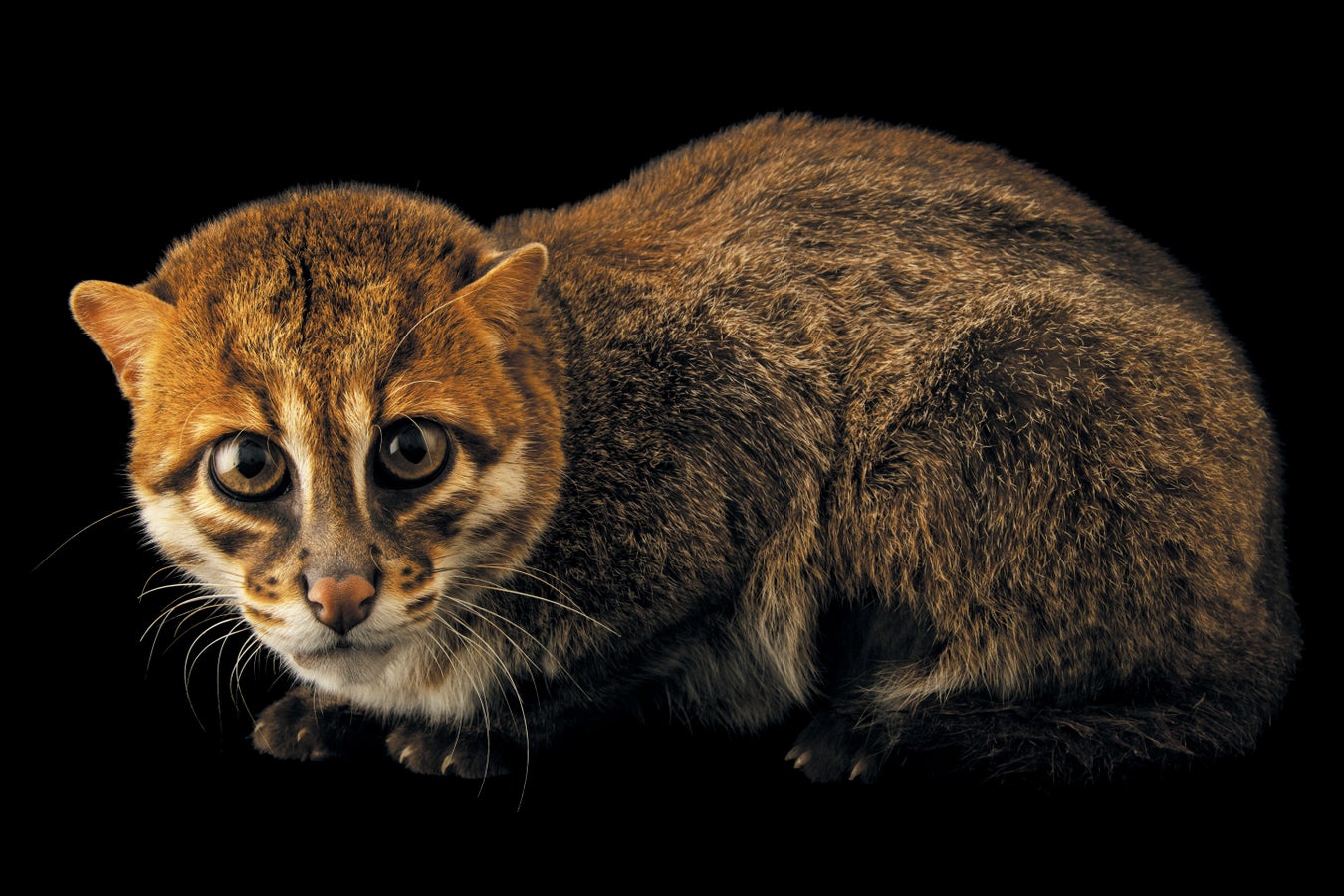
Photo: Joel Sartore/Photo Ark.
Rare flat-headed cats were declared “lost” before the species was rediscovered in 1995.

Lady Macbeth says, “What’s done cannot be undone.” Similarly, when a species is truly extinct, it’s done, never mind random talk of bringing back a wooly mammoth from its DNA. What is more feasible is bringing back to its former range a species that is merely extinct in that region.

Remember our post on the tiger quoll, thought to be extinct in southern Australia? And how about that gray whale, thought to be extinct in the Atlantic Ocean? It just showed up, although that was probably a sign of melting ice that could have opened a passage from the Pacific.

You might like Daniel Shailer’s related story at Scienific American on species that scientists think may yet be found. He explains how researchers will go about prioritizing their searches.

“Gison Morib was home lying in bed, sick from exhaustion after a month-long jungle expedition, when his phone buzzed and a black-and-white photograph appeared. Morib ran outside, jumped on his motorbike and sped through the city of Sentani on Indonesian New Guinea to his colleagues’ expedition and research base — where he broke down in tears.

“ ‘I cannot believe we found it,’ was all he could say, over and over. The photograph showed the first recorded sighting in more than 60 years of an Attenborough’s long-beaked echidna, an egg-laying mammal. After the researchers had spent three years of research and four weeks of trekking through the island’s remote Cyclops Mountains … the team’s camera trap had finally captured an image of the echidna. ‘Even now I can’t describe the feeling,’ … says Morib, a biology undergraduate student at nearby Cenderawasih University. …

“It can be painful for scientists to conclude that an entire species is gone forever. So after at least a decade without recorded sightings, local researchers sometimes simply declare a species temporarily ‘lost’ — hoping it may eventually be found again — instead of giving up entirely. In 2023 that hope led to rediscoveries of animals that included Attenborough’s echidna, De Winton’s golden mole in South Africa and the Victorian grassland earless dragon, a type of Australian lizard that went unseen for half a century. Such hope also fuels ongoing, decades-long searches for species such as the American Ivory-billed Woodpecker, which was last seen in 1944.

“Now an international study published [in] Global Change Biology aims to ‘bring a bit of science back to the search’ for all mammals, amphibians, reptiles and birds playing hide-and-seek, according to senior study author Thomas Evans, a conservation scientist at the Free University of Berlin. In a span of two years, Evans and a team of researchers across the globe — from the U.S. to China, Ecuador and South Africa — compiled what they call the most exhaustive catalog ever of four-limbed creatures that were considered lost to science and those among these animals that were later rediscovered. …

“Although there has been plenty of research into lost species, the study authors say that rediscoveries haven’t been thoroughly assessed since 2011. Analysis tallying losses and rediscoveries across animal groups is even rarer, Evans says.

“His team’s catalog suggests that 856 species are currently missing and that the number of lost species is growing around the world faster than expedition parties can keep up. And this is occurring even though researchers are finding animals through the use of increasingly sophisticated technology, including systems that detect environmental DNA (eDNA) traces of burrowing birds near the South Pole, software that disentangles the noises of different nocturnal species, and even techniques used to spot microscopic traces of rare frogs in ship rats’ stomachs.

“Adding up losses and rediscoveries also suggests that roughly a quarter of lost species are likely already extinct. … Analysis shows that many rediscovered species fit a certain profile: they are big, charismatic mammals or birds that tend to live across a range of habitats, often near humans and in more-developed countries. So, Evans says, if an animal fits the bill for the kind of species that is usually found more easily but continues to evade researchers after long searches, it is probably gone forever. The thylacine, or Tasmanian tiger, is a good example: since the last captive thylacine died in a zoo in 1936, the wolflike species has taken on huge cultural significance across Australia and inspired decades of searching, but it remains lost. The paper argues that precisely because the thylacine is a perfect candidate for rediscovery, the fact it remains lost strongly suggests that it is actually extinct. The same goes for more than 200 other lost species that have been thoroughly searched for as well, Evans says.

“On the other hand, creatures that don’t fit the profile for easy rediscovery, especially reptiles, could still be out there. Because they’re often hard to find and inspire less search effort, small, uncharismatic species are more likely to genuinely be lost but still alive, Evans says. His optimism is backed up by the numbers: new species of small reptiles continue to be discovered at a steady rate, and rediscoveries have boomed, with more than twice as many lost reptiles found between 2011 and 2020 than in the decade before.

“The thylacine has acquired a Bigfoot-like status, complete with amateur hunters and highly questionable sightings. Meanwhile reptiles such as the Fito leaf chameleon of Madagascar are probably sitting pretty and waiting to be found. …

“A probability analysis of some factors also rang ‘alarm bells’ in different ways for different classifications of lost species, Evans says. Mammals classified as lost on islands, such as the Bramble Cay melomys, a rat lost in 2009 and declared extinct in 2016, are disproportionately likely to be gone for good, compared with mammals in other environments. There’s also a sweet spot for finding birds after they’ve been lost: 66 years, on average. This time span is long enough to raise interest in search expeditions but not so long that the animals are considered extremely likely to be extinct. So the odds are not good for the more than a dozen bird species that were lost more than a century ago.

“Evans hopes such details about what may be simply unseen versus what is more likely extinct will help conservationists.”

More at Scientific American, here.

Read Full Post »

janes_closeup

Art: Bradshaw Crandell
Jane Hall, a screenwriter at Hollywood’s most glamorous studio, would be lost to us but for her daughter’s painstakingly researched biography. Here she is on the cover of the October 1939 edition of
Cosmopolitan magazine.

I’ve been thinking about the unacknowledged accomplishments of women.

Having just finished a great biography on Frances Perkins, a trailblazer in FDR’s administration, I find myself not at all surprised that she is almost unknown today. Perkins is just one more example of accomplished women throughout history who have failed to get their just due. It’s complicated.

Being dismissed by men is not the only reason, Dear. Sometimes you were dismissed by women, too. Sometimes you didn’t sign your poem or your art and so became known as “Anonymous.” Sometimes, like Perkins, you were determined to do the most possible good for the most people in need by the most effective means.

Thinking about this led me to a New Yorker article on women in the early days of Hollywood.

Margaret Talbot writes, “One of the stranger things about the history of moviemaking is that women have been there all along, periodically exercising real power behind the camera, yet their names and contributions keep disappearing, as though security had been called, again and again, to escort them from the set.

“In the early years of the twentieth century, women worked in virtually every aspect of silent-film-making, as directors, writers, producers, editors, and even camera operators. The industry — new, ad hoc, making up its own rules as it went along — had not yet locked in a strict division of labor by gender. Women came to Los Angeles from all over the country, impelled not so much by dreams of stardom as by the prospect of interesting work in a freewheeling enterprise that valued them. …

“Some scholars estimate that half of all film scenarios in the silent era were written by women, and contemporaries made the case, sometimes with old stereotypes, sometimes with fresh and canny arguments, that women were especially suited to motion-picture storytelling.

“In a 1925 essay, a screenwriter named Marion Fairfax argued that since women predominated in movie audiences — one reason that domestic melodramas, adventure serials featuring acts of female derring-do, and sexy sheikh movies all did well — female screenwriters enjoyed an advantage over their male counterparts. They were more imaginatively attuned to the vagaries of romantic and family life, yet they could write for and about men, too.

“After all, men ‘habitually confide in women when in need either of encouragement or comfort,’ Fairfax wrote. ‘For countless ages woman’s very existence — certainly her safety and comfort — hinged upon her ability to please or influence men. Naturally, she has almost unconsciously made an intensive study of them.’

“Alice Blaché, the French-born director behind some six hundred short films, including ‘The Cabbage Fairy’ (1896), one of the first movies to tell a fictional story, … wrote in 1914, ‘There is nothing connected with the staging of a motion picture that a woman cannot do as easily as a man, and there is no reason why she cannot completely master every technicality of the art.’

In a way, the early women filmmakers became victims of the economic success that they had done so much to create.

“As the film industry became an increasingly modern, capitalist enterprise, consolidated around a small number of leading studios, each with specialized departments, it grew harder for women, especially newcomers, to slip into nascent cinematic ventures, find something that needed doing, and do it.

“ ‘By the 1930s,’  Antonia Lant, who has co-edited a book of women’s writing in early cinema, observes, ‘we find a powerful case of forgetting, forgetting that so many women had even held the posts of director and producer.’ …

“Trying to figure out who actually worked on films is not as easy as you might think. Credits were assigned haphazardly in the early days of filmmaking. …

“In the tendentious but mostly persuasive book ‘Nobody’s Girl Friday: The Women Who Ran Hollywood’ (Oxford), J. E. Smyth … tots up an impressive array of women film editors, costume designers, talent agents, screenwriters, producers, Hollywood union heads, and behind-the-scenes machers. … It’s little wonder that studios of the era catered to female audiences, with scripts built around the commanding presence of such actresses as Bette Davis and Joan Crawford, and with stories thought to reflect women’s prevailing concerns.

“Smyth quotes Davis, who pulled enough weight in Hollywood to have been dubbed the Fourth Warner: ‘Women owned Hollywood for twenty years,’ she said in a 1977 interview, so ‘we must not be bitter.’…

“Smyth burrows enthusiastically into humble sources that, she suggests, other scholars have looked down on: studio phone directories, in-house newsletters. Researchers on similar quests have come upon evidence in still more unlikely forms and places. Reels of film forgotten or lost sometimes turn up randomly — interred in an archive in New Zealand, or sealed into a swimming pool in a remote town in the Yukon.” The search goes on.

It’s a long article. Read it here. And while we’re on the subject, be sure to read Robin Cutler‘s wonderful book, Such Mad Fun, about her mother’s role as a writer in Hollywood.


Read Full Post »

The last time I looked, Travelers Aid helped people in train stations and bus stations who were lost or confused or needed a translator. The website still notes that history.

“Travelers Aid Family Services began in 1916 as an all-volunteer effort, one of hundreds of organizations that emerged around the country in response to the needs of the thousands of new immigrants arriving in the United States each day. The agency, which was incorporated in 1920 as the Travelers Aid Society of Boston, provided help with housing, transportation, and employment to new immigrants, stranded travelers, and the poor at Boston’s train stations and docks.”

I wish when I directed a stranded Amtrak passenger to the Travelers Aid office office this morning that today it has the deeper purpose of ending homelessness. Oops.

The traveler was a pleasant if anxious man in his 40s who had come up from Virginia to meet a flight his 14-year-old daughter was taking from Greece. Not knowing our wily ways up north, he gave money to another train passenger who asked for $10. After he got off the train, he realized his wallet was gone.

Amtrak police were surly and told him to go a Boston Police station to file a report — but didn’t tell him how to get there. He wandered around for a couple hours. Then he stopped me and asked where the police station was.

I am pretty wary of these hard-luck travel stories. People of all ages make them up on the subway (one woman has a different story every day about why she doesn’t have the fare for Fitchburg or Worcester), but the traveler was only asking for directions to a police station that I didn’t know how to find.

So I sent him to Travelers Aid across from South Station. At least there will be kind people there, right? Even if he isn’t homeless and doesn’t fit their new mission? I sure hope so. if you know anything about Travelers Aid today, please tell me.

Photograph: Travelers Aid Family Services

Read Full Post »