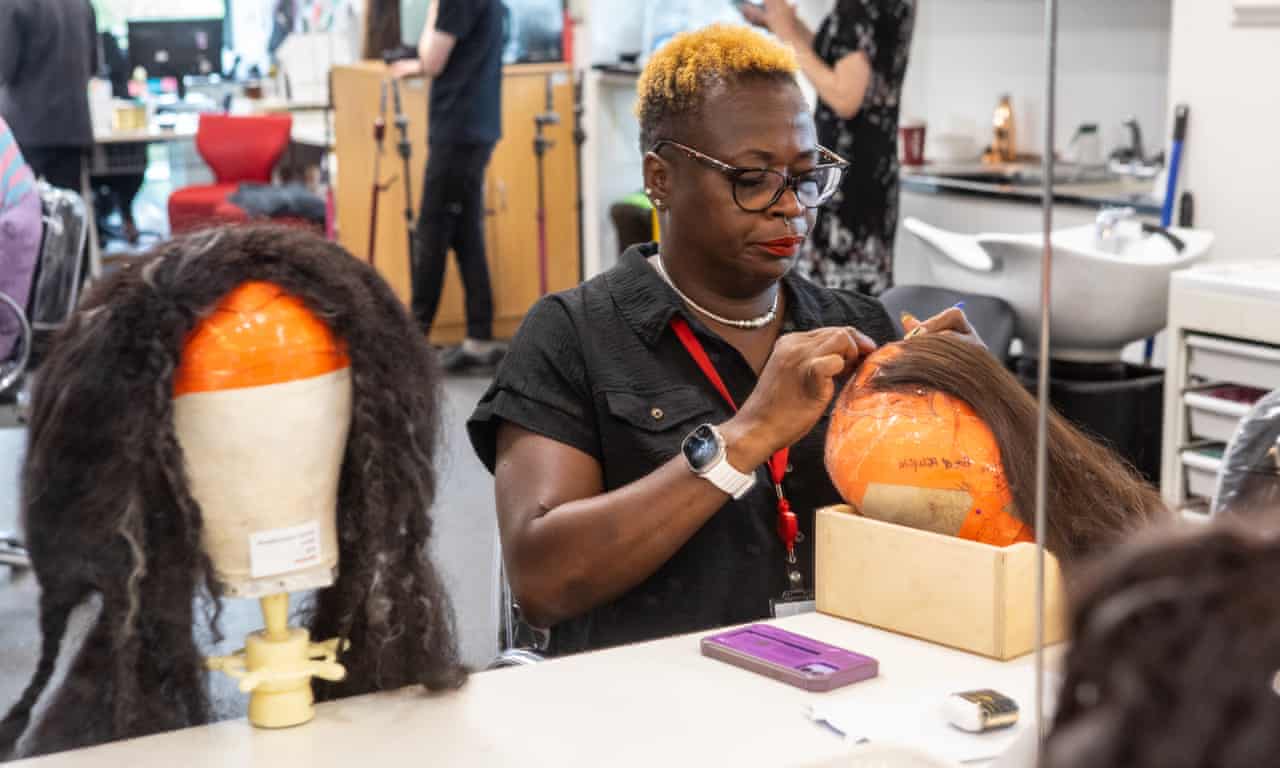
Photo: Antonio Olmos/The Observer.
Skilled wigmaker Violet Barrie at England’s RSC [Royal Shakespeare Company].
Although I was in many theatrical productions as a kid, the first time I learned anything about wigs was when I had chemo. I lost my hair and wasn’t brave enough to go to work without any. (John told Suzanne, who was living in Switzerland then, “Mom looks like a little, bald mouse.”) But Dana Farber was known for nice wigs, and I got one there that I liked a lot.
Today’s story from the Guardian is all about wigs for the theater. Which can get complicated.
David Jays writes, “It’s a sunny afternoon in Stratford upon Avon and I’m watching actors become witches. In Georgia McGuinness’s design for Macbeth, the witches seem to be mostly hair. Amber Sylvia Edwards and Dylan Read peer out from mountains of furry locks, each looking as if a yeti has fallen asleep on their shoulders. The tumble of tresses is so heavy, it needs a harness for support. Welcome to the wild world of wigs.
“Some hairpieces are bobby-dazzlers: towers of Restoration foppery, ravishingly long Rapunzels. Others slink by unnoticed, disguised in realism. Who makes them? Who pins them on night after night? To find out, I meet two wig mavens. Sandra Smith is head of wigs at the RSC [Royal Shakespeare Company], and has warmly invited me to spend the day with her team in Stratford. Chris Smyth, meanwhile, only recently began his wig journey: he designed a memorable crimson creation for Jane Asher in The Circle at the Orange Tree in London. …
“The RSC storeroom’s wooden doors conceal mop after mop of blondes, browns and russets. A separate cupboard holds periwigs and judges’ rugs, like a bevy of poodles. This hoard reflects a practice built on sustainability and thrift. Mounds of witchy hair were foraged from the stores, saving thousands of pounds. ‘Nothing goes to waste, even the ratty bits,’ Smith says.
“Wigs, like actors, never retire. ‘We keep them till they die,’ her colleague Lavinia Blackwell says matter-of-factly. … ‘Wigs is an area of theatre that has been drastically cut back,’ designer Tom Piper says. ‘People have disappeared and budgets have gone down. I’m so grateful for somewhere like the RSC, who’ve got the team and a lot of stock.’ …
“Only when I see the foundations for all the team’s creations do I appreciate the challenge of our lumpy, bumpy human variety. Some heads are footballs, some shaped for rugby. The wigs team wrap actors’ heads in clingfilm and wind round sellotape to map the cranium, marking the hairline. …
“Theatrical wigs take quite a bruising, and the hair may be reused, which helps explain why the V&A [Victoria & Albert] collection holds few early wigs – the oldest come from Diaghilev’s Ballets Russes in the early 20th century. Even so, key artifacts indicate their role in nailing character. When Vivien Leigh played Blanche DuBois in the film of A Streetcar Named Desire in 1951, ‘the wig fundamentally made her appear less glamorous,’ [says Simon Sladen, V&A senior curator of theatre and performance] says. Leading theatrical wig-maker Stanley Hall created ‘impoverished, rather thin hair … to point out her highly nervous, worn-out character.’ …
“It’s painstaking work. ‘You tie each hair with a tiny little hook,’ Smyth tells me. How did he acquire the skills? ‘I do drag and I make my own costumes,’ he says. ‘I did a couple of days’ training in wigs and just fell in love, because it’s so difficult. It’s like the dark arts. I will never know everything. Everybody does it differently; it’s a rabbit hole that keeps deepening and deepening.’ …
“Everyone’s route into wig world is different. Smith was studying hairdressing and beauty therapy in Pontypridd when a friend took a job at the RSC, and she visited for work experience. ‘I had a lovely two weeks and I haven’t left since. I’ve been with the RSC for 38 years.’
“I crouch beside Violet Barrie, who ran a salon in Leamington Spa until Covid struck. Hairdressing was a family trade in her Jamaican childhood, so the fascination began early – just as it did when Smith grew up in Wales, watching friends and neighbors who came to get their hair done by her aunt on a Thursday evening. No wonder the wig room feels like a hug. …
“ ‘We invade somebody’s space from the first moment,’ Smith asserts. ‘We’ve got to be really skilled, but equally sophisticated in personal care: 90% of our job is reacting to somebody’s needs.’ The team intuit who is comfortable, who hates to be touched. …
“In the wings, Thérèse Bradley, playing Duncan, rushes up with a huge beam and a hug for Smith. ‘These women!’ she says. However careworn you may be when you sit in the wig room chair, she says, you leave ready for anything. ‘They perform miracles!’ ”
More at the Guardian, here. No firewall. Donations solicited. Check out the wild wigs for the Macbeth witches.


 Suzanne's Mom's Blog