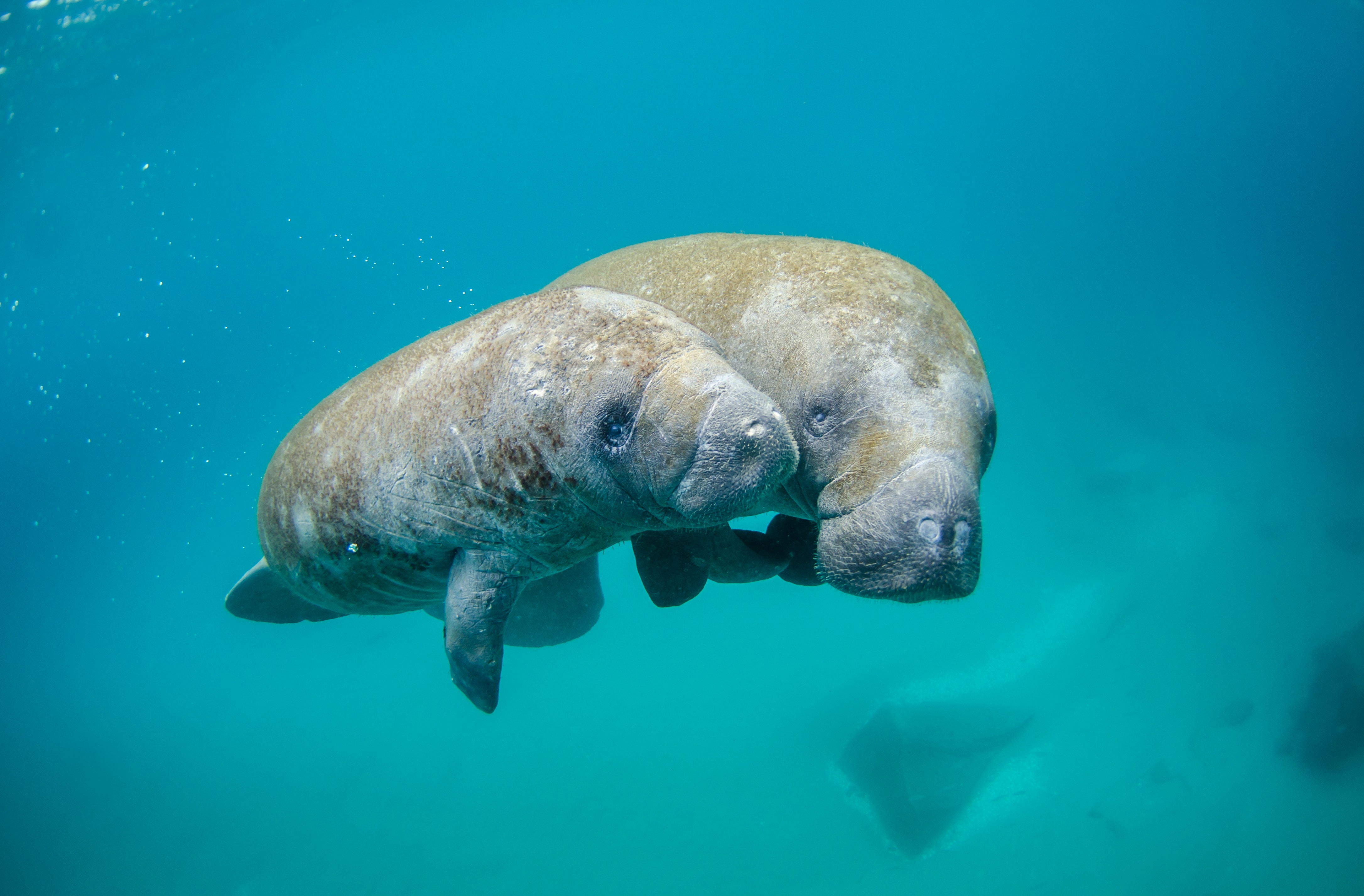
Photo: NOAA [National Oceanic and Atmospheric Administration].
The return of seagrass in Florida is a hopeful sign for the embattled manatee.
One doesn’t normally think of Florida politicians as being big environmentalists, but whatever their motivations for supporting cleaner water, one has to cheer them for putting some funding behind it. Florida treasures like the manatee need the help.
Richard Luscombe reports for the Guardian, “A picturesque expanse of water along Florida’s space coast is offering a modicum of hope for the state’s embattled manatees as wildlife officials review whether to restore the beloved sea cows to the endangered species list.
“The recovery of seagrass, the manatees’ favorite food, in Mosquito Lagoon means that an emergency hand-feeding program that has kept many of the starving aquatic animals alive over the last two winters can be discontinued, at least temporarily.
“While scientists say this might be only a small step in the wider fight to rescue a species that has seen a record die-off in recent years from water pollution and habitat loss, what’s happened at Mosquito Lagoon offers signposts to how the manatees’ battle for survival might ultimately be won.
“ ‘At least in a portion of the lagoon, we are seeing a rather rapid resurgence of the Halodule variety of seagrass that, even if we don’t know exactly how it happened, does tell us that it’s much more resilient than we might have been thinking,’ said Dennis Hanisak, a professor of marine botany at Florida Atlantic University’s Harbor Branch Oceanographic Institute, and director of its seagrass nursery. …
“Hanisak and his team, in partnership with the Florida fish and wildlife commission (FWC), have focused their restoration efforts on the lagoon in northern Brevard county, one of the most popular feeding grounds for manatees during the colder winter months.
“That’s where the majority of manatee deaths, an unprecedented 1,100 in Florida in 2021, 10% of the population, and another 800 in 2022, occurred. They were part of what federal and state authorities classify as an ongoing unusual mortality event (UME) with the majority of fatalities through malnutrition and starvation, a reflection of the loss of about 90% of the lagoon’s seagrass to algae blooms and pollutants.
“It’s too early to say exactly what role the seagrass nursery project has had there; Hanisak says it has ramped up in size and resources in recent years as wildlife agencies respond to the disaster with improved funding.
“It’s one of several projects underway in Florida [and] a prominent component of a catalog of FWC manatee habitat restoration schemes, themed mostly around improvements in water quality and aquatic vegetation, that experts believe has potential to turn years of declining numbers into a robust recovery. …
“[In January], Florida’s governor Ron DeSantis announced a $100m award of state funds for water-quality improvements in the Indian River Lagoon, one of North America’s most biologically diverse waterways. The cleaner the water, the better the seagrass. …
“Hanisak and his students have steadily been building the capacity of the seagrass nursery at multiple locations. That seagrass will ultimately be transplanted into the Indian River Lagoon and elsewhere. …
“It remains to be seen if this year’s drop in manatee deaths in Florida is a one-off, or represents the start of a recovery. But more abundant seagrass in Mosquito Lagoon, which led to the welcome suspension of the experimental lettuce-feeding project, bodes well.
“Lawmakers also appear to be at least partly on board. Thompson said the Florida legislature provided an additional $20m in fiscal year 2022-23 to the FWC to enhance captive manatee support facilities and manatee habitat enhancement to supplement the previous year’s $8m. …
“Patrick Rose, a veteran aquatic biologist and executive director of the Save the Manatee Club [said] the extra funding, which his group lobbied for, is welcome [but] ‘a drop in the bucket literally to what needs to be done.’ Ultimately, Rose said, manatees need clear, clean water to survive. Without it, seagrass will not flourish. …
“ ‘Nutrients are the direct cause of harmful algal blooms which have been so intense that they literally cut the light off to the seagrasses, and the seagrasses die,’ he said.”
More at the Guardian, here.

 Suzanne's Mom's Blog