
This is how the three-story Central Sierra Snow Lab on Donner Summit looked in 2011. The lab contains one of the longest sets of manually collected data on snow in the world.
As my neck of the woods gets back to normal (some family members got over two feet of snow last weekend), I’m thinking about places with traditionally high snowfall and wondering what might be happening under climate change. Step one: keeping good records.
Julie Brown reported at SFGate in November 2021, “At the top of Donner Summit, an old cabin rests in a thicket of tall trees. The structure is three stories tall, including the basement. Still, in the heaviest of winters, the snow drifts are deep enough to bury the front door, so the only way into the building is through a window on the top floor.
“The cabin is the home of an obscure laboratory, called the Central Sierra Snow Lab, that holds records of snowfall on Donner Summit dating back to 1878. That makes the laboratory’s measurements one of the longest sets of data on snowfall in the world — and many of those records were written by hand, in long-form cursive penned on dated entries in small red notebooks.
“The lab is just five minutes off an exit on Interstate 80. But there are no signs to mark the way to the cabin, which stands at the end of a dirt road and a steep hill. Even among UC Berkeley researchers and the biggest snow nerds in Tahoe, the laboratory has remained hidden, quietly collecting data for decades without much fanfare.
“Then, two years ago, the laboratory and its valuable collection of data were almost lost amid the pandemic, university budget cuts and a hiring freeze. To save the laboratory, a small group of researchers banded together to prove the value of the work being done there, find funding and hire new blood to take the lab into the future. … A new station manager, who is an atmospheric scientist, moved in, and Google Maps even knows the lab’s location now.
“ ‘It was mind-blowing to me,’ said Robert Rhew, about the first time he visited the snow lab five years ago. Rhew is a faculty member in the department of geography at UC Berkeley and the director of the Central Sierra Field Stations, which includes the snow lab and Sagehen Field Station in Truckee.
‘There’s this research gem just hanging out in the forest near Donner Pass, collecting all sorts of important data for California’s snowpack and for the future of water in California,’ Rhew said. …
“The Central Sierra Snow Lab is unlike those with stark white walls and spotless counters. Inside the old cabin, closets are stuffed full of winter boots and outdoor gear. Signs are posted to advise occupants to leave the doors open; the cabin is so old its walls tend to sway beneath the weight of the snowpack, making the doors stick shut in their frames. …
“ ‘You just continually find things,’ said Andrew Schwartz, the lab’s new researcher and station manager. Since he moved in, he’s spent a lot of time cleaning and organizing. ‘You find all kinds of weird stuff, peek through cabinets and look at what’s in them. And then you take a closer look and oh, there’s some $15,000 instrument in there.’ …
“The earliest records of snowfall stored at the laboratory come from the transcontinental railroad. The Central Sierra Snow Lab was built in 1946 by the Army Corps of Engineers and the Weather Bureau. … Since 1946, researchers at the laboratory have measured every inch of snowfall, stomping out into the snow with a ruler and a scale at 8 a.m. sharp.
“Because of the Central Sierra Snow Lab, we know that the winter of 1982-1983 was the biggest winter since 1970, which is how far back the digitized records go. That winter, 671 inches of snow fell at the lab. That’s more than 55 feet.
“Today, the Forest Service owns the building and the land, but UC Berkeley oversees the laboratory and the research. In 1996, Berkeley hired a snow researcher named Randall Osterhuber, who would become the lab’s longtime steward and sole employee. …
“During the tenure of Osterhuber, the snow lab hosted many research projects, including testing new technologies to measure how much water is in the snow, called the snow-water equivalent. This is an essential reading for California because it helps researchers understand how much water is stored in the snowpack, and subsequently, how much water will melt come spring and flow down the watershed into the lower elevation reservoirs and valleys. More than 60% of California’s water supply comes from the Sierra Nevada, according to the Sierra Nevada Conservancy.
“The data that Osterhuber presided over is also invaluable for determining trends in climate. The lab’s contributions were mostly for public knowledge, used by numerous government agencies. …
“The University of California was in a period of budget austerity, Rhew said, and the pandemic put even more pressure on already limited funding. The snow lab was at risk of being zeroed out in the budget. … Rhew convened a meeting for anyone in the landscape of research institutions and government agencies who had a vested interest in the snow lab to garner support to keep the lab’s work going.
“ ‘It was very clear to everybody that we need to continue,’ Rhew said. …
“For Schwartz, who just finished a Ph.D. in atmospheric sciences in Australia, the job was a great fit. … When he arrived, though, the laboratory was abandoned save for the spiders and the mice. The internet was too slow to even send an email, and a lot of things needed to be fixed.
“Behind the cabin, scientific equipment stands atop rickety scaffolding that could easily topple over. So Schwartz is building a new platform with a sturdy foundation to hold all that scientific equipment safely.
“He is also liberating the data, taking all those handwritten records in the red notebooks that are collecting dust on a shelf and putting them online so they’ll be available to anyone who wants to use them. He built a new website. He started posting snow measurements from recent storms and historical observations on a Twitter account he set up for the lab.
“ ‘A large portion of the knowledge that we have on snow hydrology now, on meteorology and climate in the region, is directly due to this lab,’ Schwartz said.”
At SFGate, here, there are more pictures, and you can read about research on atmospheric rivers the lab is undertaking. No firewall.
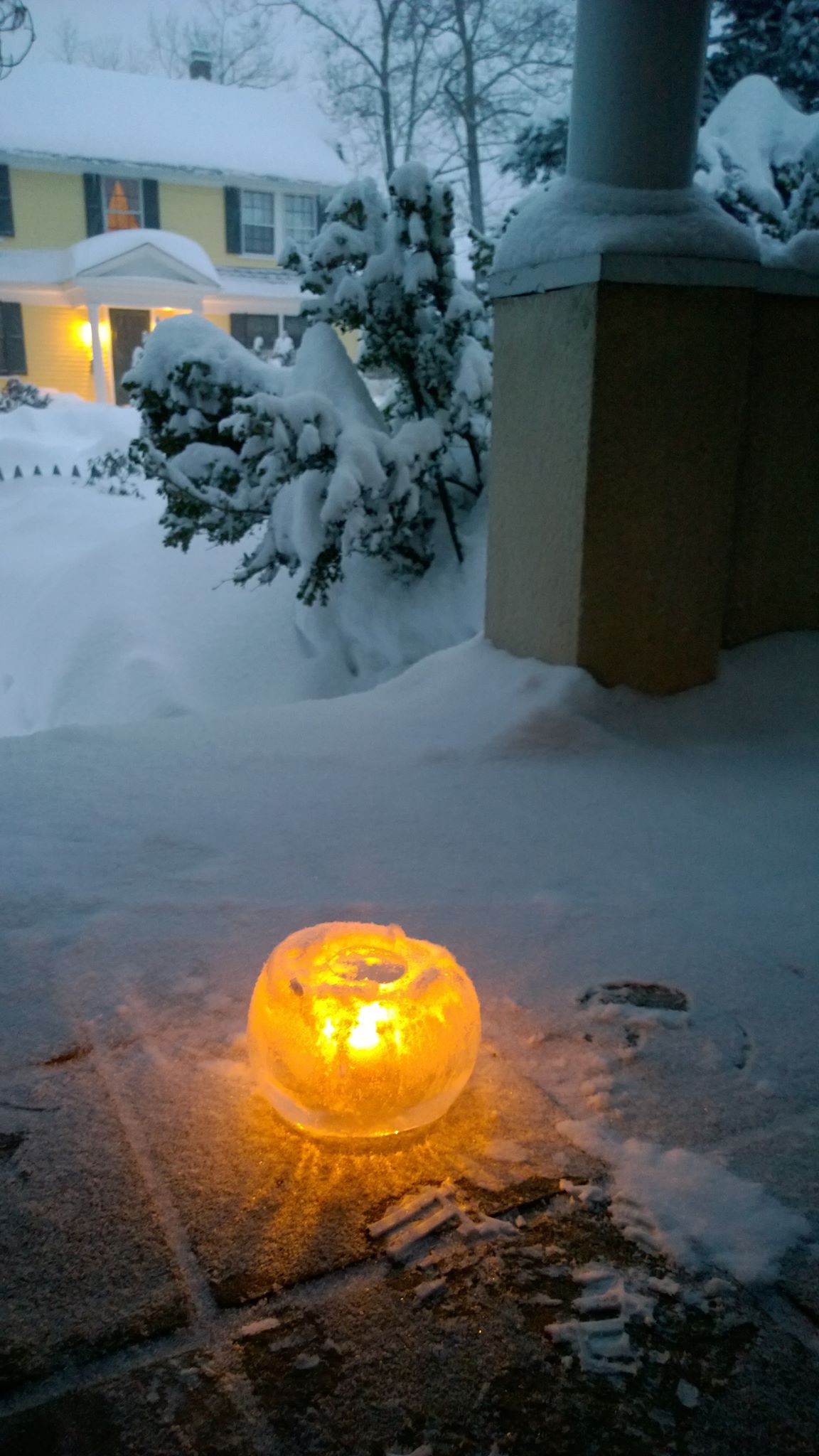
Our big snowfall last weekend reminded me of past snowfalls. Who remembers 2015, when I made ice globes?


 Suzanne's Mom's Blog